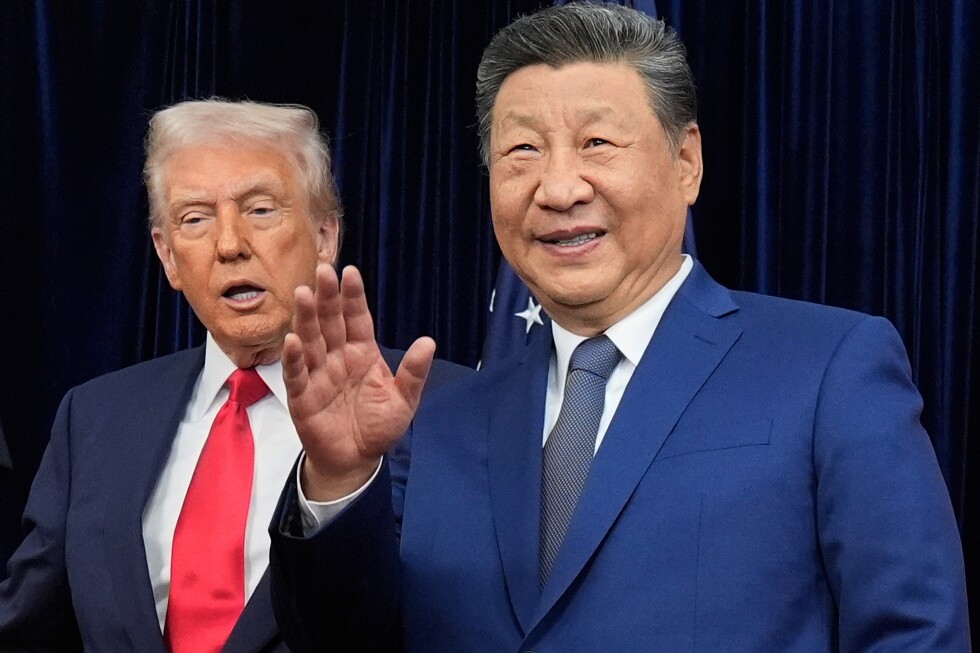
WASHINGTON — Ahead of the much-anticipated bilateral summit between Chinese President Xi Jinping and U.S. President Donald Trump, officials from both major powers have emphasized that bilateral relations have held broadly steady in recent months, with both sides prioritizing the preservation of that stability going into the meeting. Yet even as consensus around stability holds, the world’s most consequential bilateral relationship faces a sprawling roster of intractable disputes with no clear path to quick resolution, leaving analysts skeptical that major breakthroughs will emerge from the talks. From tech competition to the long-simmering Taiwan issue, and now the Iran conflict, every topic on the agenda carries high global stakes.
Henrietta Levin, a senior fellow at the Center for Strategic and International Studies’ Freeman Chair in China Studies, noted that both sides share a core agreement on the value of U.S.-China stability. Beyond that foundational consensus, however, the future of the relationship grows far more complex, she said, making limited progress the most likely outcome of the leaders’ meeting.
### Trade: A Fragile Truce Holds, But Core Issues Remain Unresolved
The U.S.-China trade conflict first erupted during Trump’s first term, and escalated sharply last April when the U.S. president announced 34% tariffs on all Chinese goods in a move he labeled “Liberation Day.” China responded quickly with reciprocal tariffs and targeted countermeasures, including new restrictions on its rare earth exports. The tit-for-tat escalation pushed bilateral tariffs as high as 145% before both sides acknowledged the unsustainable economic damage and agreed to a trade truce, pausing most punitive economic measures.
The two leaders first extended the truce for an additional year during an October meeting in South Korea, with China committing to increased soybean purchases from American agricultural producers and the U.S. cutting existing tariffs by more than half. Zhao Minghao, an international relations professor at Shanghai’s Fudan University, explained that China’s approach has centered on pushing back against U.S. tariffs while working to preserve overall bilateral stability.
While some observers expect the two sides to announce a new comprehensive trade agreement during the summit, Zhao cautioned that such a deal would not mark a permanent end to the trade conflict, and would include conditional terms. Last year’s truce failed to resolve any core structural disputes, nor did it return bilateral economic relations to their pre-trade war status. China has since implemented new export permit requirements for rare earths, a regulation that allows Beijing to tighten shipments at any time.
Wendy Cutler, vice president of the Asia Society and a former U.S. trade negotiator, noted that this summit lacks the intensive pre-meeting bilateral engagement that characterized past high-level talks. In April, Beijing introduced a new regulatory framework to counter foreign sanctions targeting Chinese companies, which instructs affected domestic firms to ignore extraterritorial U.S. restrictions — a directive already applied to a Chinese petroleum refinery processing Iranian crude in defiance of American sanctions. Cutler described the current trade arrangement as a “fragile truce,” noting that even if the truce is extended, both sides have continued to take targeted actions against one another’s economic interests. The White House has also confirmed that leaders will discuss a proposal for a new bilateral “Board of Trade” to maintain ongoing economic dialogue between the two powers.
### Advanced Semiconductors: Export Restrictions Push China Toward Self-Reliance
U.S. restrictions on exports of advanced computer chips and related manufacturing technology to China were first introduced during Trump’s first term, and the issue remains a major point of friction ahead of the summit. Leading American chip designer Nvidia has lobbied the Trump administration to relax export curbs, with founder Jensen Huang arguing that continued access to American chips would leave Chinese artificial intelligence firms dependent on U.S. technology.
However, growing export restrictions have only accelerated Beijing’s push to develop a domestic, self-sufficient semiconductor industry. In written comments, Zhao noted that China’s position has shifted subtly in recent years: Beijing now prioritizes advancing its domestic chip sector over continued reliance on American advanced semiconductor imports.
### Taiwan: Beijing Labels the Issue the ‘Biggest Risk’ to Bilateral Ties
Two weeks before the summit, Chinese Foreign Minister Wang Yi told U.S. Secretary of State Marco Rubio that while overall bilateral relations remain stable, the Taiwan question remains the single biggest threat to U.S.-China ties. Beijing reaffirmed ahead of the meeting that Taiwan would be a top priority for discussions.
The Taiwan issue has lingered since the 1949 Chinese civil war, which split the two sides. Beijing claims the self-ruled democratic island as part of its sovereign territory, and tensions have risen steadily since the election of Tsai Ing-wen from the independence-leaning Democratic Progressive Party (DPP) in 2016. Beijing cut off official communication with Tsai’s administration and has stepped up military pressure, conducting nearly daily naval and air patrols near the island in recent years. Current Taiwanese President Lai Ching-te, also a member of the DPP, has faced repeated criticism from Beijing, which has depicted him as a separatist in state propaganda accompanying large-scale military exercises around the island.
The U.S. is legally required to provide Taiwan with defensive military hardware, but maintains a longstanding policy of “strategic ambiguity” over whether it would intervene militarily if China attempts to take the island by force. Recent comments from Trump confirming he discussed arms sales to Taiwan with Xi have renewed uncertainty over U.S. policy toward the island. Zhao suggested a limited pragmatic compromise could be on the table: a framework of reciprocal restraint, under which the U.S. would reduce arms sales to Taiwan in exchange for China cutting back military drills targeting the island. Few analysts expect a permanent resolution to the issue to emerge from the summit.
### The Iran Conflict: U.S. Pushes for Chinese Influence, Beijing Remains Cautious
As the international community awaits a ceasefire in the Iran conflict that has disrupted global energy markets, the issue is set to be added to the summit agenda. Beijing has positioned itself as an unofficial mediator in the conflict thanks to its close political and economic ties to Tehran, but has so far avoided deep direct involvement. China has publicly criticized the U.S. and Israel over the ongoing war.
Levin argued that Beijing has little incentive to resolve a regional crisis that Washington created: “I don’t think China has any interest in solving the problems the U.S. has created for itself in the Middle East,” she said. Ahead of the summit, U.S. Treasury Secretary Scott Bessent publicly called on China to pressure Iran to reopen the Strait of Hormuz, a critical global energy chokepoint, and accused Beijing of funding terrorism through its purchases of Iranian crude. Speaking to Fox News, Bessent said: “Iran is the largest state sponsor of terrorism, and China has been buying 90% of their energy, so they are funding the largest state sponsor of terrorism. Let’s see if China steps up with some diplomacy and get the Iranians to open the strait.”