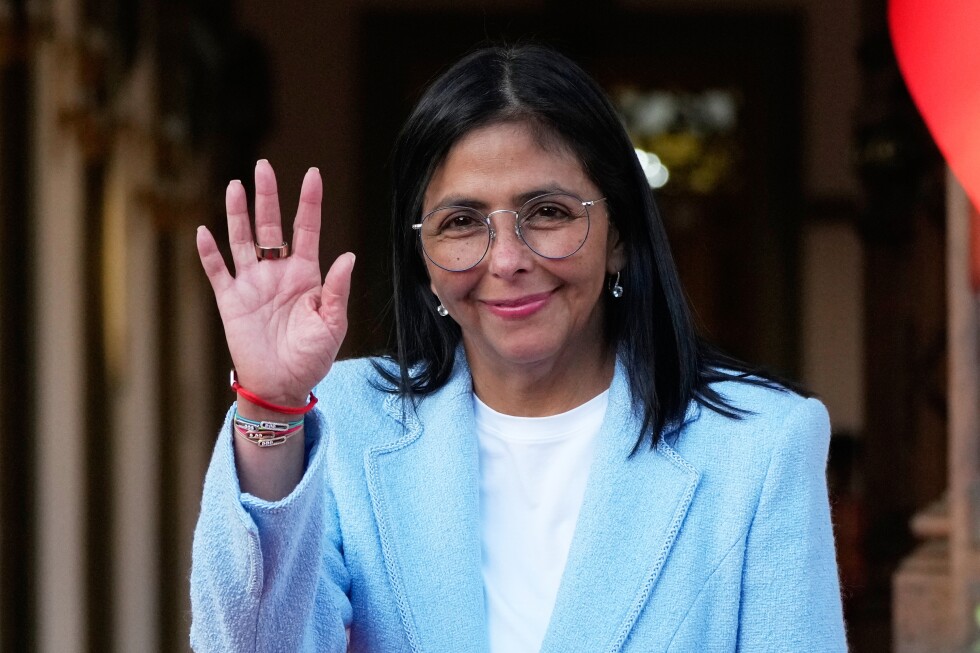
THE HAGUE, Netherlands — During closing arguments at a high-stakes International Court of Justice (ICJ) territorial hearing on Monday, Venezuela’s acting President Delcy Rodríguez publicly pushed back against an extraordinary remark from former U.S. President Donald Trump, who recently claimed he was “seriously considering” recognizing Venezuela as the 51st U.S. state.
The hearings, which concluded this week, center on a long-running territorial dispute between Venezuela and neighboring Guyana over the Essequibo region — a 62,000-square-mile territory that accounts for two-thirds of Guyana’s current land area. The resource-rich region holds extensive gold, diamond, and timber reserves, and sits adjacent to massive offshore oil deposits that currently produce 900,000 barrels of crude daily, a volume nearly matching Venezuela’s total daily output of 1 million barrels and lifting Guyana from one of South America’s smallest economies to a major global energy player.
Addressing reporters after her court appearance, Rodríguez made clear Venezuela has no interest in becoming part of the United States. Standing on the ICJ’s public platform, she emphasized, “We will continue to defend our integrity, our sovereignty, our independence, our history.” She added that Venezuela is “not a colony, but a free country,” noting that the country remains open to constructive dialogue with U.S. officials. “Venezuelan and U.S. officials have been in touch and are working on cooperation and understanding,” she said.
Trump first made the 51st state comment during an interview with Fox News earlier on Monday, as shared on social media by Fox co-anchor John Roberts. The White House has not yet issued an official response to requests for comment on the remark, which is not unprecedented for Trump: he has previously floated similar suggestions about absorbing Canada into the U.S.
Before responding to Trump’s comment, Rodríguez laid out Venezuela’s formal legal position to the ICJ’s panel of international judges on the Essequibo dispute. The territorial conflict stretches back more than a century: Venezuela has claimed the region as its own since Spanish colonial rule, when the jungle territory fell within its administrative boundaries. A 1899 arbitration ruling, led by representatives from Britain, Russia and the U.S., redrew the border along the Essequibo River and awarded almost the entire region to what is now Guyana. Venezuela has long contested this decision, arguing a 1966 Geneva agreement negotiated between the two sides effectively invalidated the 19th century ruling.
The current legal process at the ICJ was triggered in 2018, three years after U.S. energy giant ExxonMobil announced major oil discoveries off the Essequibo coast. Guyana brought the case to the United Nations’ highest court, asking judges to formally uphold the 1899 border decision. Rodríguez called Guyana’s move “opportunistic,” noting that “at a time when the mechanisms established in the Geneva agreement were still fully in force, Guyana unilaterally chose to shift the dispute from the negotiating arena to a judicial resolution. This change was not accidental; it coincided with the discovery in 2015 of the oil field that would become world-renowned.”
Tensions between the two South American nations escalated sharply in 2023, when then-President Nicolás Maduro held a national referendum on converting Essequibo into a Venezuelan state and threatened military annexation of the region. Maduro was ousted from power in January during a U.S. military operation in Caracas, captured, and taken to New York to face federal drug trafficking charges, to which he has pleaded not guilty. Rodríguez assumed the acting presidency following the operation.
In opening remarks to the court last week, Guyana’s Foreign Minister Hugh Hilton Todd described the dispute as “a blight on our existence as a sovereign state from the very beginning,” noting that 70% of the country’s current territory is at stake in the ruling.
The ICJ is expected to take several months to issue a final, legally binding decision on the case. Venezuela has repeatedly stressed that its participation in the hearings does not constitute consent to or recognition of the court’s jurisdiction over the dispute, maintaining that only direct bilateral negotiations aligned with the 1966 Geneva agreement can deliver a lasting resolution to the conflict.