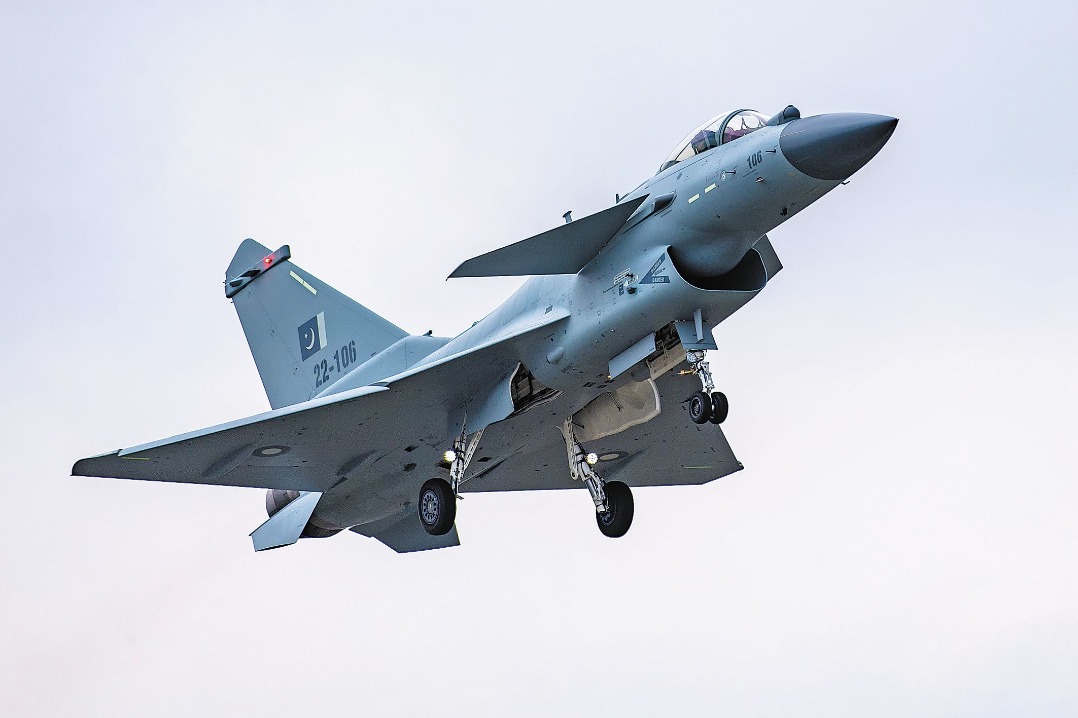
China’s largest aerospace manufacturer, Aviation Industry Corp of China (AVIC), is set to implement ongoing upgrades and customer-specific customizations for its export-focused J-10CE advanced fighter jet, aligning the platform with the unique operational requirements of international clients, according to the aircraft’s chief designer.
Li Jun, a senior researcher at the Chengdu Aircraft Design and Research Institute — one of AVIC’s key Sichuan-based subsidiaries — outlined the jet’s development roadmap during a public media briefing held Thursday as part of an open-house event hosted by the institute and Chengdu Aircraft Industry Group. Li noted that the J-10CE, the first export-exclusive variant of the J-10 fighter family, retains substantial room for technological advancement and is projected to remain a competitive, market-relevant platform for a minimum of 20 to 30 years of service.
“ We are ready to export this aircraft to any friendly nation that aligns with our development vision, provided their procurement requests meet China’s relevant national laws and regulations, ” Li stated.
The Chengdu-based AVIC units are responsible for developing and manufacturing some of the Chinese People’s Liberation Army Air Force’s most capable combat aircraft, including the entire J-10 fighter family and the fifth-generation J-20 stealth fighter fleet. The J-10CE has already been acquired and entered active service with the Pakistan Air Force, marking the platform’s first international deployment.
Li emphasized that the J-10CE is built to adapt to a wide range of mission profiles, from establishing air superiority to executing precision ground strike operations. The platform can be modified to accommodate the unique operating environments and operational demands of different buyer nations, with flexible optional payload packages available to meet specific customer needs.
Compared to earlier generations of J-10 aircraft, the J-10CE delivers a generational leap in combat system technology, emerging as a fully multi-role operational platform. Early J-10 models were only compatible with roughly 10 types of armament, while the J-10CE can carry dozens of different weapons tailored for air-to-air, air-to-ground, and air-to-sea combat missions, Li explained.
The jet’s avionics suite has also received a full generational upgrade, headlined by an Active Electronically Scanned Array (AESA) radar that can rapidly detect and track multiple targets, outperforming older mechanically scanned radar systems by a significant margin. Additional advanced capabilities include network-centric cooperative combat operations, beyond-visual-range engagement of multiple targets in high-intensity contested electromagnetic environments, multi-mode precision strike capability, and superior performance in medium- and low-altitude close-range dogfights.
Beyond delivering the fighter jet itself, AVIC provides international clients with a complete end-to-end combat ecosystem that includes early warning, command and control, and electronic warfare infrastructure. Li pointed to the J-10CE’s proven real combat record — credited with shooting down multiple hostile aircraft while sustaining zero operational losses — as clear proof of the platform’s capabilities and the strength of its supporting combat systems.
Zhang Xuefeng, a retired People’s Liberation Army Air Force officer and independent military technology analyst, noted that China’s advanced fighter aircraft portfolio, led by the J-10 series, is reshaping the global defense trade market through a set of unique competitive advantages. Zhang explained that Chinese fighter jets offer exceptional cost-effectiveness: while Western-made advanced fighters typically carry a price tag of hundreds of millions of dollars per unit, Chinese alternatives deliver comparable combat performance at a far more accessible price point. Additionally, China can tailor full defense packages to fit a wide range of buyer budgets, matching the diverse operational and financial needs of nations across the global spectrum.
Zhang added that China also holds a unique capability to export fully integrated end-to-end weapon systems, including a complete lineup of airborne armaments and electronic warfare infrastructure. “ We can deliver compatible airborne early warning aircraft and supporting data links that enable full digital modernization of a buyer nation’s entire combat force structure, ” he said.