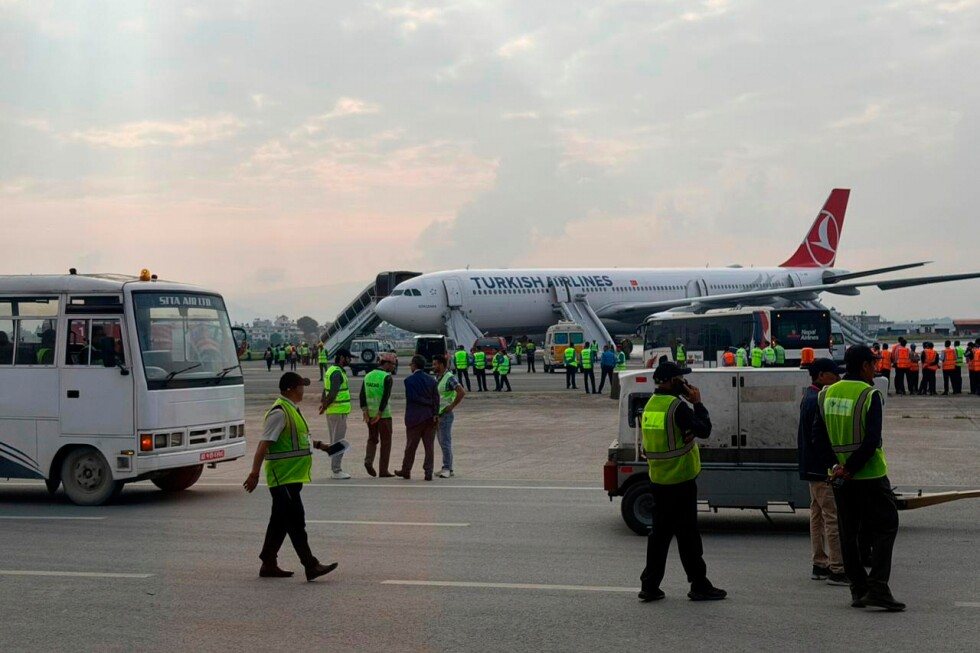
On a Monday morning in Kathmandu, Nepal, an unexpected emergency disrupted operations at the country’s busiest air hub: a Turkish Airlines passenger jet erupted in flames while touching down at Tribhuvan International Airport. Though the incident caused significant disruption to regional air travel, no casualties or injuries have been confirmed by local aviation authorities.
According to airport officials, the Istanbul-originating flight landed with visible fire and thick smoke billowing from the aircraft’s right landing gear. Emergency response teams were activated immediately after the incident, and first responders successfully brought the blaze under control in a timely manner. All 277 passengers on board the Airbus A330 were safely evacuated from the aircraft without harm.
The single active runway at Tribhuvan — Nepal’s only international gateway — was closed shortly after the emergency to allow for official investigations and clearance work. With the runway out of service, multiple incoming commercial flights bound for Kathmandu were forced to hold over alternative airspace or divert to alternate airports, leaving hundreds of passengers affected by delays across the region.
This incident adds to Nepal’s long-running history of aviation challenges, rooted in its unique geographic and meteorological conditions. The country’s mountainous landscape creates unpredictable flying conditions, and civil aviation records show Nepal experiences a higher-than-average rate of aircraft accidents and incidents compared to global averages.
Notably, this is not the first time a Turkish Airlines aircraft has faced an emergency during landing at Kathmandu airport. Back in 2015, another jet from the carrier skidded off a rain-slicked runway amid heavy dense fog, forcing a multi-day shutdown of the airport. Miraculously, that incident also resulted in zero reported injuries. After the aircraft was recovered from the runway, it was towed out of the airport and eventually converted into a public aviation museum.