The festering rivalry between Saudi Arabia and the United Arab Emirates that is now reshaping regional and global politics has roots stretching back to a 1950s border conflict, a power struggle rooted in historical distrust and modern ambitions for regional dominance. Late veteran journalist David Holden first chronicled the 1950s Buraimi dispute in his 1966 work *Farewell Arabia*, recounting how Saudi Arabia attempted to bribe Zayed bin Sultan al-Nahyan—then the “Lord of Buraimi” and later the founding father of the UAE—from the ruling al-Nahyan family to hand over control of the oil-rich Buraimi oasis. When Zayed rejected the bribe, Saudi Arabia launched an invasion that ultimately failed, setting a template for decades of tension between the two Gulf monarchies.
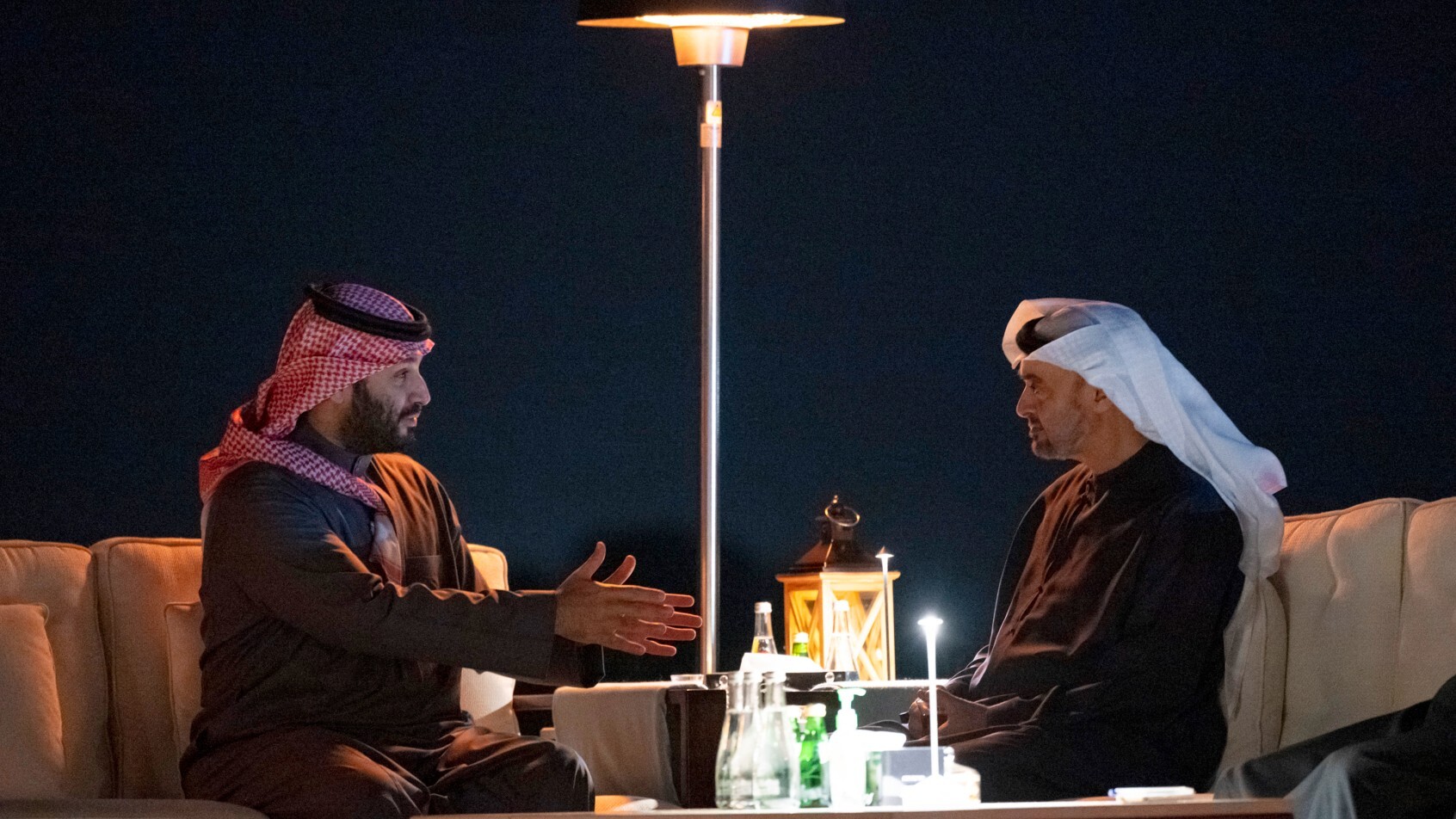
Today, that historical rivalry has reignited between Zayed’s son, current UAE President Mohamed bin Zayed (known widely as MBZ), and Saudi Crown Prince Mohammed bin Salman (MBS). The two nations are now at odds across nearly every major sphere of influence in the Middle East and beyond, from the battlefields of North Africa to global energy markets, and analysts widely agree that the outcome of their feud will define the future of the entire region—especially as American engagement in the Gulf faces growing uncertainty amid the Israel-Iran conflict. The spillover of their rift will even reach household budgets in Europe, Asia, and North America, through shifts in global energy pricing.
The most high-profile public split came this month, when Abu Dhabi ended its 60-year membership in the Saudi-led Organization of the Petroleum Exporting Countries (OPEC), vowing to increase daily oil production by millions of barrels. Energy analysts note that the surface-level disagreement centers on long-term strategy: the UAE prioritizes maximizing immediate profits by ramping up output, while Saudi Arabia prefers managing global supply to sustain higher long-term oil prices.
But this policy rift is merely a symptom of a far deeper power struggle. For decades, OPEC has operated as a bloc of major oil-exporting Muslim-majority nations led by Saudi Arabia, which holds more than twice the UAE’s proven oil reserves, is home to Islam’s two holiest sites (Mecca and Medina), and has a population of 36 million—more than triple the UAE’s total population of 10 million, just one million of whom are native Emirati citizens. “Saudi Arabia wants to project its power through OPEC and the Gulf Cooperation Council (GCC). Because of its size and resources, it sees itself as the natural leader of the Gulf,” explained Rob Geist Pinfold, an international security expert at King’s College London. “The UAE is small, but it has undergone a remarkable transformation to become a larger-than-life global brand. The UAE feels deferring to the Saudis prevents it from exercising power on the world stage.”
Historical context reinforces this distrust: the coastal trading communities that formed the modern UAE have long been squeezed between Persian influence to the east and the expansionist Saudi royal family, originating from the central Arabian region of Najd, to the west. Analysts argue that MBZ’s contemporary foreign policy is a modern iteration of this ancient rivalry, supercharged by decades of oil wealth and cutting-edge digital and military technology. “The Emiratis have always viewed the Saudis as a predatory neighbour who want to make them their vassals,” noted Patrick Theros, a former U.S. Ambassador to Qatar who first arrived in the Middle East when the Buraimi dispute was still a raw, unresolved issue. “They have also, traditionally, been wary of the Persians asserting their own zone of influence in the Gulf. MBZ finally decided that it’s possible for a small Gulf country to stand up to the Saudis and the Persians.”
Today, the UAE has emerged as one of the most vocal Gulf supporters of U.S. and Israeli military action against Iran, and has received Israeli air defense systems to fend off Iranian drone and missile attacks. To offset its small size and geographic limitations, the UAE has also built alliances with local factions across strategically important states west of the Arabian Peninsula—a strategy that has repeatedly clashed with Saudi interests.
The two Gulf powers back opposing factions in Sudan’s ongoing civil war: the UAE supports the Rapid Support Forces (RSF) paramilitary, while Saudi Arabia backs the established Sudanese government. Middle East Eye first revealed that Saudi Arabia even lobbied Washington to impose sanctions on the UAE for its RSF support, exposing how deeply bilateral ties have been strained in that theater. In Yemen, just before the 2025 Israel-Iran war escalated, Saudi Arabia launched strikes against UAE-aligned secessionist groups in eastern Yemen, even partnering with Oman to block an Emirati power grab in the region.
For the UAE, control or allied influence in these regions delivers critical strategic depth that its small domestic territory cannot provide. A RSF victory in Sudan would give the UAE an allied partner on the Red Sea coast directly opposite Saudi Arabia, while the UAE-aligned Southern Transitional Council seeks to split from Yemen to control oil-rich territory bordering the strategic Bab el-Mandeb Strait. The UAE has also recognized the breakaway Republic of Somaliland, a move backed by Israel, further expanding its influence along key global shipping lanes. Amid ongoing Iranian threats to close the Strait of Hormuz, the primary chokepoint for Gulf oil exports, control of alternative Red Sea shipping routes has become a critical geopolitical priority for both nations.
Beyond territorial competition, the two nations hold fundamentally different approaches to post-Arab Spring regional order. After the 2011 uprisings that collapsed multiple long-standing Arab regimes, the UAE has backed secessionist and anti-Islamist factions across conflict zones including Yemen, Libya, and Sudan, while Saudi Arabia has prioritized backing unified national governments and preserving existing state institutions. “Our Saudi approach is based on supporting the nation state: preserving its unity, strengthening its institutions and sovereignty, and contributing to its reconstruction rather than its fragmentation,” explained Hesham Alghannam, a scholar at the Carnegie Endowment for International Peace. “Conversely, the other side’s regional engagement has often been characterised by an obsessive, narrow strategic emphasis on combating Islamists or political rivals. This has weakened state institutions, empowered militias, and created parallel forces that challenge legitimate authority. We clearly support combating extremism and terrorism, but through national institutions operating within the framework of the state and the rule of law. This should not be done through arming non-state actors or entrenching internal divisions.”
It is important to note that the current rift was not inevitable: for a decade after the 2011 Arab Spring, the two monarchies shared common interests that temporarily aligned their policies. The 2012 electoral victory of the Muslim Brotherhood in Egypt spooked both royal houses, which viewed Islamist political movements as an existential threat to their rule. Both also saw the rise of the Houthi movement in Yemen as an Iranian-aligned threat, and jointly led the three-and-a-half-year blockade of Qatar, accusing Doha of supporting groups hostile to Gulf monarchies. Experts note this cooperation was partially rooted in personal ties: when MBS rose to power in 2015, MBZ mentored the younger crown prince, and was instrumental in convincing MBS to launch the Qatar boycott. “You can absolutely see in those early days when MBS was coming to prominence, the close working relationship. It was basically MBZ that convinced MBS to boycott Qatar,” said Neil Quilliam, a Gulf expert and associate fellow at Chatham House.
But analysts emphasize this period of cooperation was an aberration, not the norm. Long before the Arab Spring, the two nations fell out over plans for deeper Gulf integration. In 2009, the UAE withdrew from the GCC monetary union project, which aimed to create a single shared currency for Gulf states, after Abu Dhabi was angered by the decision to site the union’s headquarters in Riyadh. “It would be like France and Germany having spat over the EU and one withdrawing,” noted Kristian Coates Ulrichsen, a Middle East fellow at Rice University’s Baker Institute. “Before the Arab Spring, it looked like the break was going to be between the UAE and Saudi Arabia, not Qatar. The Arab Spring temporarily brought them together, but if you take a long-term view, pre-2010 and post-2020, they were at loggerheads.”
The two nations have also diverged sharply on reconciliation with Qatar after the 2021 al-Ula agreement that formally ended the blockade. While Saudi Arabia moved quickly to repair ties with Doha, the UAE has maintained a cool, suspicious relationship with Qatar years after the official end of hostilities.
The starkest example of their modern policy divergence comes in their approaches to Israel and the Palestinian conflict. In 2020, the UAE broke ranks with the 2002 Arab Peace Initiative, a plan crafted by Saudi Arabia and endorsed by the entire Arab League that requires the creation of an independent Palestinian state on pre-1967 borders before any Arab state normalizes relations with Israel. While Saudi Arabia had been in talks with the Biden administration to normalize relations with Israel in 2023, Israel’s full-scale military campaign in Gaza ended any prospect of a deal. The UN and multiple independent human rights bodies have classified Israel’s military operation in Gaza as genocide, which has killed more than 72,600 Palestinians to date, and public opinion in Saudi Arabia is overwhelmingly opposed to normalization; a 2023 poll by The Washington Institute for Near East Policy found 96 percent of Saudis support cutting all ties with Israel over the war. MBS has publicly echoed this widespread public sentiment. “Politics in Saudi Arabia is heading back towards the more consensual model that it was based on,” Quilliam explained. “There is a diversity of views on Israel in the UAE, but MBZ feels he doesn’t need to worry about that. MBS came to see some of MBZ’s adventurous positions as a liability and has developed a better understanding of the Arab street.”
The ongoing 2025 war between Israel and Iran has only widened this rift, pushing the two nations to build competing blocs within the U.S. alliance network. While both nations remain deeply dependent on Washington for security and economic cooperation, the UAE has deepened its strategic partnership with Israel, while Saudi Arabia has built a broader coalition with Turkey, Egypt, and Pakistan. “Neither the UAE or Saudi Arabia can give up the U.S. But those new alliances are going to grow,” Theros said. As the rivalry plays out across energy markets, battlefields, and diplomatic circles, its outcome will not only reshape the Middle East but send ripple effects across the global economy and international order.