On a day marked by rapidly shifting geopolitical friction across the Middle East, multiple interconnected developments unfolded Friday, amplifying concerns over regional stability and global energy security.
The most direct military action came from U.S. forces, which confirmed they had disabled two Iran-flagged cargo tankers that attempted to breach an American blockade of Iranian ports, a restriction that has been in place since mid-April. According to a statement posted on social platform X by U.S. Central Command, a Navy F/A-18 Super Hornet struck the vessels with precision munitions targeted at their smokestacks, successfully stopping the non-compliant ships from reaching Iranian territorial waters. This incident brings the total number of vessels forcibly halted by U.S. forces for alleged blockade violations to four.
In a diplomatic push following the strike, U.S. Secretary of State Marco Rubio called on European NATO allies to take on a larger share of responsibility for securing the Strait of Hormuz, a critical global chokepoint through which roughly 20% of the world’s oil supplies pass. Speaking after a meeting with Italian Prime Minister Giorgia Meloni, Rubio argued that Iranian efforts to assert unilateral control over the international waterway are unacceptable to the global community. He also raised questions about alliance commitments, noting that a core purpose of NATO’s U.S. force deployments in Europe has long been the ability to project power to regional contingencies, and that failure to address current threats requires a re-examination of this arrangement.
Iran, for its part, has framed its influence over the strait as a major strategic advantage. Mohammad Mokhber, an adviser to Iran’s supreme leader, described control of the Strait of Hormuz as an opportunity as valuable as an atomic bomb, emphasizing that holding sway over a chokepoint that can directly move the global economy represents an unmatched strategic lever for the country.
Diplomatic efforts to de-escalate tensions are already underway, with Qatar’s prime minister traveling to Washington Friday for talks with U.S. Vice President JD Vance. A source familiar with the closed-door meeting, speaking on condition of anonymity, confirmed that the discussions would center on U.S.-Qatar bilateral relations, the unfolding standoff over Iran, global liquefied natural gas (LNG) market stability, and broader regional security. Qatar has served as a key neutral intermediary between the U.S. and Iran in past diplomatic engagements.
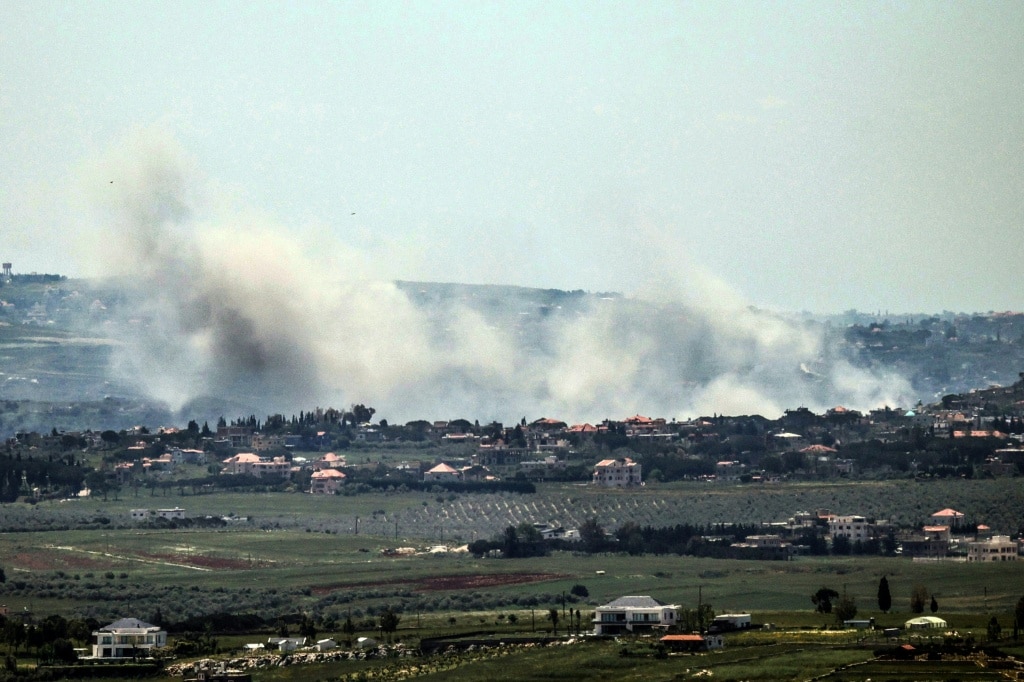
Alongside the standoff over Hormuz, cross-border violence between Israel and Lebanese militant group Hezbollah continued to flare, despite recent truce efforts. Hezbollah announced Friday that it had launched a missile attack on an Israeli military base located south of Nahariya in northern Israel, saying the strike was carried out in retaliation for recent Israeli attacks on southern Lebanon and the southern suburbs of Beirut. Shortly after the Hezbollah announcement, Lebanon’s civil defence rescue organization confirmed one of its members had been killed in an Israeli airstrike on southern Lebanon, near the village of El Qlaile where video footage shows thick smoke rising from the impact site.
In another setback for U.S. regional military operations, two anonymous Saudi sources told Agence France-Presse that Riyadh has prohibited the U.S. from using Saudi airspace and military bases for operations aimed at reopening the Strait of Hormuz. The sources clarified, however, that U.S. access to Saudi infrastructure and airspace remains intact for all other military and security purposes.
The escalating tensions have already rippled into global economic policy, with the European Union announcing new rules Friday to protect airline passengers amid spiking fuel costs driven by Middle East supply fears. The EU made clear that airlines will no longer be allowed to add retroactive fuel surcharges to tickets that have already been purchased by customers. Separately, the EU Aviation Safety Agency (EASA) updated its rules to approve widespread use of Jet A, a U.S.-produced aviation fuel that was previously only permitted in Europe for return flights originating in the United States, a move designed to expand available fuel supplies amid potential shortages.
Closing out the day’s developments, the United Arab Emirates confirmed that a recent Iranian attack using drones and missiles against the country left three people with moderate injuries, marking the latest direct escalation between Iran and Gulf Arab states.