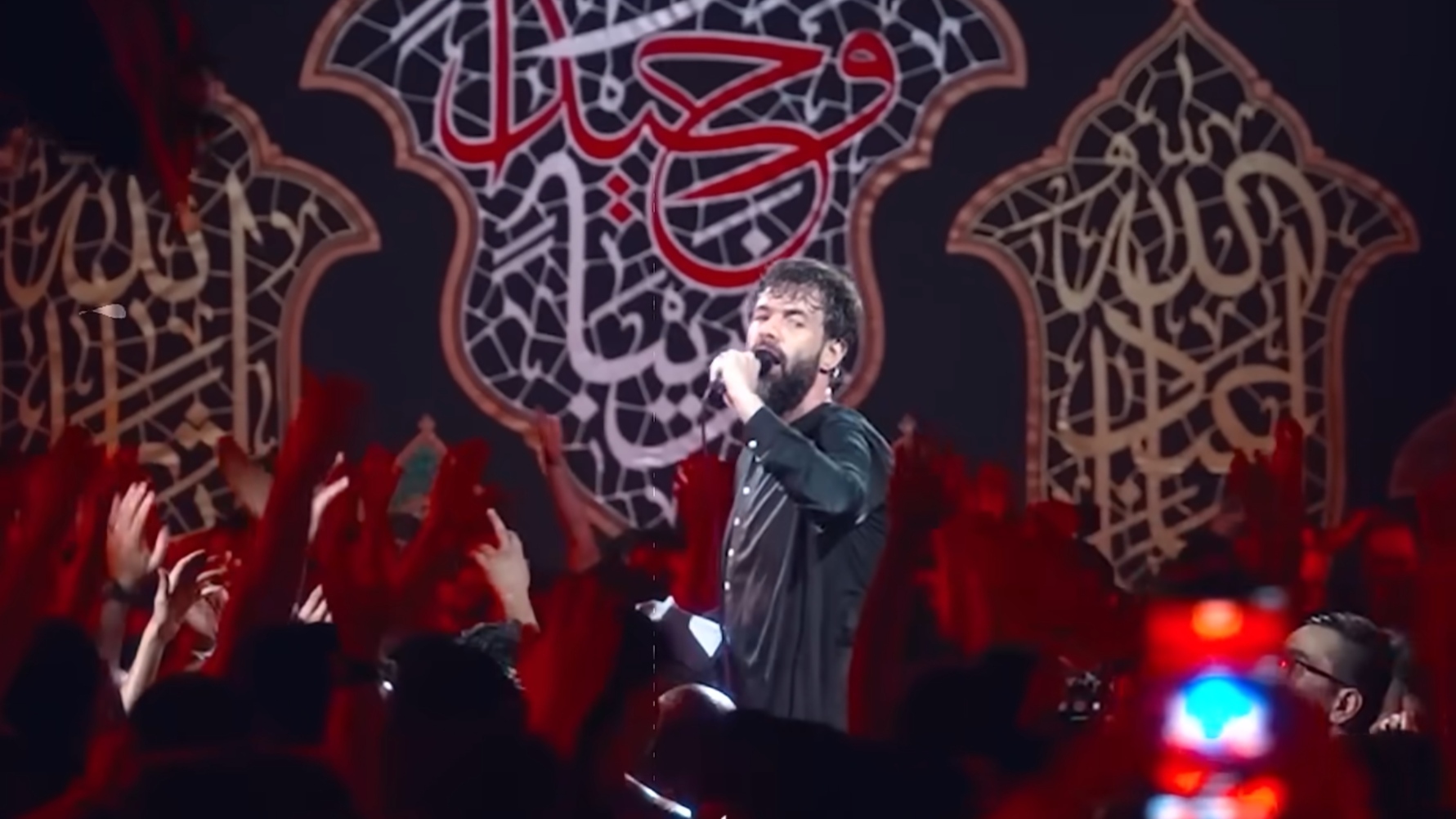
Across shadowed gathering halls in Iran, hundreds of men clad in black strike their chests in synchronized rhythm, while religious orators chant measured, mournful refrains centered on martyrdom, sacrifice, and modern conflict. These dramatic performances, commonly lit with ominous red lighting and widely circulated across Iranian social media platforms and YouTube, have emerged as a defining feature of the nation’s wartime public landscape following the 12-day Iran-Israel conflict in June 2025.
Known as latmiyah, these mourning recitations trace their origins to centuries-old Ashura rituals, which commemorate the 680 CE martyrdom of Shia Imam Hussain ibn Ali, grandson of the Prophet Muhammad, at the Battle of Karbala. In Shia religious memory, Hussain’s death—after he refused to swear allegiance to the unjust Caliph Yazid ibn Muawiyah—has long stood as a foundational narrative of resistance against illegitimate rule. In the years following the 2025 conflict, high-profile state-endorsed eulogists including Mahdi Rasouli, Hossein Taheri, Seyed Reza Narimani and Hossein Sotoudeh have released a wave of new wartime recitations that frame the ongoing US-Israel military campaign against Iran through the ancient symbolic lens of Karbala.
The fusion of religious ritual and wartime messaging has split public opinion: pro-government supporters online have praised the new recitations as powerful expressions of national and religious solidarity, while critics decry them as a deliberate effort by the Islamic Republic to tie traditional religious mourning to state-led political mobilization. In a growing shift, these modern recitations have also begun incorporating Persian nationalist motifs, framing the current conflict not only as a defense of Shia Islam, but also as a fight for Iranian national sovereignty. This dual framing has sparked broader debate over the narratives shaping Iran’s wartime public discourse, and who holds the authority to define the meaning of Karbala, nationhood, and resistance in modern Iran.
To understand this contemporary moment, it is necessary to trace the deep historical roots of Ashura rituals in Iranian political and social life. Millions of Shia Muslims across Iran and the broader region mark Ashura every year through mourning processions, poetry recitations, and pilgrimage to Karbala, located in central Iraq. After the Safavid dynasty established Twelver Shia Islam as Iran’s official state religion in the 16th century, Ashura rituals became a core pillar of religious and communal life, building a ritual infrastructure that outlasted successive dynasties and political systems, and repeatedly shaped the course of Iranian politics.
As early as the 1891–1892 Tobacco Protest, a nationwide movement opposing a foreign concession that granted control over Iran’s tobacco industry to a Western power, preachers spread leading Shia cleric Mirza Hasan Shirazi’s anti-tobacco fatwa through Ashura gatherings in mosques and bazaars. Participants in the 1905–1911 Constitutional Revolution similarly leaned heavily on Ashura symbolism in their demonstrations and political rhetoric. Decades later, the 1979 revolution that ousted Shah Mohammad Reza Pahlavi centered chants of “Our movement is Hussaini, our leader is Khomeini,” drawing a direct parallel between the 7th-century struggle for justice and the modern revolutionary movement.
In each of these moments, Ashura mourning rituals did more than preserve religious memory: they built emotional and political authority through preachers, reciters, and religious singers, known as maddahs. After the establishment of the Islamic Republic in 1979, this political role of ritual was amplified. During the 1980s Iran-Iraq War, Karbala symbolism became the central language of state wartime mobilization, cementing the role of maddahs as key intermediaries between the state and Iranian society.
That same ritual infrastructure remains central to the Islamic Republic’s mobilization efforts following the 2025 conflict. State-backed maddahs now frame both the June 2025 Iran-Israel war and the ongoing US-Israel campaign against Iran as modern extensions of the Karbala narrative, using mourning recitations to cast the conflicts as tests of sacrifice, resistance, and loyalty to the state. In a 2026 eulogy, for example, Sotoudeh framed Supreme Leader Ayatollah Mojtaba Khamenei as Iran’s modern “flag bearer,” drawing a direct parallel to Abbas ibn Ali, Hussain’s brother who carried the Islamic standard at Karbala.
This symbolic framing directly echoes recent statements from Iranian leaders. Two weeks before his death in February 2026, then-Supreme Leader Ali Khamenei drew an explicit parallel, stating that just as Hussain refused to pledge allegiance to Yazid, Iran would never “pledge allegiance to the corrupt people…who are today in power in America.”
Public polling and on-the-ground accounts confirm that most Iranians broadly oppose foreign military intervention in their country’s affairs, with online videos showing near-nightly pro-government rallies drawing hundreds to thousands of attendees, many featuring eulogists performing the new latmiyah recitations. But opposition to foreign intervention does not automatically translate into support for the state’s framing of the conflict through Karbala symbolism.
Multiple Iranian citizens who spoke to *Middle East Eye* expressed skepticism about the regime’s co-optation of Karbala narratives for political and foreign policy purposes. One Iran-based journalist claimed that some attendees at pro-government rallies in low-income neighborhoods had received financial incentives to participate, a claim *Middle East Eye* was not able to independently verify.
The limits of the state’s exclusive control over Ashura symbolism are not a new development. During the 2009 Green Movement opposition protests, demonstrators chanted slogans comparing Ali Khamenei to Yazid, the same unjust caliph that Karbala narratives condemn. More recently, during 2023 Ashura commemorations, mourners and independent maddahs across Iranian cities chanted anti-government slogans using the same Karbala motifs the state employs for its own messaging.
These examples demonstrate that while Ashura symbolism can confer political legitimacy, it does not serve only the interests of the state. While state-linked Karbala narratives can mobilize limited support during wartime, their long-term power depends on whether they are paired with broader social and political reforms that resonate with the Iranian public.
A key new development in recent years has been the growing integration of Persian nationalist symbols into state-backed eulogies. Shortly after the June 2025 Iran-Israel war, Ali Khamenei asked prominent maddah Mahmoud Karimi to perform a reworked version of the iconic patriotic anthem *Ey Iran* during an Ashura commemoration. Karimi revised several verses to add religious themes, rebranding Iran itself as the “land of Karbala” and folding Iranian national memory directly into the ritual language of Ashura.
In another example, a live recitation by maddah Hossein Taheri during last year’s Muharram commemoration drew heavily on imagery from the *Shahnameh*, Ferdowsi’s 10th-century epic of ancient Persian heroes and myths, blending Shia mourning traditions with references to Persian national legend. In the eulogy, Taheri declared that Hussain does not fight alone, because his modern supporters come from the “lineage of Rostam,” the *Shahnameh*’s most famous legendary warrior.
Critics argue that the state’s turn to Persian nationalist symbols is an attempt to shore up broader public legitimacy for its wartime policies amid growing domestic discontent. This debate over nationalist symbolism comes amid its use by anti-government protesters: following a sharp collapse in the value of the Iranian rial in December 2025, January 2026 anti-government protests saw demonstrators chanting slogans comparing Khamenei to Zahhak, the villainous mythical tyrant from the *Shahnameh*.
Iran has long sought to frame national identity and religious mission as inseparable. During the Iran-Iraq War, Ali Khamenei articulated this view, stating: “You cannot defend Iran without fighting for Islam, and you cannot protect the borders of Islam without raising the flag of Iran.” The presence of Iranian flags carried by many mourners during last year’s Ashura ceremonies suggests this idea still resonates beyond official state speeches, with official data recording tens of thousands of privately organized mourning ceremonies held during last year’s Ashura commemorations, a testament to how deeply these rituals remain rooted in Iranian civil society.
This deep social embeddedness explains why Karbala symbolism remains such a useful tool for the Islamic Republic during moments of war and national crisis. But wartime mobilization is not equivalent to lasting political legitimacy. The state can draw on Ashura, adapt its narratives, and fuse it with national symbols, but it cannot control how these narratives are received and interpreted by the Iranian public. The resonance of the state’s framing depends not only on the stories Tehran tells, but on the domestic political and economic conditions in which Iranians encounter those stories. Without broader political and economic reform, even the most skillful symbolic adaptation can only go so far.