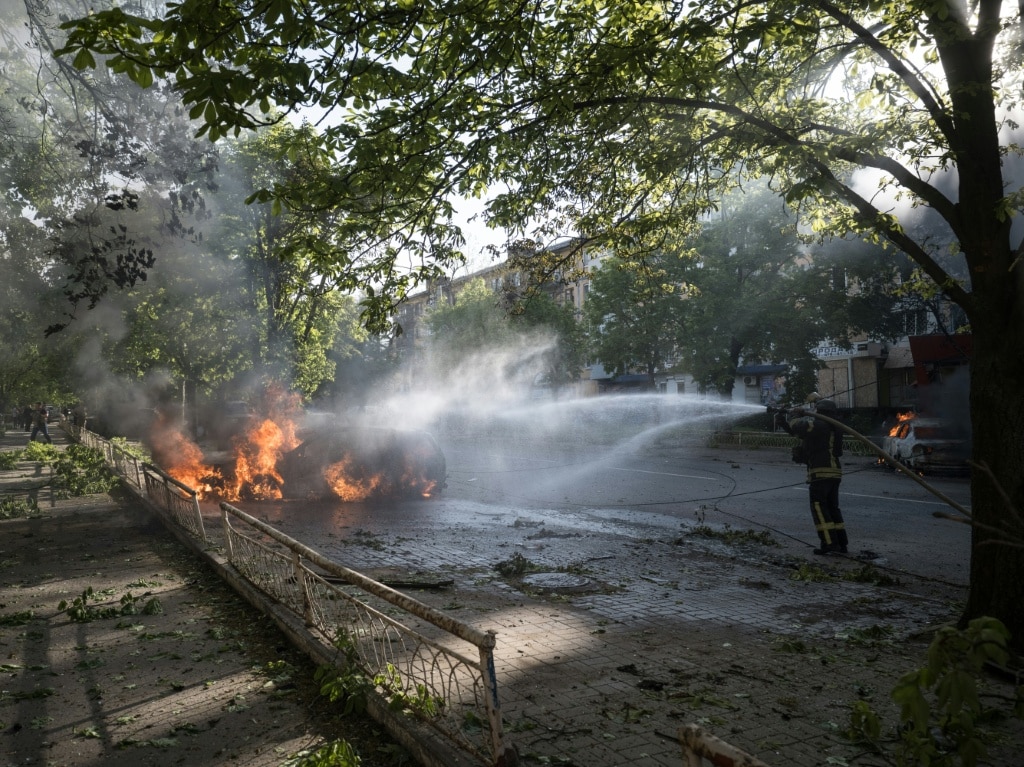
Just hours after Russia launched its unilateral two-day ceasefire to coincide with its annual World War II Victory Day holiday celebrations, Russian authorities announced they had intercepted multiple drones targeting the capital Moscow on Friday, while escalating threats of retaliatory strikes against Kyiv that have drawn sharp international backlash.
The temporary ceasefire has been dismissed by Ukrainian leadership as nothing more than a propaganda tactic designed to secure Russia’s iconic May 9 Red Square military parade – one of the most symbolically charged patriotic events in Russian President Vladimir Putin’s 25-year tenure in power. Putin has anchored much of his political narrative to the memory of the Soviet Union’s victory over Nazi Germany, even invoking that legacy to justify his full-scale invasion of Ukraine in 2022.
In remarks ahead of the ceasefire taking effect, Ukrainian President Volodymyr Zelensky issued a stark warning to allied nations considering sending representatives to attend the Moscow parade. “We have also received messages from some states close to Russia, saying that their representatives plan to be in Moscow… A strange desire… in these days. We do not recommend it,” Zelensky stated. He went on to accuse Russia of seeking a temporary pause in fighting only to protect its ceremonial event before resuming military aggression: “They want from Ukraine a permit to hold their parade so that they can go out onto the square safely for one hour once a year, and then go on killing.”
Zelensky’s own earlier proposal for a reciprocal Ukrainian ceasefire starting May 6 has gone unanswered by the Kremlin. In the final days leading up to the unilateral truce, Russian forces intensified their attacks on Ukrainian positions, with Ukraine launching counterstrikes of its own. On Thursday, Russia’s defense ministry claimed its forces had destroyed nearly 350 Ukrainian drones in overnight operations. Per updates posted by Moscow Mayor Sergei Sobyanin on Russian social platform Max, an additional 20 drones were intercepted in the first two hours after Russia’s ceasefire went into effect.
In the lead-up to the holiday, the Russian defense ministry issued an urgent formal call for Kyiv residents and foreign diplomatic personnel to evacuate the Ukrainian capital, warning of impending retaliatory strikes should Ukraine continue offensive operations during the truce. “We remind the civilian population of Kyiv and staff at foreign diplomatic missions once again of the need to leave the city in good time,” the ministry said, echoing a similar evacuation warning for diplomats issued by the Russian foreign ministry late Wednesday.
International reaction to the Russian threats was swift and critical. The United Kingdom’s foreign office called Moscow’s warnings “unwarranted, irresponsible and completely unjustified,” noting that any attack on foreign diplomatic premises would represent a dangerous new escalation of the ongoing conflict. German Foreign Ministry official Johann Wadephul confirmed to Bloomberg TV that Berlin has no plans to withdraw its embassy staff from Kyiv, while a senior anonymous source close to Zelensky told Agence France-Presse that the Ukrainian president would remain in Kyiv through the weekend.
Under the terms of Russia’s unilateral ceasefire, the defense ministry pledged a “complete” halt to offensive fire along the entire front line and an end to long-range strikes on Ukrainian military infrastructure, while warning that any failure by Ukraine to match the pause would prompt a proportional Russian response. In a reflection of growing security unease ahead of this year’s event, Moscow has announced multiple unusual changes to the annual parade: for the first time in nearly two decades, no heavy military hardware such as tanks and ballistic missiles will be displayed along Red Square, a shift that comes as Ukraine has expanded its long-range drone strike capacity and stepped up attacks on Russian territory far from the front lines in recent weeks.
Attendance from foreign leaders has also plummeted. According to the Kremlin, only the heads of state of Belarus, Malaysia, and Laos will attend the event, alongside leaders of two Russia-backed breakaway Georgian regions that lack United Nations recognition. Moscow has also implemented intermittent city-wide internet shutdowns that will remain in place through Saturday, further signaling heightened security concerns.
The conflict, which has grown into the most devastating armed confrontation in Europe since World War II, remains at a stalemate, with diplomatic negotiations to end the hostilities making little to no progress and largely overshadowed by rising tensions in the Middle East tied to the Iran conflict. Moscow’s core peace demand – that Ukraine withdraw its forces from four eastern and southern regions Russia claims as its own – remains completely unacceptable to the Kyiv government.