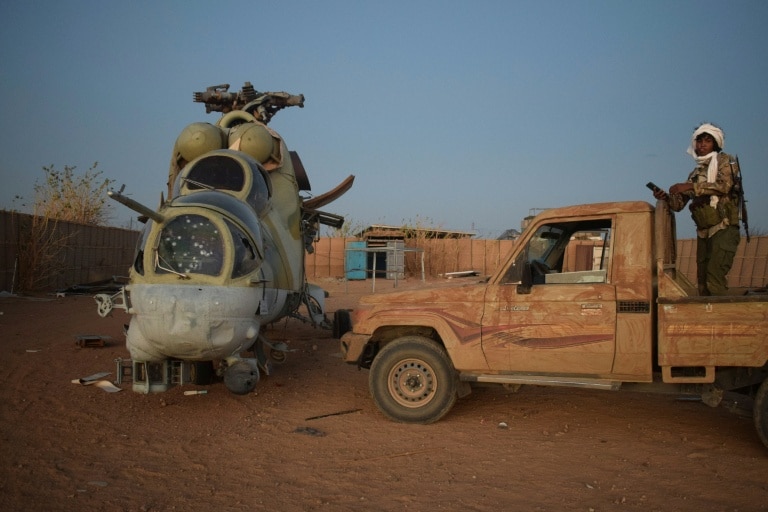
Mali’s already fragile security landscape has been shattered by a new wave of deadly violence, as two coordinated attacks claimed by an Al-Qaeda-affiliated jihadist group have killed more than 30 people in central regions of the West African nation, multiple local, security and administrative sources confirmed to Agence France-Presse on Thursday.
The near-simultaneous strikes on the villages of Korikori and Gomossogou unfolded just under two weeks after a massive joint offensive by jihadist and separatist forces against positions held by the country’s ruling military junta, a campaign that pushed Mali into one of its most severe security emergencies in years. A local youth official put the confirmed death toll at a minimum of 35 people killed in Wednesday’s attacks, while both security and administrative sources corroborated a toll of more than 30 fatalities. The assaults have been officially claimed by the Group for the Support of Islam and Muslims (JNIM), the largest Al-Qaeda-aligned militant network operating in the Sahel region.
West African Sahel security journalism collective WAMAPS has published a higher provisional toll, reporting more than 50 villagers killed with multiple residents still unaccounted for. The organization added that widespread looting of community property and arson attacks on local buildings accompanied the assaults. According to a senior security source, the attacks were launched in retaliation for recent actions by Dan Nan Ambassagou, a prominent community self-defense militia formed by local populations to counter persistent jihadist incursions in central Mali. The source noted that while most of the fatalities were militiamen, the dead also included teenage civilians and young children.
Composed primarily of ethnic Dogon traditional hunters, Dan Nan Ambassagou has repeatedly defied government orders to disband. Malian authorities have labeled the group responsible for a 2019 massacre in the central village of Ogossagou that left 160 people dead. In response to this week’s attacks, the Malian military announced Thursday that it had conducted a focused counter-terrorism operation in the affected area, neutralizing approximately a dozen militant fighters. The military has not released any additional details on the operation to date.
This latest violence comes on the heels of a devastating coordinated offensive across northern and central Mali launched April 25 and 26 by a coalition of JNIM and the Azawad Liberation Front (FLA), an ethnic Tuareg separatist movement. The offensive targeted key strategic locations, including the northern desert town of Kidal and Kati, a major military garrison town just outside the capital Bamako. The attacks claimed the life of Malian Defense Minister Sadio Camara, the 47-year-old architect of the junta’s military alliance with Russia, who was killed by a car bomb at his personal residence. Kidal and multiple other northern population centers have since fallen under the control of the coalition, which has implemented a blockade of the capital to pressure the junta.
Central Mali has emerged as a persistent hotspot of lethal intercommunal and militant violence in recent years. Following the 2019 Ogossagou massacre, the village was the site of a 2020 raid that left roughly 30 ethnic Fulani people dead; Fulani communities across the Sahel have long faced unfair accusations of colluding with jihadist groups. In March 2022, nearly 300 civilians were massacred in the town of Moura, with Human Rights Watch implicating the Malian military and its foreign allies, widely understood to be mercenaries from Russia’s Wagner Group. Just three months later, JNIM attacks in Diallassagou killed more than 130 civilians.
In the wake of last month’s large-scale offensive against the junta, Mali has also seen a sweeping crackdown on perceived opponents. Multiple security, legal and family sources confirmed to AFP that a number of opposition political figures and active-duty military personnel have been detained or forcibly abducted since the attacks. Last week, the military prosecutor’s office stated it held concrete evidence of complicity among certain military members, accusing them of aiding in the planning, coordination and execution of the April offensive. But a senior anonymous political official warned the crackdown amounts to a targeted political purge, arguing that the junta is exploiting the security crisis to eliminate dissent within both the political opposition and military ranks. “Everything suggests that these events are being used as an opportunity to carry out a purge,” the official said.
Mali has been trapped in a deep-seated security crisis since 2012, fueled by overlapping insurgencies from Al-Qaeda and Islamic State-affiliated fighters, activity from local criminal gangs, and separatist mobilization among ethnic Tuareg communities in the north. The country has been under unelected military rule since two successive coups in 2020. Shortly after last month’s offensive, JNIM issued a public call for a united opposition front to remove the junta from power and create a path toward a peaceful, inclusive political transition.