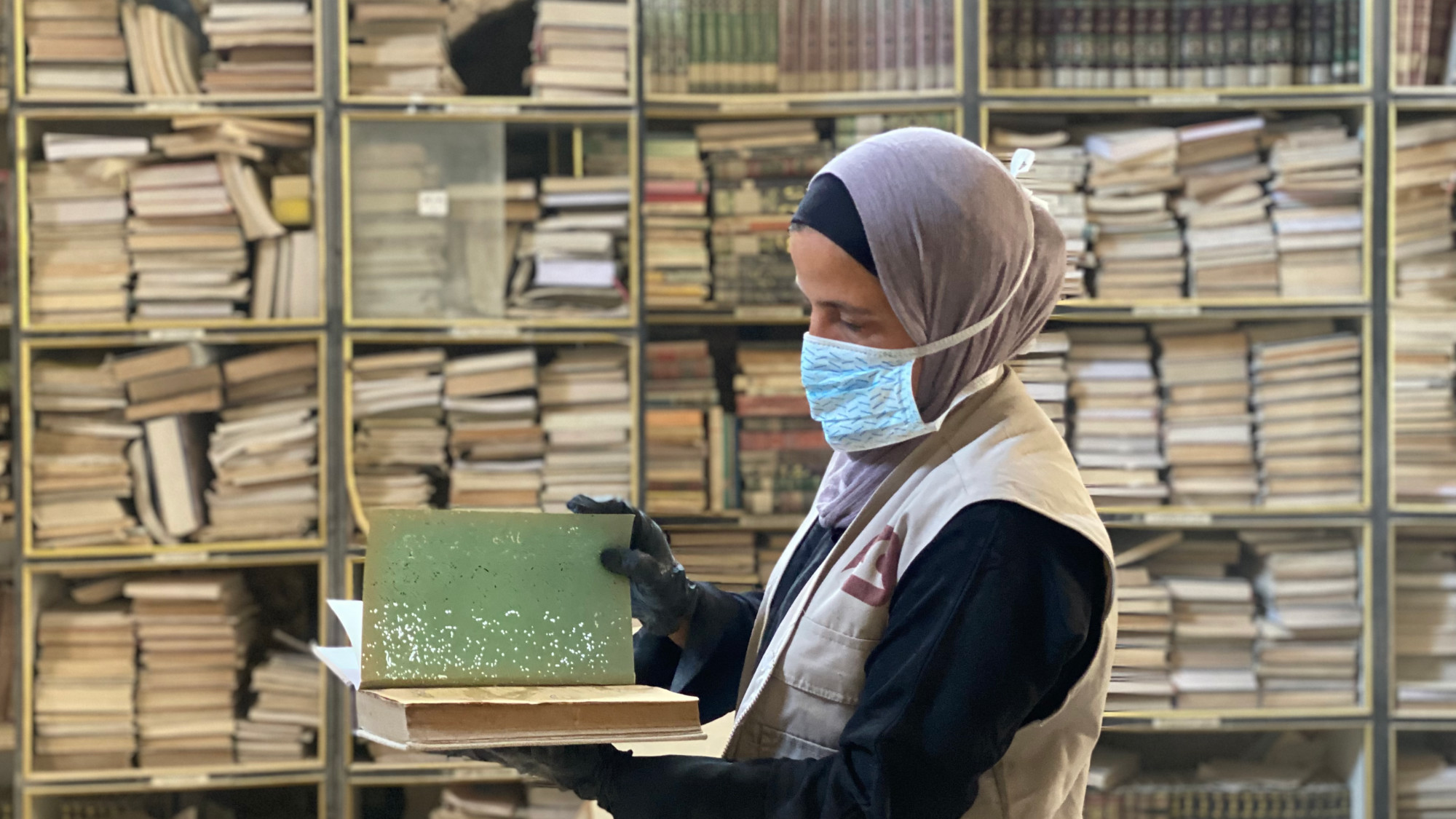
Against the backdrop of relentless conflict and widespread destruction across Gaza, a small, determined group of Palestinian women volunteers is waging a quiet, urgent battle to save one of Gaza’s most significant cultural treasures from total loss. Their mission centers on the centuries-old library of the Great Omari Mosque, a historic institution reduced to rubble by repeated Israeli bombardment amid the ongoing Gaza genocide.
Raneem Mousa, a 35-year-old master’s graduate in Arabic language, is one of the volunteer leads on this improvised rescue effort. As she carefully dislodges a water-damaged volume from a war-shattered shelf, she uses a simple hand brush to sweep away decades of dust mixed with rubble and shrapnel before passing the text to a teammate for a gentle wipe down. The recovered book is then carried to the group’s self-designated “safest corner” — a tiny, makeshift holding space tucked away in the damaged mosque, where all salvageable texts are stored.
When Mousa first arrived at the site after the most recent strikes, the scene was one of total devastation. “The library was filled with shrapnel, rubble, and dung from stray animals taking shelter,” she recalled in an interview with Middle East Eye. “Hundreds of shattered books and torn papers were scattered on the ground, covered in stones.”
The volunteers, all affiliated with Gaza City’s Eyes on Heritage Institute, have framed their work as a “first-aid mission” to stabilize and preserve whatever can be saved from the library’s irreplaceable collection. Working without any specialized conservation tools, professional cleaning supplies, or formal institutional support, the group has relied on the most basic of materials: dry cloths, simple household brushes, and open air to dry waterlogged volumes damaged by seasonal rain.
The Great Omari Mosque itself carries profound historical weight: as Gaza’s largest and oldest place of worship, it sits on a site that has hosted sacred structures for millennia, evolving from a Philistine temple to a Roman place of worship, then a Byzantine church, before being converted to a mosque in the 13th century. Its library, ranked the third-largest in all Palestine, once held roughly 20,000 volumes, including 187 rare manuscripts, some of which dated back more than 500 years. Over the course of the ongoing conflict, Israeli forces have bombed the mosque at least three times, leaving the structure in ruins and the library’s collection decimated.
Despite the crippling challenges of ongoing siege, mass displacement, and a total lack of resources, Mousa and her teammates refuse to abandon their work. For them, this effort is about far more than saving old books: it is a defense of Palestinian identity and historical claims to their land. “This library has an educational and historical value that underscores the Palestinian historical right to their home,” Mousa explained.
Time is not on their side. Months of exposure to Gaza’s humid, wet winter conditions have accelerated decay, with fungi growing on paper pages and the ink slowly eroding away. “Every time a page crumbles in my hand, I feel a pang of guilt, as if a witness to history is dying,” Mousa said.
Every step of the rescue work is an exercise in improvisation and sacrifice. Coordinated via a simple WhatsApp group chat, volunteers must arrange trips to the mosque amid conditions that have made travel across Gaza nearly impossible: most of the territory’s population is displaced, nearly all vehicles have been destroyed, and fuel is so scarce that even short journeys cost more than most Gazans can afford. Mousa herself lost her home in Jabalia, northern Gaza, to an Israeli strike, and now lives in a makeshift tent in Deir al-Balah — a displacement that leaves her constantly worried about being able to afford the trip to continue her work.
The group also lacks safe storage for the books they recover. All volunteers live in overcrowded temporary shelters, so there is no space to move salvaged volumes off-site. The small corner they have set aside in the damaged mosque remains under constant threat from the elements. “We often have to clean them again because the building is still in ruins and offers no real protection,” Mousa noted. “We are racing against the weather; the winter rain and wet wind are just as much an enemy as the bombs were.”
Mousa says the group’s long-term hope is to secure international funding for proper storage shelves, professional conservation materials, and the equipment needed to digitize the entire surviving collection, preserving these texts digitally even if the physical copies are lost. “People in Gaza have always taken pride in education and culture,” she said. “If we, the educated generation, do not protect these books, who will preserve them for those who come after us?”
Haneen al-Amasi, 33, director of the all-women Eyes on Heritage Institute, founded the organization in 2009 with a core mission: to rescue, restore, and digitize rare books, manuscripts, and historical documents across Gaza, to safeguard Palestinian cultural heritage for future generations. It was not until a brief ceasefire in March 2025 that al-Amasi was able to visit the Great Omari Mosque library for the first time since the current conflict began — and she said she was unprepared for the scale of the destruction. “Entire archives of books, manuscripts and historical documents were burned or shattered in Israeli attacks,” she told Middle East Eye. “Many others were damaged, eaten by rodents, or taken by displaced people to be used as fuel amid severe gas shortages in Gaza.”
Many of the lost and damaged texts are irreplaceable: original documents recording centuries of Palestinian life, including scholarly works on jurisprudence, geography, and social customs, with many capturing unique details of life in the Palestinian territories before the 1948 Nakba.
Al-Amasi argues that the deliberate targeting of libraries and cultural institutions is part of a broader Israeli campaign to erase Palestinian collective memory by destroying the physical evidence of their history and connection to the land. This is not the first time the institute has lost its work to Israeli strikes: during the 2014 Gaza offensive, the group’s original office in eastern Gaza City was bombed, killing five volunteer women who had fled their homes in Shujaiya and taken shelter in the building, and destroying hundreds of books and manuscripts that the team had already archived.
After that attack, the devastated but determined team rebuilt their operations in a new location, and over the following years managed to recover and digitize hundreds more rare manuscripts, some dating back to the medieval period. In September 2025, that second office was also destroyed in an Israeli air strike. “Once again, we lost our library,” al-Amasi said simply.
Even after repeated loss, the group has refused to end their work. “We feel it is our duty to keep striving to preserve and revive Palestinian cultural heritage in Gaza,” al-Amasi said. She has reached out to multiple international humanitarian and cultural organizations to request support, but says most global actors prioritize immediate needs like food and medical care in Gaza, ignoring the crisis facing Palestinian cultural heritage. “I believe cultural heritage is just as important,” she emphasized. “Future generations in Palestine will ask what we did to preserve our history.”
Back at the Great Omari Mosque, the volunteers continue their slow, painstaking work, even as violence and crisis unfold around them. Al-Amasi recalls a time before the current war, when Gaza’s schoolchildren took part in regular reading competitions at the mosque library, an event that drew eager crowds of young learners. Today, Gaza’s children spend their days queuing for food aid and clean water, growing up surrounded by constant trauma from war. “By saving these books, we are trying to ensure that when the war ends, our children have something to read other than news of death,” al-Amasi said.