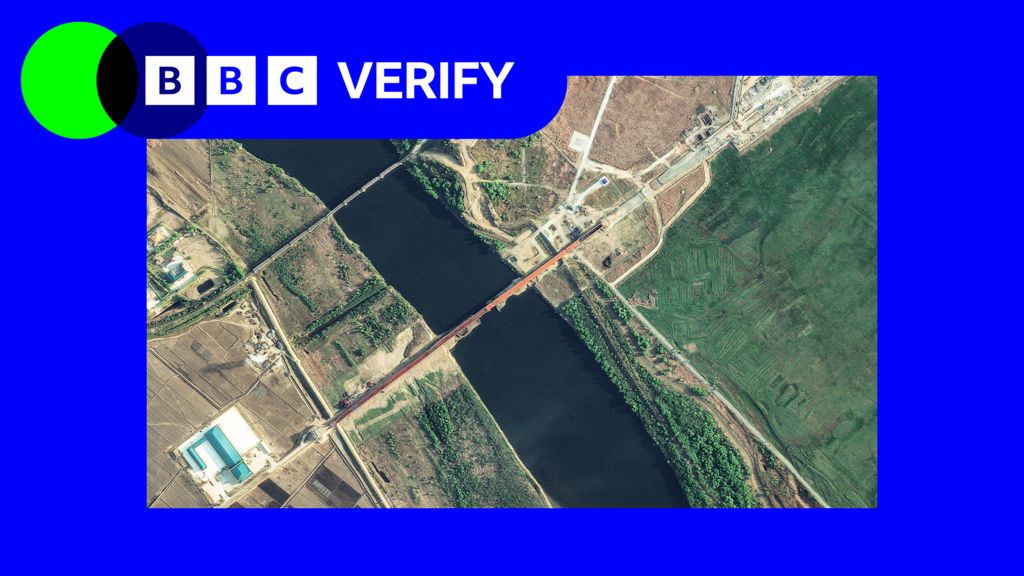
New analysis of commercial satellite imagery conducted by BBC Verify has revealed that the first dedicated road bridge linking North Korea and Russia is in the final stages of construction, marking a tangible milestone in the rapidly deepening strategic partnership between the two nations against the backdrop of Russia’s full-scale invasion of Ukraine.
Located just hundreds of meters from the existing Friendship Bridge – the only current cross-border connection between the two countries, which operates solely as a rail link – the new 1-kilometer Khasan–Tumangang Bridge spans the Tumen River. The latest satellite photos confirm that alongside the main bridge span, all required supporting infrastructure has been nearly finished: new access roads, a dedicated border checkpoint, paved vehicle parking areas, and service facilities are all in place, signaling the project is on track to meet its scheduled completion date of June 19, 2026. A ceremony to connect the two halves of the bridge was held on April 21 this year, as publicly confirmed by Russia’s embassy in Pyongyang.
The agreement to construct the new crossing was first signed during Russian President Vladimir Putin’s 2024 official visit to Pyongyang, where he met with North Korean leader Kim Jong Un. Construction broke ground roughly one year after the agreement, and BBC Verify has tracked the project’s progress through routine satellite imagery updates throughout the build phase. According to Russia’s transport ministry, the bridge is engineered to accommodate up to 300 vehicles and 2,850 cross-border travelers per day. Russian state media reports put the total construction budget at more than 9 billion roubles, equivalent to roughly $120 million or £88 million.
Regional security experts widely view the rapid construction of the bridge as clear evidence of expanding cross-border activity, driven primarily by deepening military cooperation tied to the war in Ukraine. “The speed of construction is a reflection of the volume of trade activity between the two sides,” explained Victor Cha, a senior analyst at the Washington-based Center for Strategic and International Studies (CSIS). Cha added that the surge in cross-border exchange is “spurred largely by North Korea’s provision of troops, weapons, munitions, and labourers for Putin’s war in Ukraine.”
Prior to the start of the Ukraine war, this stretch of the North Korea-Russia border was one of the least active cross-border links in East Asia. But CSIS research finds that rail traffic through the existing Friendship Bridge has remained consistently high throughout the road bridge’s construction, as bilateral trade and military exchanges have expanded dramatically. Under current operational plans, analysts expect that Russian and North Korean truck drivers will transfer cargo loads at the new checkpoint, rather than being allowed to operate vehicles deep into each other’s territory.
The new bridge is far more than an infrastructure project, according to both officials and analysts. Russia’s foreign ministry emphasized that the bridge’s opening will “become a truly landmark stage in Russian–Korean relations. Its significance goes far beyond a purely engineering task.” During the same 2024 summit that approved the bridge, Putin and Kim signed a sweeping mutual defense pact that pledges mutual assistance in the event of “aggression” against either country.
According to estimates from South Korean intelligence, North Korea has deployed approximately 15,000 troops to support Russian operations in Ukraine, alongside large shipments of missiles and long-range artillery systems. Seoul estimates that roughly 2,000 of those North Korean troops have been killed in combat to date. Neither Pyongyang nor Moscow has officially confirmed these troop numbers, but just last week Kim Jong Un joined Russian Defense Minister Andrey Belousov to unveil a memorial in Pyongyang honoring North Korean service members killed in Ukraine. Russian state media reports that Belousov and North Korean officials held extensive talks on long-term military cooperation during the visit.
Analysts say the bridge will solidify long-term bilateral ties beyond the current conflict in Ukraine. In exchange for North Korea’s military support for Moscow’s war effort, Western intelligence agencies assess that North Korea has received critical supplies including grain, fuel, and advanced military technology from Russia. “The construction of the bridge epitomizes how North Korea’s ties with Russia look to continue beyond any end to the Ukraine war,” noted Dr. Edward Howell, a Korea Foundation Fellow at the London-based Chatham House think tank. Howell added that the crossing will provide a critical new logistics route for moving military goods and munitions between the two countries, in both directions.