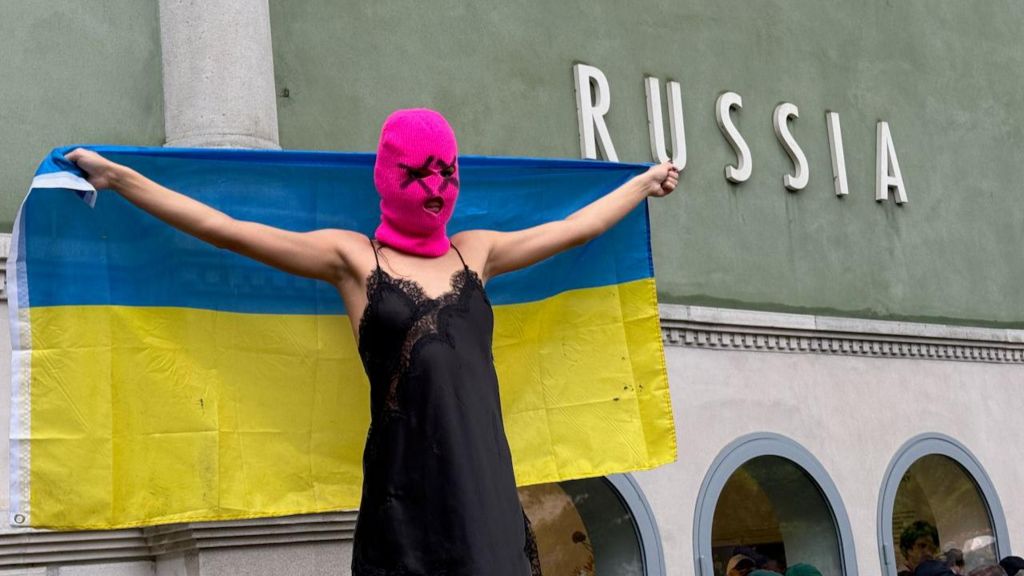
One of the art world’s most prestigious global gatherings, the Venice Biennale, has been roiled by high-profile demonstrations and bitter political division ahead of its official public opening, centered on the controversial decision to allow Russia to return to the event for the first time since Moscow launched its full-scale invasion of Ukraine in 2022.
Two prominent activist groups – Russian protest punk collective Pussy Riot and Ukraine-founded women’s rights movement FEMEN – teamed up for a dramatic, attention-grabbing demonstration outside the Russian national pavilion. Dressed head-to-toe in black with eye-catching fluorescent pink balaclavas, the activists charged through the Biennale’s iconic canal-side gardens, chanting loudly directly outside the glass-doored pavilion venue. As security personnel scrambled to slam the pavilion’s doors shut to block the protest, the demonstrators ignited colored smoke flares, raised their fists in defiance, and shouted slogans including, “Russia kills! Biennale exhibits!” One prominent protest poster carried a searing message: “Curated by Putin, dead bodies included.”
Nadya Tolokonnikova, a founding member of Pussy Riot, framed Russia’s reinstatement to the Biennale as a deliberate component of Moscow’s broader hybrid warfare campaign against the West. “They’re drinking vodka and champagne inside their pavilion, soaked in the blood of Ukrainian children,” Tolokonnikova said in an interview. “This isn’t just about tanks, drones, murder and rape in Ukraine. It’s also about culture, art, language – it’s how Russia tries to conquer the West, and you all just opened the doors for them.”
Controversy over Russia’s return has stretched far beyond the activist protest. The European Commission has issued a strong condemnation of the decision, threatening to withdraw €2 million in core funding for the Biennale. Brussels argues that allowing an aggressor state like Russia to showcase its art on this global platform directly violates the ethical standards tied to the grant. Italy’s national culture minister has also joined the boycott, announcing he will skip the opening of the fair this Saturday. However, high-profile Italian politician Deputy Prime Minister Matteo Salvini – who drew international attention in 2014 for visiting Moscow’s Red Square wearing a Vladimir Putin-branded t-shirt – has rejected calls for a boycott, stating that “No pavilion should be excluded.” Sources familiar with the European Commission’s position indicate Brussels is unimpressed by Rome’s refusal to back the exclusion.
The political friction at the 61st Venice Biennale is not limited to Russia’s participation. Last week, the entire international jury for the event resigned in protest after a reference was made to countries whose leaders face arrest warrants from the International Criminal Court for suspected war crimes – a designation that covers both Russia and Israel. On Wednesday morning, a separate group of demonstrators targeted the Israeli pavilion, covering the entrance floor with rain-soaked leaflets branding the space a “Genocide Pavilion.” Israel’s foreign ministry has previously hit back, accusing a “political jury” of turning the Biennale into a venue for “anti-Israeli political indoctrination.”
Venice Biennale president Pietrangelo Buttafuoco, a right-wing former journalist who has publicly expressed admiration for Russian President Vladimir Putin, has broken his near-silence on the growing controversy to push back against critics. He slammed calls for the exclusion of Russia and Israel as a “laboratory of intolerance,” dismissing the demands as censorship and exclusion. “If the Biennale began to select not works but affiliations, not visions but passports, it would cease to be what it has always been: the place where the world meets,” Buttafuoco told reporters before walking out of the press conference without taking questions.
But critics say Buttafuoco’s argument ignores the harsh reality of the war in Ukraine, highlighted by a series of striking posters pasted across Venice this week. The advertisements promote an “Invisible Biennale,” featuring imaginary events by Ukrainian artists and writers killed during the Russian invasion. One entry highlights Volodymyr Vakulenko, a Ukrainian author shot by Russian troops after they occupied his village; each poster is stamped with the line: “Cancelled. Because the author was killed by Russia.”
Held every two years, the Venice Biennale’s national pavilions are widely viewed as one of the most high-profile platforms for countries to project soft power globally, a role that is particularly significant for authoritarian states seeking to shape international perception. After Russia’s full-scale invasion in 2022, the curators of the Russian pavilion pulled out in protest, and the space was loaned to Bolivia for the 2024 edition. For this year’s event, a Russian team has filled the pavilion with an installation centered on an upside-down tree paired with experimental sound performances.
When asked if Russia deserved a place at the Biennale amid its ongoing war in Ukraine, pavilion commissioner Anastasia Karneeva dismissed the question entirely. “This is our house, we come to our place,” she said. “I don’t think about the protests. I am very busy.” Karneeva is the daughter of a deputy head of Rostec, Russia’s massive state-owned weapons producer that is currently under international sanctions; she declined to comment on that connection and ended the interview shortly after.
Notably, Russia’s participation this year is only partial: the pavilion is set to close after this week’s pre-opening events, and it remains unclear whether the early closure is a response to protests or the impact of ongoing international sanctions. The planned performances, however, have been recorded and will be screened on an outdoor screen for the duration of the fair. The audio from these screenings will carry just a short distance down the garden path – directly toward Ukraine’s official pavilion, located steps away from the main entrance.
Ukraine’s contribution to the 2026 Biennale carries its own powerful, haunting message. Hanging suspended by thick steel straps from a crane just outside the entrance is a concrete cast of an origami deer, created by Ukrainian artist Zhanna Kadyrova. The sculpture was originally installed in Pokrovsk, a city in eastern Ukraine’s Donbas region, when the frontline with Russian forces was still 40 kilometers away. As Russian troops advanced on the city in 2024, Kadyrova made the decision to evacuate the work to save it from destruction or occupation.
“We have a destroyed city that does not exist now. I hope this message is clear and people who visit the Biennale can understand it,” Kadyrova explained in a recent interview from her Kyiv studio. The deer has become a poignant symbol of displacement, mirroring the fate of millions of Ukrainians forced to flee their homes by the invasion. “Pokrovsk is now an occupied city. A lot of people were killed there. But we saved this artefact. The question is how many artefacts were not saved in this war? How many other kinds of heritage were destroyed?” she asked. “This was a lively city. And it does not exist now because Russia came.”