In the bustling core of Manhattan’s Chinatown, nestled between a midtown hotel, a local spa, and a neighborhood coffee shop, sits an unassuming six-story glass-front building. What looks to passersby like an ordinary community space sits at the center of a high-stakes federal espionage case that opened this week in Brooklyn federal court, pitting U.S. prosecutors’ allegations of a secret Chinese spy operations hub against defense claims of an innocent community service project derailed by geopolitical tension.
U.S. prosecutors allege the location was an unregistered overseas outpost for China’s national police, explicitly tasked by Beijing with monitoring, silencing, and intimidating Chinese pro-democracy dissidents residing on American soil. Inside the space, authorities discovered a banner clearly labeling the site the “Fuzhou Police Overseas Service Station, New York USA.”
The accused, 64-year-old Lu Jianwang — a U.S. citizen who has lived in the country for decades, also known as Harry Lu — went on trial Wednesday, more than three years after federal agents arrested him at his Bronx residence. He faces two felony charges: conspiracy to act as an unregistered foreign agent and intentional destruction of evidence, including deleted WeChat communications that prosecutors claim were sent to his Chinese government handler.
Opening arguments laid out two starkly conflicting narratives of Lu’s work. Prosecutor Lindsey Oken told jurors that while Lu resided in New York City, he ultimately took direction from Beijing. Oken explained that Lu and co-defendant Chen Jinping, who has already pleaded guilty to the conspiracy charge, launched the Chinatown outpost in 2022, shortly after Lu attended an official ceremony in his home province of Fujian. At that event, China’s Ministry of Public Security publicly announced the launch of 30 similar overseas police stations across the globe.
Oken emphasized that these outposts are a tool of the Chinese government to track and pressure individuals Beijing labels as threats to its national interests. She told the jury that the prosecution will call a dissident who was directly targeted by the New York outpost as a witness during the trial. The Manhattan outpost shared office space with the America ChangLe Association, a community group co-founded and operated by Lu and his brother Jimmy. Tax filings for the group list it as a “social gathering place for Fujianese people,” and defense counsel noted the name “ChangLe” translates to “eternal joy.”
While Oken acknowledged that the group openly advertised its service helping Chinese diaspora members renew Chinese driver’s licenses remotely, a workaround for pandemic-era international travel bans, she noted that even this public activity violates U.S. law. Under the federal Foreign Agents Registration Act, any individual acting on behalf of a foreign government or official entity must register their activity with the U.S. Department of Justice — a step Lu never took, Oken said.
Lu’s defense attorney, John Carman, pushed back hard against the prosecution’s framing of the case as a high-stakes international spy plot, instead casting it as a minor bureaucratic oversight that has been blown out of proportion amid rising U.S.-China tensions. Carman argued that the entire case boils down to an unfiled government form, not espionage. “He is not a spy, not a part of Chinese intelligence services, not a member of the Chinese Communist Party, and he is not an agent of the Chinese government,” Carman told jurors in his opening statement. He summed up the case with two common phrases: “No good deed goes unpunished” and “Guilt by association.”
Carman recounted that the FBI launched a raid on the Chinatown space in October 2022, acting on a report from a non-profit that monitors transnational repression by China. During the raid, agents searched through drawers, seized paperwork, broke open locked cabinets and a safe, and confiscated a desktop computer and multiple cellphones. “They turned the place upside down,” Carman told the jury.
Prosecutors confirmed that the day after the raid, Lu admitted to FBI agents that he had set up the outpost, maintained contact with a contact in China via WeChat, and deleted all of their messages. Carman noted that neither of Lu’s two hours of interviews with FBI agents were recorded, a procedural detail that undermines the reliability of the prosecution’s account. Lu was ultimately arrested in April 2023.
Co-defendant Chen Jinping pleaded guilty to conspiracy to act as a foreign agent in December 2024. He is currently released on bond and will not be sentenced until after Lu’s trial concludes.
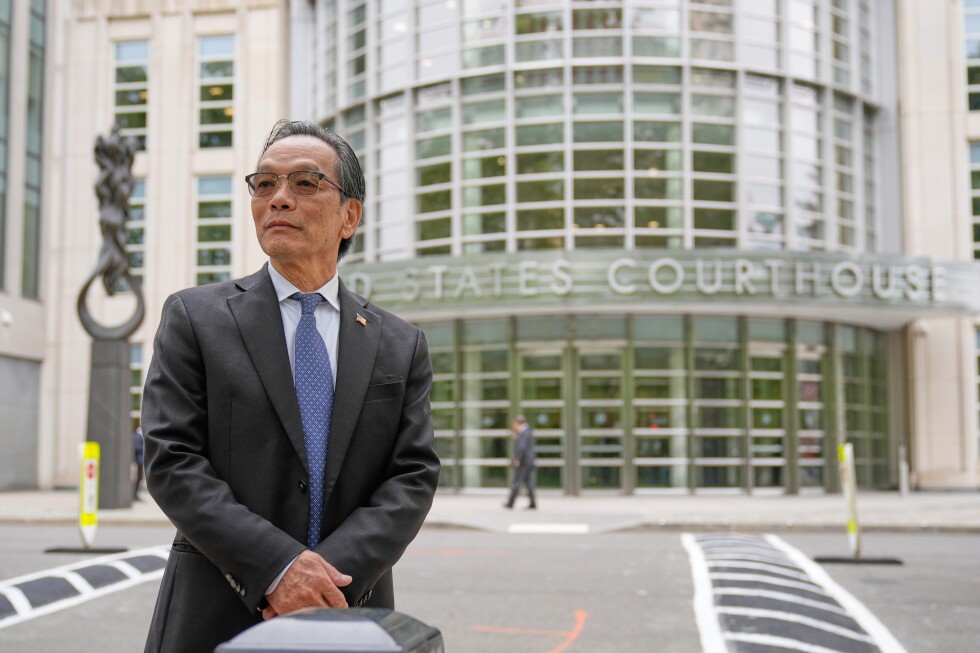
At the defense table on Wednesday, Lu sat alongside Baimadajie Angwang, a former New York Police Department officer who was acquitted of charges accusing him of acting as an “intelligence asset” for China three years ago. Angwang, who is currently suing the NYPD to get his job back, is working as an investigator for Lu’s defense team. Lu, dressed in a dark suit, pale blue tie, and glasses, speaks limited English and followed the proceedings through a translation earpiece that rendered arguments into his native Fujianese. Both Lu and Angwang wore small American flag pins on their lapels.
As Lu and his legal team arrived at the courthouse Wednesday morning, several dozen supporters — including members of Lu’s local church — gathered outside to rally on his behalf. Participants held signs reading “Justice for Harry Lu” and “Chinese Americans Are Americans!” and waved small American flags to demonstrate their support.
Carman closed his opening argument by reinforcing that Lu’s only loyalty is to his local community. “If Harry Lu is an agent of anyone, he is an agent for his community — the local people in his neighborhood,” he told jurors. “You have the life of an innocent man in your hands.”