The world of 20th century media has lost one of its most transformative figures: Ted Turner, the brash, risk-taking visionary who launched the world’s first 24-hour cable news network CNN and reshaped global journalism forever, has died at the age of 87. His death was announced publicly on Wednesday, closing the book on a life that extended far beyond media into sports, high-stakes business, and large-scale philanthropic and environmental action.
Born Robert Edward “Ted” Turner III in Cincinnati, Ohio in November 1938, Turner’s trajectory into media leadership began under tragic circumstances. After his father died by suicide amid crippling financial stress, a young Turner stepped in to salvage the family’s failing advertising business. He would not stop there: building a portfolio of local radio stations through the 1960s, he made his first foray into television in 1970 with the purchase of a struggling Atlanta-based broadcast station. A decade later, that small station became the cornerstone of his nationwide Turner Broadcasting System, and the profits from the growing network laid the groundwork for the project that would make his name: the launch of CNN in 1980.
CNN revolutionized news consumption entirely. As the first non-stop 24-hour cable news outlet, it arrived at a moment when American audiences were already shifting from over-the-air broadcast to cable television, and it rose to global prominence during the 1990–1991 Gulf War, when it delivered unprecedented, continuous live coverage of the conflict via cutting-edge satellite technology. CNN’s runaway success sparked a global industry shift, inspiring the launch of competing 24-hour networks from Turner rivals and peers including Rupert Murdoch’s Fox News, MSNBC, and dozens of similar outlets across every continent.
Turner’s media empire expanded far beyond breaking news. His portfolio grew to include entertainment and sports networks TBS and TNT, classic film outlet Turner Classic Movies, and children’s network Cartoon Network, among other properties. Along the way, he made a series of high-stakes business bets: a 1980s attempt to acquire broadcast giant CBS ended in failure, and he purchased MGM/UA Entertainment Co. studios for a short period before selling the studio back just months later, retaining the rights to most of its iconic film library.
The 1990s brought the largest deal of Turner’s career: a 1996 merger between Turner Broadcasting and media giant Time Warner that elevated him to the role of vice chairman of the combined entertainment powerhouse. Five years later, internet pioneer AOL acquired Time Warner in a $165 billion deal that remains the largest corporate merger in history. But the combination quickly unraveled as AOL’s business fortunes collapsed, with the deal unwound entirely within a decade. As Time Warner’s largest individual shareholder, Turner lost billions of dollars in the failed combination.
Beyond boardrooms and newsrooms, Turner was a towering figure in global sports. He purchased the MLB’s Atlanta Braves in 1976, leading the once-struggling franchise to multiple World Series appearances and a championship title in 1995. He also owned the NBA’s Atlanta Hawks and the NHL’s Atlanta Thrashers, with all three teams transferring to Time Warner as part of the 1996 merger; the Braves continued to play at the Turner-named Turner Field until 2016. On the water, Turner skippered the U.S. yacht *Courageous* to victory in the 1977 America’s Cup, and his decades-long rivalry with fellow media titan Rupert Murdoch intensified after a 1983 collision between Murdoch-sponsored and Turner-owned yachts during the Sydney-Hobart race sank Turner’s schooner, leading Turner to famously challenge Murdoch to a public fistfight.
Against the backdrop of Cold War tensions and tit-for-tat Olympic boycotts between the U.S. and Soviet Union in the 1980s, Turner launched the Goodwill Games, an international multi-sport event designed to ease global tensions; the last Games were held in 2001.
Turner was also a familiar public figure for his high-profile personal life, most notably his 10-year marriage to Academy Award-winning actress Jane Fonda, his third wife, which ended in divorce in 2001. By his own account, the split was driven by Fonda’s conversion to Christianity, while Fonda countered that Turner required constant, full-time attention that amounted to caregiving rather than a partnership. Turner was named Time Magazine’s Man of the Year in 1991, the same year the pair married.
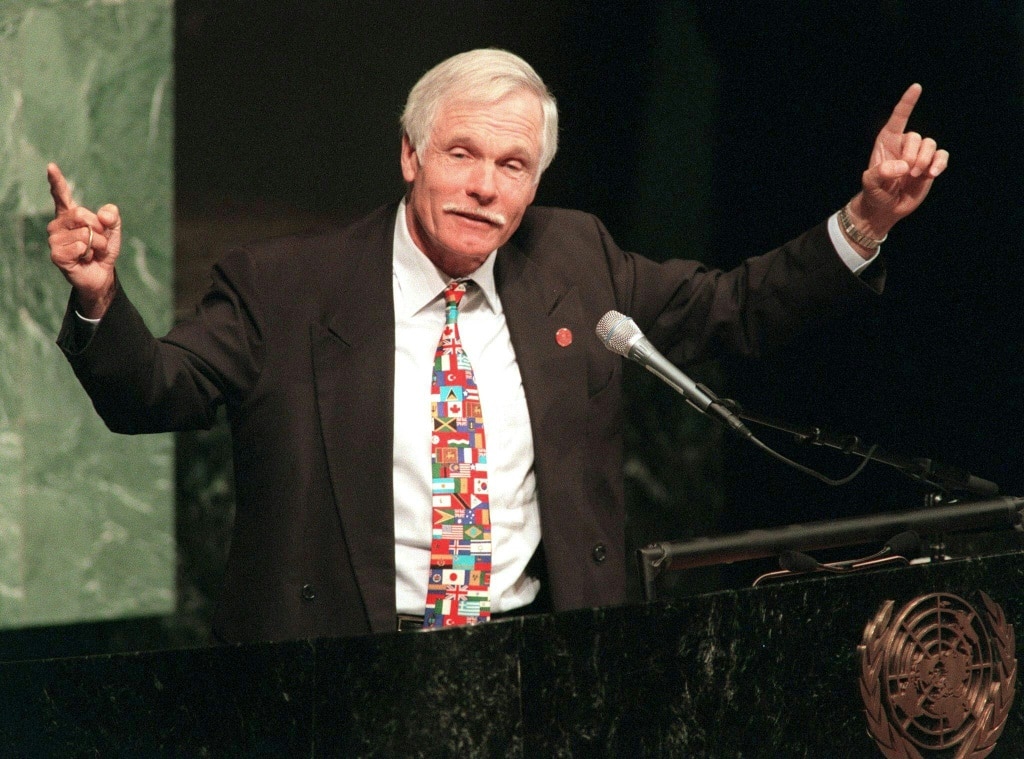
In his later life, Turner dedicated himself nearly full-time to philanthropy and environmental conservation after stepping down from his role at Time Warner in 2003. A longtime critic of wealthy individuals who refused to give away their fortunes, he made a landmark $1 billion donation to the United Nations in 1998 to found the UN Foundation, which has since advanced work on climate action, sustainable development, public health, and technological equity. He had already founded the Turner Foundation in 1990, which has disbursed roughly $380 million to support climate action and improvements to global air and water quality. In 1997, he launched the Turner Endangered Species Fund, which partners with private landowners to protect at-risk species from gopher tortoises to monarch butterflies. Most recently, in 2015, he launched Ted Turner Reserves, an eco-tourism venture that gives visitors access to his four New Mexico properties to learn about on-site conservation work.