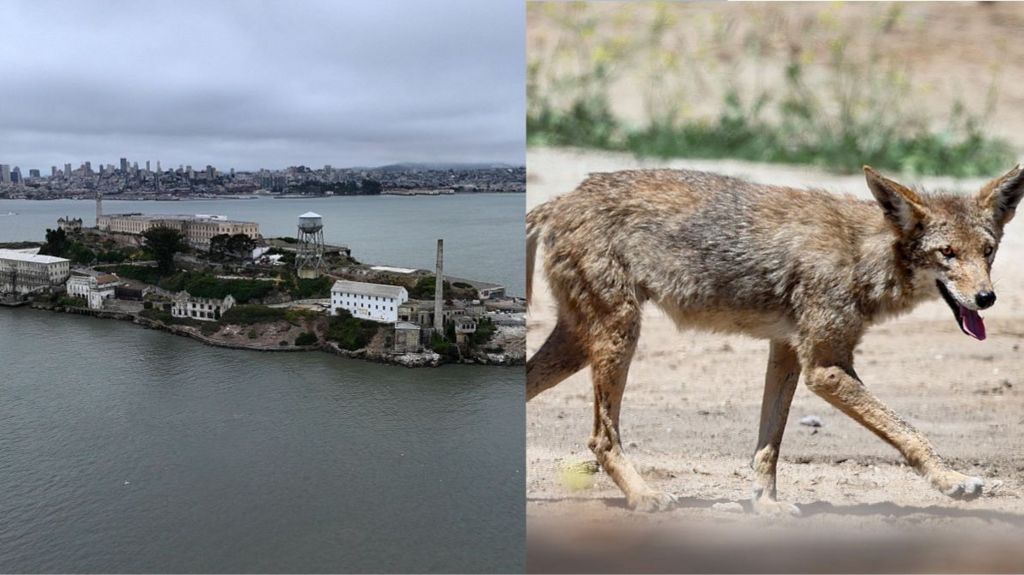
A male coyote that captured national attention after reaching California’s Alcatraz Island by swimming across San Francisco Bay has upended researchers’ initial assumptions about his journey, with new DNA analysis revealing the animal swam nearly twice the distance experts originally estimated. The coyote’s unexpected January arrival on the site of the infamous former federal prison marked the first confirmed coyote sighting on Alcatraz in more than five decades, leaving both scientists and visiting tourists stunned.
When the sighting was first reported, wildlife specialists assumed the coyote had set out from the city of San Francisco, a crossing of just over one mile. But new genetic testing completed on samples collected from the animal has traced his origins to Angel Island State Park, a full two miles away from Alcatraz, the National Park Service (NPS) announced in a public statement Monday. To date, the coyote’s current location remains entirely unconfirmed, despite weeks of targeted monitoring.
National Park Service wildlife ecologist Bill Merkle noted that the team’s working hypothesis had long centered on a shorter crossing from San Francisco, due to the obvious reduced physical challenge of that route. “We couldn’t help being impressed by his accomplishment in making it to Alcatraz,” Merkle said in the release. “Coyotes are known to be resilient and adaptable, and he certainly demonstrated those qualities.”
The extraordinary crossing was first captured on camera by tourists in late January, whose footage of the coyote pushing through cold, choppy Bay waters to reach Alcatraz’s shore surprised both researchers and local San Francisco residents. The animal quickly gained a fanbase online, with many people dubbing him “Floyd,” a nod to the fictional getaway driver for iconic outlaws Bonnie and Clyde.
Shortly after the sighting, NPS officials set up a network of camera traps and audio recorders across Alcatraz to track the coyote’s movements. Officials also began planning efforts to capture and relocate the animal over concerns that the predator would prey on the island’s vulnerable native seabird colonies. To confirm the coyote’s origin, researchers collected track measurements and samples of the animal’s scat, which were sent for genetic analysis at the University of California, Davis. The lab results confirmed the coyote belonged to a well-documented coyote population already established on Angel Island, confirming his 2-mile starting point for the epic swim.
The NPS’s release, headlined “Alcatraz Coyote Wasn’t a City Boy After All,” also noted that the San Francisco Bay Area is home to three separate, genetically distinct coyote populations, a testament to the species’ widespread adaptability across urban and wild landscapes. Despite weeks of intensive monitoring across Alcatraz, the coyote has not been spotted since the initial tourist sighting, and officials no longer believe he remains on the island.
“We don’t know what happened to the coyote,” Merkle said. “But he proved himself an expert swimmer to get to Alcatraz, and I hope he made a successful swim back home to Angel Island.” Coyotes, which are native North American canids closely related to wolves, have spread across nearly the entire continental United States, and are now commonly spotted even in urban green spaces and upscale residential neighborhoods across San Francisco.
In a separate recent development tied to Alcatraz, the island long nicknamed “The Rock” for its reputation as an unescapable maximum-security fortress made headlines again this spring when the Trump administration proposed a $152 million budget allocation to lawmakers that would fund rebuilding the shuttered penitentiary and reopening it as a modern high-security prison for the country’s most dangerous incarcerated people. The request covers the first year of construction costs for the project.