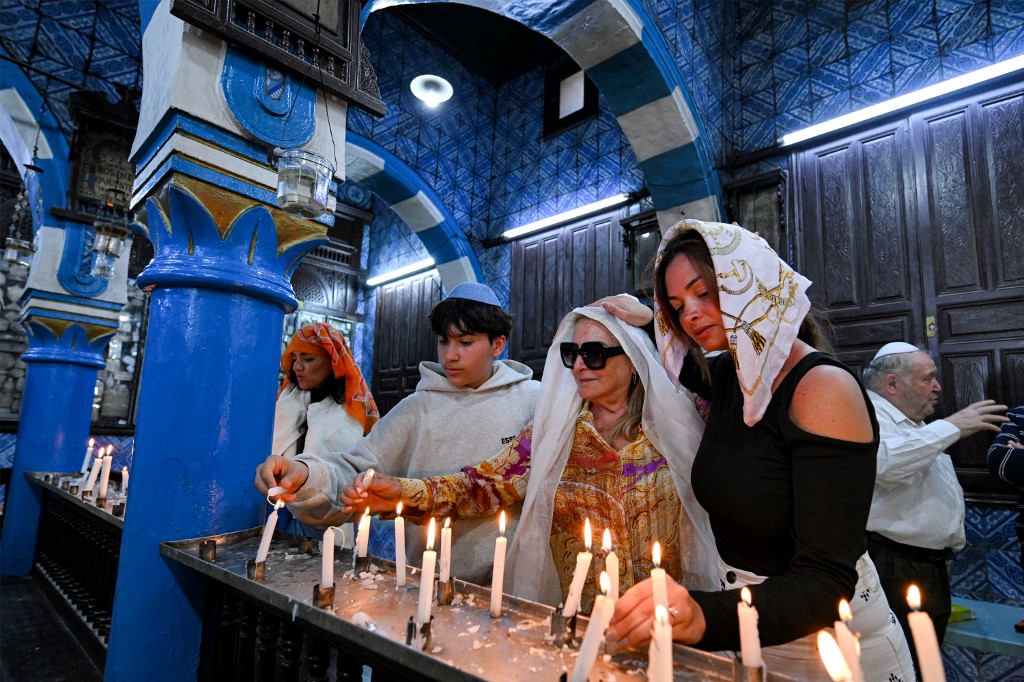
After years of tightly restricted access driven by repeated security threats, the annual pilgrimage to Tunisia’s iconic Ghriba Synagogue — one of the oldest active Jewish sites on the African continent — is witnessing a notable revival in 2025, with rising international participation and boosted security protections from Tunisian authorities.
The centuries-old pilgrimage, held each spring on Tunisia’s Djerba Island, was for decades a major global Jewish gathering, drawing thousands of worshippers and visitors from across Europe, North America and beyond. But the event was gutted by scaled-down operations following a devastating attack on the synagogue complex in May 2023, which left six people dead including two visiting pilgrims and three Tunisian security officers.
That attack, carried out by off-duty National Guard officer Wissam Khazri, unfolded on the final day of the 2023 pilgrimage. Khazri first killed a fellow officer, seized the officer’s ammunition, and opened fire on worshippers and security personnel at the site before being fatally shot by responding security forces. Nine additional people were injured in the violence. The attack was the deadliest incident targeting the synagogue since a 2002 suicide truck bombing that killed 21 people at the same location.
In the two years after the 2023 attack, attendance was drastically limited to address ongoing safety concerns. In 2024, public processions were canceled entirely, with events restricted to small-scale prayer services and candle lighting. Just 50 pilgrims participated that year, a drop from the roughly 7,000 attendees that took part in the 2023 gathering before the attack occurred. That low turnout also came on the heels of a separate anti-Jewish attack just one week before the 2024 event, when a Jewish jeweller was stabbed in his Djerba shop by an assailant wielding a butcher knife.
The trial of individuals accused of aiding Khazri concluded in February 2025, with all convicted accomplices receiving prison sentences ranging from one to 15 years. The legal proceedings remain controversial, however: both defense attorneys representing the defendants and lawyers for civil parties harmed in the attack have publicly condemned the investigation as deeply flawed, while Tunisian government officials have never formally labeled the 2023 attack as an antisemitic act.
This year, authorities have taken a new approach, permitting organized international pilgrimage groups to travel to Djerba while rolling out sweeping enhanced security measures across the island and around the synagogue. Rene Trabelsi, former Tunisian Tourism Minister and one of the lead organizers of the pilgrimage, told Agence France-Presse that a clear rebound in turnout is already underway this year. “This year, there has been a marked return of pilgrims to the island. We estimate that around 200 have come from abroad,” Trabelsi said. He added that confidence in the event is slowly recovering, noting that organizers are grateful for the extensive security infrastructure the Tunisian state has deployed to protect attendees.
Constructed as early as the 6th century BCE, Ghriba Synagogue holds the distinction of being the oldest active synagogue in Africa, and it is widely viewed as a landmark symbol of Tunisia’s long history of religious and cultural diversity. Today, roughly 1,500 Jewish residents remain in Tunisia, with the majority residing on Djerba Island. That number is a sharp decline from the estimated 100,000 Jews who lived in the country before it gained independence from France in 1956, when large numbers of Jewish residents emigrated to Israel and France in the decades following independence.