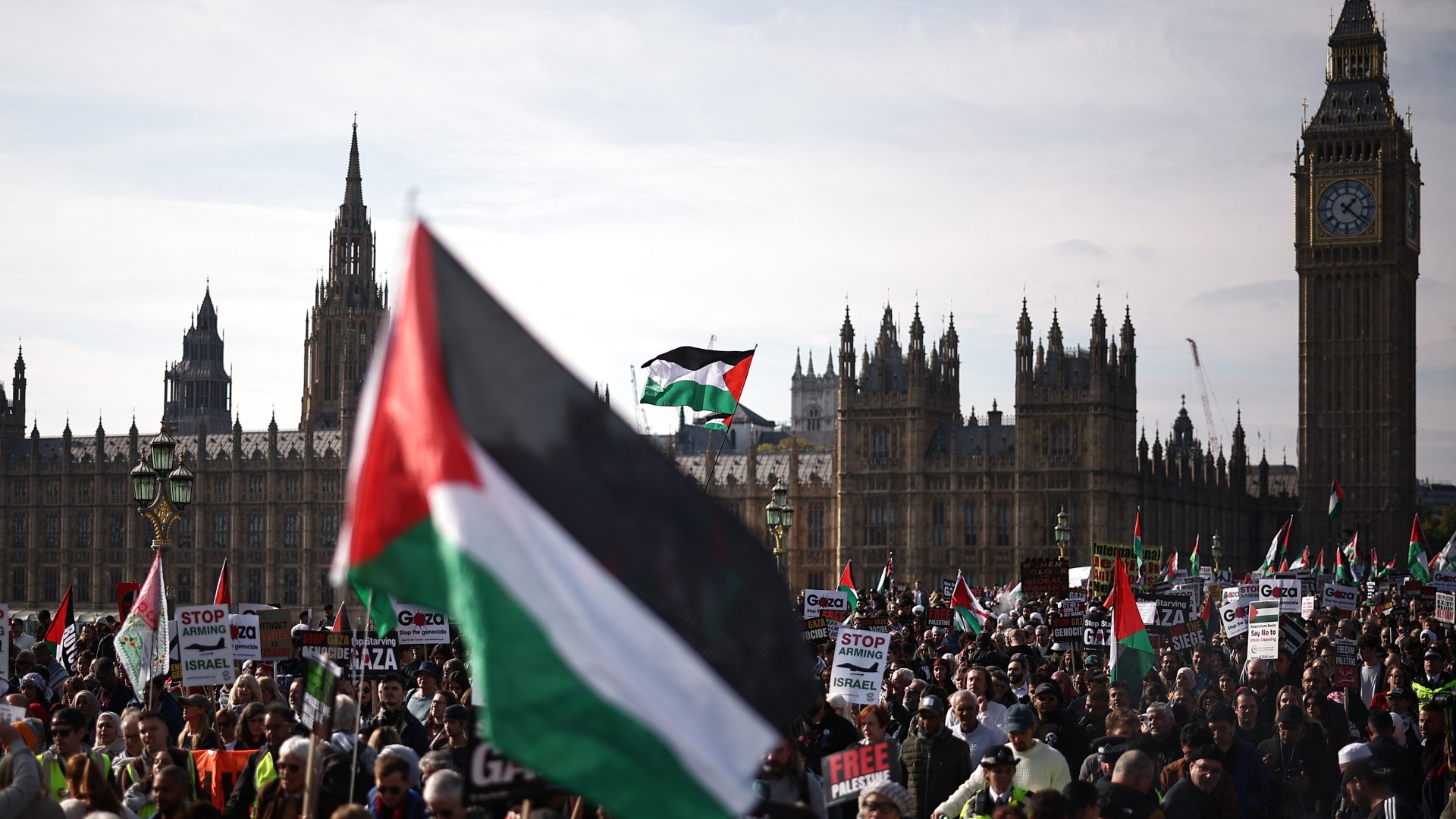
A growing controversy has erupted in London over claims from Metropolitan Police Commissioner Mark Rowley that organizers of pro-Palestine protests have repeatedly intentionally routed demonstrations past synagogues, a claim that major pro-Palestine advocacy groups have denounced as false and defamatory.
Four leading campaign organizations — the Palestine Solidarity Campaign, Friends of Al-Aqsa, the Stop the War Coalition, and the Palestinian Forum of Britain — have banded together to publicly call on Rowley to issue an immediate, public retraction of his remarks, which they label a scurrilous misrepresentation of their protest planning practices. The accusation stems from comments Rowley gave to The Times, where he argued that repeated attempts by organizers to include synagogues on march routes sent a message that felt like antisemitism.
“The fact that features as the organisers’ intent, I think that sends a message… that feels like antisemitism. That may be a fair or unfair inference, but that’s the message it sends,” Rowley told the outlet.
In a formal response, the coalition flatly rejected Rowley’s account, saying his claims are not just unfounded but damaging to community relations. The groups pointed to their planning for the upcoming Nakba Day demonstration scheduled for May 16 as clear evidence of their commitment to avoiding sensitive Jewish sites. They told Rowley they first submitted a proposed route from Embankment to Whitehall back in December 2023 — a path they had used twice previously that does not pass any synagogues. After three months of no response, police rejected the route, they said, on the grounds that far-right figure Tommy Robinson had been granted permission to hold a demonstration in central London, forcing the pro-Palestine groups to relocate.
A second proposed route, from the Israeli embassy in West London to Trafalgar Square, also included no synagogues, according to the coalition. That proposal was also rejected, with police instead arbitrarily imposing a much shorter route on the organizers. “The truth is that at no point have we ever requested to ‘walk by’ a synagogue on any of our marches,” the coalition stated. “We have no interest in doing so. Police recordings of our meetings with you will confirm this.”
In an official clarification following the coalition’s demand, a Metropolitan Police spokesperson pushed back, saying Rowley’s comments were not targeted specifically at the upcoming May demonstration. Instead, the spokesperson said the commissioner was referring to the full scope of pro-Palestine protests held since the outbreak of the Israel-Gaza conflict in October 2023. Over that period, the coalition has organized roughly 30 large-scale marches across London. Half of those events, the Met said, were originally planned to start, end, or pass near a synagogue, and police intervened to change the route 20 times to protect Jewish communities from potential disruption or intimidation. Rowley still maintains that repeated attempts to gather near synagogues sends a threatening message to Jewish communities that amounts to antisemitic intimidation, according to the spokesperson.
The pro-Palestine coalition argues that Rowley’s false accusations, coming from the UK’s most senior police officer, are completely unacceptable and risk inflaming already heightened community tensions across the country. This is not the first time the groups have pushed back against efforts to discredit their movement: just last week, they condemned coordinated attempts by politicians and mainstream media outlets to smear the protests and floated proposals to ban the demonstrations entirely.
The controversy comes in the wake of a recent stabbing attack in Golders Green, a majority-Jewish neighborhood in northwest London, where two Jewish men were stabbed by a 45-year-old Somali-born British national. The suspect is also accused of stabbing a Muslim man, Ishmail Hussein, in a separate attack in south London earlier the same day. Following the attack, senior politicians including Prime Minister Keir Starmer publicly linked the violence to pro-Palestine protests and called for severe restrictions on the demonstrations. Appearing on the BBC’s *Today* program over the weekend, Starmer said offensive language used at protests should be actively policed, and suggested that a full ban on mass pro-Palestine demonstrations could be justified under current circumstances.