Tucked in Taiwan’s earthquake-prone Hualien County, the small town of Fenglin has built a gentle, well-loved reputation: a place where the frantic pace of modern life fades, and visitors can step back to breathe and reconnect. With a population of just 10,000 — down threefold from decades ago and now marked by a super-aged demographic with over 20% of residents over 65 — Fenglin did not fight its slow rhythm. Instead, it leaned into it, turning that identity into a symbol of community resilience, anchored by an unlikely local icon: the garden snail.
Fenglin’s bond with snails dates back to 2014, when it joined the Cittaslow international network, a global movement of small communities dedicated to centering quality of life, local food systems, and sustainable development over rapid growth. The movement’s official symbol, fittingly, is a snail carrying a small cluster of buildings on its back — a metaphor that aligned perfectly with Fenglin’s natural character.
That quiet commitment to slow living became a lifeline for the region after a devastating 7.2-magnitude earthquake struck Hualien in April 2024, leaving 18 dead, over 1,100 injured, and cratering local tourism. Fears of aftershocks kept visitors away, and many residents relocated from the quake-prone county entirely. To reverse the downturn and draw travelers back to the region, local organizers launched an annual event that leaned into Fenglin’s slow identity: an open-to-all snail race.
“Two years after the quake, tourism still feels its impact, because many people worry another large temblor could strike at any time,” explained 32-year-old local resident Hsu Lu. “Many people have already left Hualien because of repeated seismic activity.” For the community, snail racing was never meant to be a silver bullet — just a small, intentional step to rebuild foot traffic. “We thought that our event could attract people, and that would be a small help,” said Cheng Jen-shou, one of the event’s founding organizers.
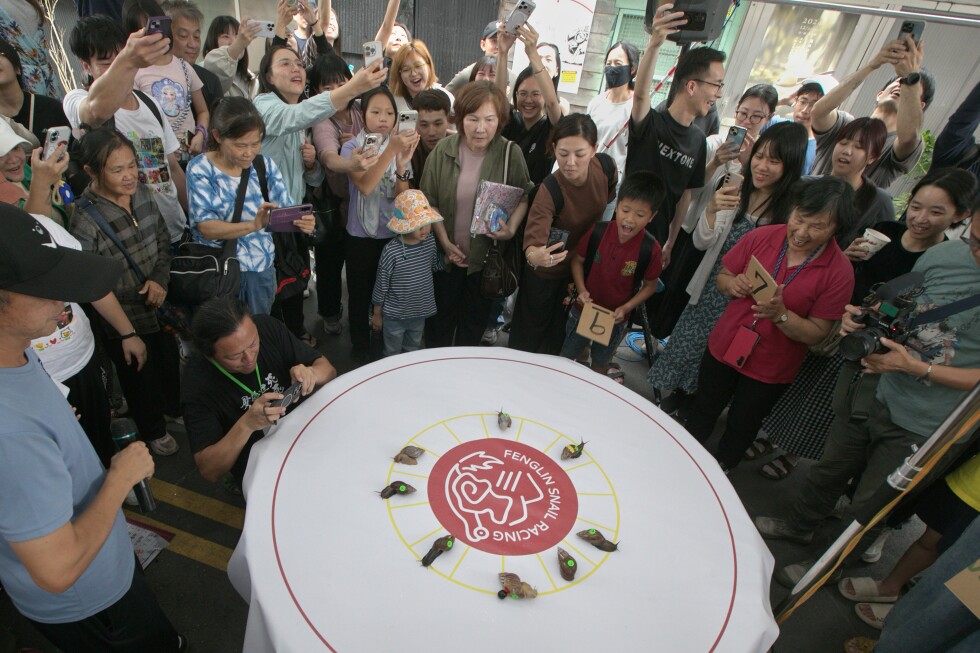
This May Day holiday marked the third iteration of the quirky race, drawing dozens of enthusiastic participants and spectators from across Taiwan. Over two days, six preliminary heats sent snails creeping toward the finish line, with heat winners advancing to a grand final that drew cheers from the gathered crowd. The event’s rules are delightfully simple: 10 snails are placed at the center of a round table covered in thin vinyl, and the first to reach the edge takes the top prize.
Participants bring their snails from across the island, with many locals harvesting their competitors straight from their own backyards. Seventy-year-old Fenglin retiree Li Cheng-wen started raising snails after finding them feasting on leafy greens in his vegetable garden; instead of killing the pests, he turned them into pets, feeding them slices of banana, papaya, and fresh leaves, and giving them daily showers. When selecting racers, he prioritizes two traits: “I usually select those that are very active and pleasing to the eye,” he explained.
For one family from southern Taiwan, the race became a long-awaited do-over. Kelvin Hong and Tiara Lin traveled five hours from Kaohsiung with their 2-year-old daughter Murphy and their giant African snail Aquaman, who had been signed up for the 2024 race before Lin went into early labor on the drive north. This year, the whole family returned to see Aquaman compete.
Despite his larger size, Aquaman failed to outpace the local competition. The 2025 crown went to Guage, better known to fans as Brother Snail, a repeat champion owned by 39-year-old Tanya Lin from Hualien. Brother Snail has held the title since 2024, and this year he crossed the 33-centimeter course in just 3 minutes and 3 seconds, earning his champion’s reward: a hearty serving of organic sweet potato leaves and a place of honor on the tiny event’s winner’s podium.
Beyond the snail race itself, Fenglin’s local government has built out a broader tourism strategy around the town’s slow-life identity, offering guided e-bike tours that stop at historic tobacco barns, well-preserved Japanese colonial-era buildings, and a museum dedicated to the local Hakka ethnic community. The concept has resonated with travelers tired of the nonstop pace of Taiwan’s major cities. University students Annette Lin and Tanya Liu took a 30-minute train from Hualien City to experience the race and Fenglin’s laid-back energy, describing the event as wonderfully unique. Liu summed up the appeal for many visitors: “I think for travel or a trip, it’s a great choice. But maybe living here would not really be my dream choice.”
For Fenglin, though, the slow pace is not a temporary attraction — it is the core of the town’s identity, and a tool that has helped it rebuild after disaster one small, slow step at a time.