In a landmark political shake-up that has reshaped India’s regional electoral map, Prime Minister Narendra Modi’s Bharatiya Janata Party (BJP) secured a historic first-ever majority win in West Bengal, a state long held as an unassailable stronghold of the regional opposition All India Trinamool Congress (TMC). The final results from India’s multi-phase April-May state and territorial elections, announced Monday, delivered a series of seismic shifts across five jurisdictions, with far-reaching implications for national politics ahead of the 2029 general election.
With vote counting completed under heavy security deployment in West Bengal, a state home to more than 100 million people, the Election Commission of India confirmed the BJP won 206 of the 294 legislative assembly seats — a record-breaking outcome that ends TMC’s 14-year consecutive rule of the state. Beyond West Bengal, the BJP also secured its third consecutive term in power in the northeastern state of Assam, and earned a place in the ruling governing coalition in the small coastal union territory of Puducherry.
For Prime Minister Modi, 75, the surprise breakthrough in West Bengal comes as a major political boost as he navigates pressing domestic economic challenges and complex foreign policy priorities, including persistently high national unemployment and a pending bilateral trade deal with the United States, ahead of the 2029 national general election.
Taking to social media to address the win, Modi framed the result as a victory for popular mandate and performance-focused governance. “The 2026 West Bengal Assembly Elections will be remembered forever,” he wrote. “People’s power has prevailed and BJP’s politics of good governance has triumphed. BJP’s record win in West Bengal would not be possible without the efforts and struggles of countless Karyakartas (workers) over generations.”
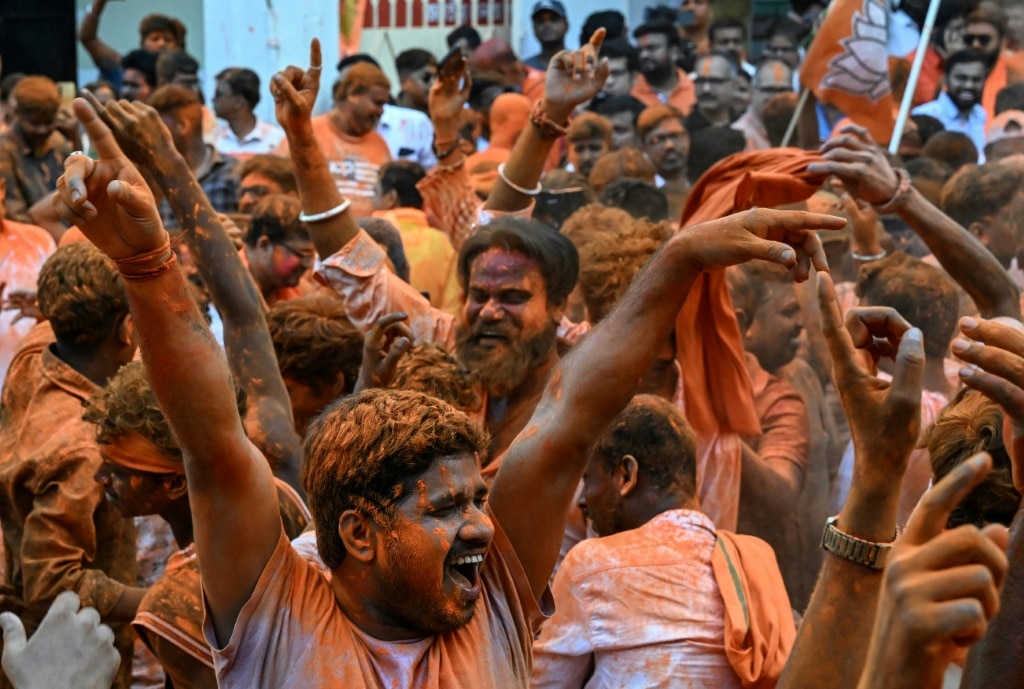
Thousands of party workers and supporters poured onto the streets of Kolkata, West Bengal’s capital, to celebrate the historic win, dancing to pro-party victory anthems amid widespread jubilation. The BJP had waged an aggressive year-long campaign to unseat TMC leader Mamata Banerjee, the 71-year-old firebrand incumbent who had held power in the state since 2011. The campaign was marred by controversy over the removal of millions of names from state voter rolls: officials framed the purge as a necessary step to remove ineligible, duplicate voters, but critics argued the process disproportionately targeted marginalized and minority communities, skewing the electorate in the BJP’s favor.
Banerjee, who herself lost her longtime Bhabanipur constituency seat to BJP candidate Suvendu Adhikari by a margin of more than 15,000 votes, levelled serious allegations of electoral misconduct against the BJP and the national election body. A visibly emotional Banerjee told reporters in Kolkata, “BJP looted more than 100 seats. The Election Commission is the BJP’s commission,” before adding she would regroup and “bounce back” in future contests.
Political analysts note the West Bengal win will significantly consolidate the BJP’s control across eastern India, cementing its status as India’s undisputed national dominant party. “It’s a tremendous victory,” said Sushila Ramaswamy, a veteran political analyst, in an interview with AFP. “It also shows the electoral machinery of the BJP, how effective and how much detailing goes into their election campaign. And it establishes the BJP as the dominant party in the country.”
Addressing supporters and party members in the national capital Delhi, Modi called for calm and unity across all election regions, rejecting calls for retaliation against political opponents. “Today, when the BJP has won, the talk should not be of ‘revenge’, but of ‘change’,” he said. “Not of fear, but of the future.”
The election cycle delivered another major upset in the southern industrial state of Tamil Nadu, where veteran chief minister MK Stalin, leader of the ruling Dravida Munnetra Kazhagam (DMK), lost his longtime Kolathur constituency seat to a little-known candidate from a newly launched political party. The debutant party, Tamilaga Vettri Kazhagam (TVK), was founded in 2024 by C. Joseph Vijay, one of Tamil cinema’s most commercially successful A-list actors, who ran on a platform prioritizing youth employment and transparent governance. TVK defeated the incumbent DMK to win a majority in the state, leaving Stalin’s party a distant second.
Political scientist Ramu Manivanan said the Tamil Nadu result reflects growing demand for new political leadership among the state’s large youth electorate, rather than just general anti-incumbency sentiment. “This result shows that the youth want a new face. It is not just anti-incumbency,” Manivanan explained. “Vijay as an actor has a large female fan base as a cinema star. All that has influenced the outcome.”
In the southern coastal state of Kerala, the final remaining Communist-led government in India was voted out of power after two consecutive five-year terms. A Congress party-led alliance defeated the incumbent Left Democratic Front, earning a clear governing majority. Congress leader Rahul Gandhi thanked Kerala’s voters for what he called a “truly decisive mandate” in the wake of the result.