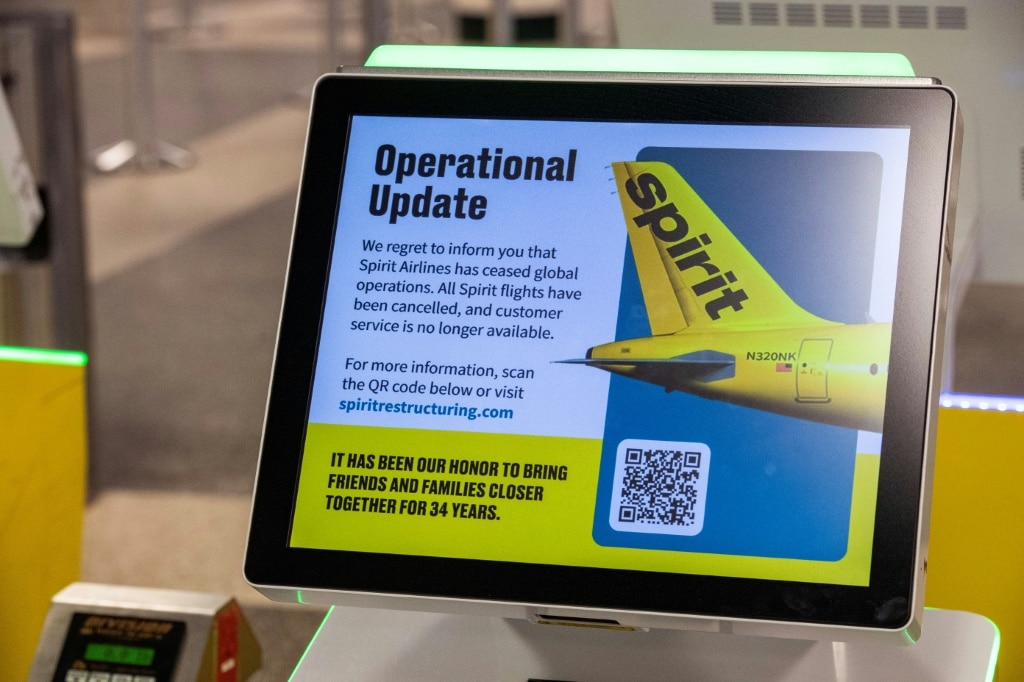
On a chaotic Saturday for U.S. air travel, discount carrier Spirit Airlines — recognizable by its iconic bright yellow aircraft — formally halted all global operations with immediate effect after last-ditch negotiations between creditors, company leadership, and the Trump White House collapsed. The sudden shutdown left thousands of passengers stranded overnight and nearly 7,500 employees facing sudden unemployment, prompting rival major carriers to launch emergency response efforts to accommodate displaced travelers and recruit out-of-work aviation staff.
Founded in 1964 and repositioned as one of America’s first low-cost carriers in 1992, Spirit had been teetering on the edge of collapse for nearly two years. The company first filed for bankruptcy protection in November 2024, followed by a second bankruptcy filing in August 2025 after its financial position failed to stabilize. By late February 2026, Spirit announced a tentative debt restructuring agreement that it hoped would allow it to exit bankruptcy by early summer. That progress unraveled days later, when the Strait of Hormuz was closed following U.S.-Israeli military strikes on Iran, sending global jet fuel prices soaring and erasing any remaining path to solvency.
In an official statement announcing the wind-down, Spirit leaders framed the shutdown as an unavoidable outcome: “The recent material increase in oil prices and other pressures on the business have significantly impacted Spirit’s financial outlook. With no additional funding available to the company, Spirit had no choice but to begin this wind-down.” The carrier has pledged full refunds to all passengers holding tickets for canceled flights, a promise echoed by U.S. transportation officials.
In the wake of the shutdown, major U.S. carriers including American Airlines, Delta Air Lines, United Airlines, and JetBlue Airways moved quickly to absorb stranded passengers. The airlines introduced deeply discounted “rescue fares” for travelers who woke Saturday to find their itineraries canceled, and announced adjustments to flight schedules — adding extra frequencies and deploying larger aircraft on routes where Spirit previously held a large market share. Beyond assisting passengers, multiple carriers also moved quickly to hire Spirit’s out-of-work ground crew, flight attendants, pilots, and maintenance staff, who were suddenly left without jobs.
The shutdown has already sparked political finger-pointing over what led to the carrier’s collapse. U.S. Transportation Secretary Sean Duffy defended the Trump administration’s handling of the crisis during a Saturday press briefing at Newark Liberty International Airport, arguing that the White House pushed aggressively to keep the carrier afloat. “The president was like a dog on a bone trying to figure out a way to keep Spirit afloat,” Duffy said. He pinned ultimate blame on creditors, who rejected the government’s proposed bailout terms, and noted that “we oftentimes don’t have a half a billion dollars laying around in a spare account that we can put into a bailout of an airline.” Duffy also blamed the prior Biden administration for blocking a proposed merger between Spirit and JetBlue in March 2024, a decision he argued set the stage for the carrier’s ultimate demise.
Unions representing Spirit’s 7,500 employees condemned the failed rescue talks, warning that the brunt of the collapse would fall on frontline workers rather than corporate leadership. “The pain of this decision will not be felt in boardrooms. It will be felt by pilots, flight attendants, mechanics, dispatchers, and ground crews, and by the families and communities that depend on them,” a statement from the Air Line Pilots Association read.
For many passengers, the sudden shutdown upended long-planned travel. Sixty-year-old Florida resident Ramon, who only gave his first name to AFP, had been scheduled to travel to Honduras this week to visit family. He and his son Kevin had seen reports of Spirit’s financial troubles in recent days, but declined an early refund offer because replacement tickets on other carriers were prohibitively expensive, and there was no clear indication the carrier would collapse immediately. “I was trying to go today on another airline, but it was like $1,000 a ticket,” Ramon said. The family now plans to wait for their Spirit refund before rebooking travel for early June.
Industry analysts say the collapse of Spirit will have lasting impacts on U.S. air travel prices. Bradley Akubuiro, a crisis management expert at Bully Pulpit International, noted that while the post-strike spike in fuel prices delivered the final blow to the struggling carrier, Spirit was already in an unsustainable position long before the energy market shock. “The more lasting consequence is that one of the strongest sources of low-fare pressure in the US market is gone,” Akubuiro told AFP.