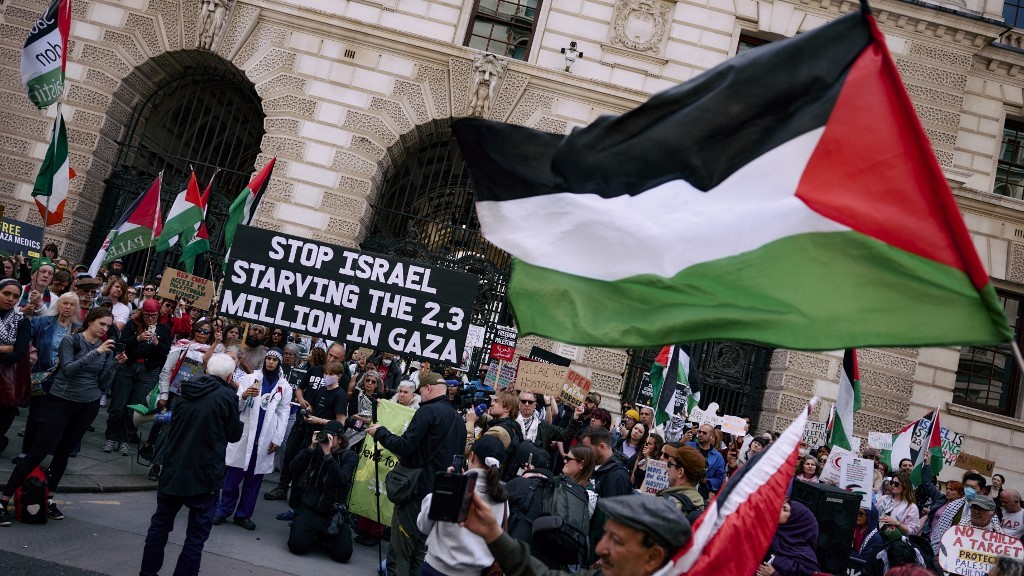
Britain’s largest representative body for Muslim communities has launched a sharp rebuke of the UK government over what it calls misleading and damaging narratives that falsely tie pro-Palestine solidarity demonstrations to a recent surge in antisemitic violence across the country.
In an official statement released Sunday, the Muslim Council of Britain (MCB) — an umbrella organization encompassing more than 500 affiliated groups including mosques, educational institutions, local representative bodies, professional networks and advocacy organizations — first condemned the late April stabbing of two Jewish men in a northwest London neighborhood with a large established Jewish population. The organization emphasized that it stands unwavering in solidarity with the British Jewish community, which has faced an alarming and abhorrent uptick in antisemitic attacks in recent months.
The core of the MCB’s pushback centers on the UK government’s recent framing of the rising hate crime trend. The organization stressed that attempts to hold British Muslims, and all people who advocate for Palestinian human rights, collectively responsible for growing antisemitism are both factually inaccurate and politically counterproductive. While the statement did not name specific officials, it is widely understood to target the administration of Prime Minister Keir Starmer, who earlier the same week drew a direct connection between antisemitic attacks and pro-Palestine protests opposing Israeli military operations in Gaza.
A key detail the MCB highlighted that has been largely omitted from mainstream public discussion is the attacker’s additional targeting of a Muslim man earlier on the same day of the London stabbings. The 29 April attack suspect, who had recently been discharged from a psychiatric care unit, is accused of carrying out three separate attempted murders that day: first targeting Ishmail Hussein, a Muslim resident of Southwark, at his home, before carrying out the attacks on the two Jewish men. The MCB pointed out that the near-total lack of media and political attention to the attack on Hussein exposes a troubling disparity that demands serious scrutiny.
That gap in coverage has been challenged by other public figures as well. Ayoub Khan, a Member of Parliament for Birmingham, raised the issue on social media platform X, noting that the suspect faces three charges of attempted murder for an attack that targeted both Jewish and Muslim communities. He called the media’s widespread erasure of the Muslim victim deeply disturbing. Award-winning journalist Owen Jones echoed that criticism, questioning what editorial justification could exist for failing to even acknowledge the third charge of attempted murder and the Muslim victim of the attack.
The Muslim Association of Britain (MAB) issued its own separate statement echoing the MCB’s criticism, arguing that the attack is being intentionally weaponized to advance a pre-written political narrative targeting Muslim communities, pro-Palestine solidarity organizing, and the fundamental right to political dissent. MAB added that the wave of anti-Muslim rhetoric that has flooded mainstream media in the wake of the attack is not accidental or subtle — it is the entire point of the misleading narrative.
The organization further noted that repeated calls to ban pro-Palestine marches, while far-right extremist groups are allowed to march through central London with no restrictions, makes the government’s selective approach to civil liberties clear. What is being framed as a public safety measure is in fact a targeted attack on fundamental rights, MAB argued, warning that when hatred is deliberately instrumentalized for political gain, no community in the UK is ultimately safe.