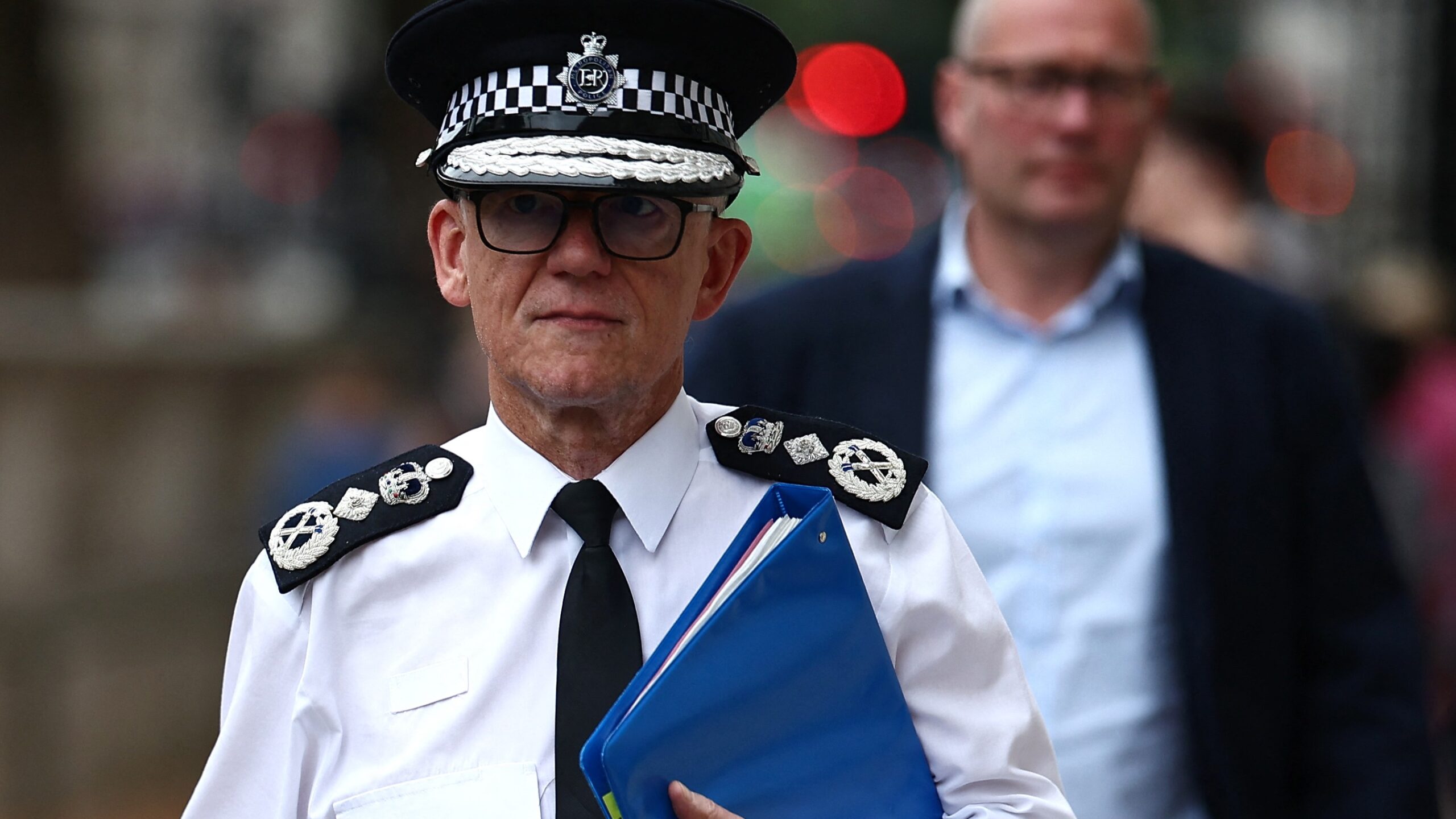
A public dispute has erupted between the organisers of London’s recurring pro-Palestine ceasefire marches and the head of London’s Metropolitan Police, after Commissioner Mark Rowley claimed protest leaders have repeatedly sought to route demonstrations near Jewish synagogues — allegations organisers and prominent Jewish community figures have vehemently rejected as false and inflammatory.
Rowley made the remarks during an interview with *Good Morning Britain* earlier Friday, when he was pressed over how his force is safeguarding London’s Jewish community following a stabbing attack that injured two people in Golders Green, a north London neighbourhood with a large Jewish population. Rowley told reporters he was “really troubled” by what he described as intentional planning to march near synagogues, adding that police had been forced to impose route restrictions every time to block the move. “Even that intent causes me concern that they repeatedly ask to do such things,” he said.
But senior leaders of the UK’s Palestine Solidarity movement immediately pushed back against Rowley’s claims, framing the comments as dishonest and dangerously divisive at a time of already elevated community tension across the UK. Ryvka Bernard, deputy director of the Palestine Solidarity Campaign (PSC), the lead organiser of the central London marches, called Rowley’s intervention reckless, arguing it would only stoke unnecessary fear.
“It’s shocking that Rowley would make such dishonest and reckless comments in a moment when his police force should be focused on protecting vulnerable people,” Bernard said. She emphasized the movement has consistently rejected any effort to conflate the Jewish community with the actions of the Israeli government, adding that “this dangerous misinformation … will only serve to create more fear and anxiety.”
Bernard flatly denied Rowley’s core accusation: “None of our marches or proposed march routes has ever targeted a synagogue or even directly passed one along its route, and the Met Police knows that.” She clarified that the demonstrations are rooted in solidarity with Palestinians facing Israeli military action in Gaza and opposition to the UK government’s support for Israel’s campaign, a mission that will hold for the upcoming 16 March march as well.
Lindsey German, convener of the Stop the War Coalition, another key organising partner for the protests, echoed the denial, calling Rowley’s claims “simply untrue.” “We have never set out with intent to march near a synagogue and we have never intentionally held a demonstration outside or near to one,” German said, noting that organisers intentionally plan routes to keep far away from Jewish places of worship.
She pointed to a high-profile January dispute as evidence of organisers’ willingness to compromise. During that demonstration, police blocked organisers from assembling near the BBC’s London headquarters over the presence of a synagogue several hundred yards away, forcing the group to shift a static gathering to near the UK Parliament and leading to the arrest of senior organisers who attempted to walk to the BBC to lay a wreath for Palestinian children killed in Gaza. German said organisers had already offered multiple adjustments to the timing and route ahead of the event to avoid disrupting worshippers, only to have those compromises rejected.
The latest controversy comes amid growing political pressure on UK police to crack down on large pro-Palestine demonstrations, which have drawn hundreds of thousands of participants since Israel launched its military campaign in Gaza in October 2023. Last week, Jonathan Hall, the UK’s independent reviewer of terrorism legislation, called for a formal “moratorium” on the recurring marches, citing a recent uptick in antisemitic attacks across London tied to demonstrations.
But many prominent Jewish community leaders have pushed back against that narrative, including senior north London Rabbi Herschel Gluck, who explicitly rejected any link between the pro-Palestine marches and the Golders Green stabbing Wednesday. “It is certainly not the marches that caused the tragic stabbing attacks on Wednesday in Golders Gluck,” Gluck told Middle East Eye.
Gluck, who also serves as president of the Shomrim neighbourhood patrol group that serves London’s Jewish communities, noted that a large proportion of regular march participants are Jewish, saying “pro rata, there are more Jews than any other community” taking part in the demonstrations. He added that banning the protests over antisemitism concerns would be counterproductive, noting that restricting free speech runs counter to longstanding Jewish values.
He also argued that police are facing undue political pressure to harden their stance on the marches, accusing politicians from the Labour, Conservative, and Reform UK parties of exploiting concerns over antisemitism to distract voters from pressing domestic issues including sluggish economic growth, the ongoing cost of living crisis, and global instability. “They are just using the situation for their own ends and not really caring for the Jewish community. They are using the conflict to create more conflict,” Gluck said.
Gluck called on political leaders to engage with all segments of the UK Jewish community, including those that speak out against Israel’s military campaign in Gaza. “They’re not marginal, but sadly, certain politicians choose not to listen also to these Jewish voices. And I think that again borders on antisemitism, when they decide not to listen to the concerns, feelings, and strong sentiments of a very large segment of the Jewish community. We need to enable and foster a more peaceful and harmonious atmosphere.”
The ongoing row has raised concerns among protest organisers that Rowley’s comments will erode already fragile trust between demonstration leaders and law enforcement, while amplifying harmful narratives that incorrectly paint all pro-Palestine activism as inherently antisemitic. Despite the public conflict, organisers confirmed the 16 May march will proceed as planned, reaffirming their longstanding commitment to peaceful protest and opposition to all forms of racism.