Across Western diaspora communities, Iranian dissidents who speak out against foreign military intervention in Iran and express solidarity with Palestine are facing an escalating, coordinated campaign of violence and harassment, perpetrated by pro-monarchist Iranian opposition groups with ties to far-right and pro-Israel actors. The pattern of abuse, enabled by inadequate law enforcement responses, has already resulted in a fatal stabbing in Canada and a non-fatal attack in the UK, leaving dozens of activists living in constant fear for their safety.
Arjang Alidai, an Iranian-British engineer based in Greater Manchester, is one of dozens of activists who have been targeted in recent months. Alidai became a marked figure after he participated in the 2024 Iranian presidential election – a vote that many anti-government Iranian exiles boycotted, and which they frame as complicity with the current Islamic Republic government. His activism at anti-war rallies in support of Gaza and against a US-Israeli military strike on Iran has only intensified the abuse. He has received hundreds of grotesque threats, including the chilling line: “We’re going to find you, we’re going to rape you, we’re going to kill you.”
Alidai told Middle East Eye that the intimidation campaign became relentless after large-scale protests erupted inside Iran this past January. Pro-monarchist counter-protesters regularly harass him at public demonstrations, hurling accusations of treason and personal, sexualized abuse. Monarchist-linked social media accounts have published his personal information, forcing him to shut down all his public online profiles. He has even received death threats via phone calls from untraceable international numbers. After reporting the full scope of abuse to Greater Manchester Police, the only guidance officers offered was to close his social media and change his phone number – a response Alidai calls deeply disappointing. “I’ve had to keep looking over my shoulder,” he said.
Alidai’s experience is far from an isolated case. Ghazal Diani, an Iranian tech startup founder and anti-war activist, says she has received online threats to track her down and stab her, wiping her out entirely. At one recent anti-war demonstration, she said a monarchist counter-protestor directly threatened to stab her in person. Many of the insults targeting Diani are explicitly misogynistic, she added, and she no longer dismisses the threats as empty words. “At the beginning you think these are just words and don’t take it seriously, but these things can escalate. I genuinely feel scared,” Diani said. She reported the threats to London’s Metropolitan Police, but was told investigators would only open a case if a violent attack actually occurred.
That “something more serious” Diani and police warned about has already happened. On April 22, Mohammed Reza, an Iranian father of two who was demonstrating against war on Iran outside London’s Downing Street, was stabbed multiple times by an Iranian-origin counter-protestor. Reza, who had previously faced repeated verbal and physical abuse in public, survived the attack, but the incident underscored the lethal danger the harassment campaign has created.
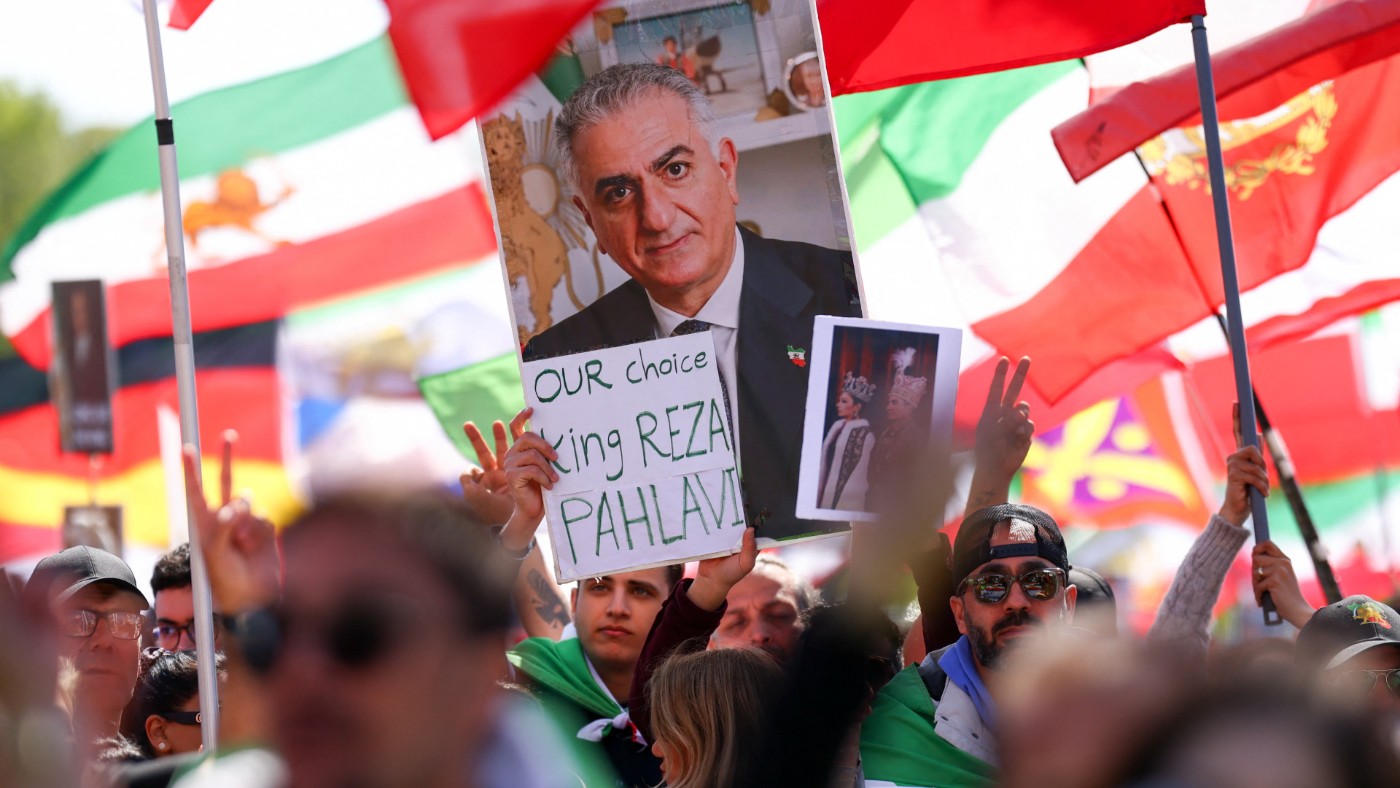
To understand the ideological roots of this violence, experts point to the core ideology of the Iranian monarchist movement, which positions itself as the ideological opposite of the Islamic Republic that ousted the Pahlavi dynasty in the 1979 Islamic Revolution. Monarchists identify as secular nationalist, drawing heavily on imagery and language from Iran’s pre-Islamic history, often referring to themselves as “Children of Cyrus” after the ancient Achaemenid Empire founder. At rallies, they fly the historic lion and sun flag that served as Iran’s national standard under the shah.
The movement is led by Reza Pahlavi, son of the last shah of Iran, whose dynasty built an ideology rooted in de-Islamicization and alignment with Western powers. Reza Shah, who founded the Pahlavi dynasty in 1925, launched a widespread campaign to remold Iranian national identity around pre-Islamic heritage, banning traditional Muslim practices, forcing women to abandon hijabs, and spreading state propaganda that blamed Arab conquests for Iran’s national decline. Reza Zia-Ebrahimi, a reader in the history of nationalism and race at King’s College London, describes this ideology as “dislocative nationalism.”
“It is derived from European colonial ideas and aims to dislodge Iran from its objective reality as a Muslim country in the Middle East, and rather reimagines it as some kind of lost European nation where people who speak Indo-European languages become connected via the Aryan race theory,” Zia-Ebrahimi explained. “It is fundamentally Islamophobic and embraces colonialism and western hegemony.”
This ideological framework explains why many monarchists actively support Western military intervention and sanctions against Iran, and back Israel’s military campaign in Gaza. “It stems from the fact that Palestinians are Arabs, and monarchists view Arabs as responsible for their downfall because they brought Islam to Iran,” Zia-Ebrahimi said.
In recent months, the movement has increasingly targeted Iranian Muslim community spaces across the UK. Clashes have broken out outside the Islamic Centre of England, a London-based Shia institution linked to Tehran, and outside Birmingham’s Imam Reza Cultural Centre, where monarchists gathered for successive nights to hold loud, disruptive counter-protests during a public mourning ceremony following the death of Ayatollah Khamenei in February.
A defining feature of the modern Iranian monarchist movement in diaspora is its formal, institutional alliance with pro-Israel groups and Western far-right actors, whose ideologies reinforce one another. At monarchist rallies, the lion and sun flag is often displayed alongside Israeli flags and British far-right St George’s Cross banners, with protesters chanting openly anti-Muslim slogans. High-profile Western far-right and pro-Zionist figures, including pro-Israel campaigner Mark Birbek, Campaign Against Antisemitism director Gideon Falter, and British far-right activist Tommy Robinson, have all appeared at monarchist events.
Zia-Ebrahimi confirmed that this alliance has become fully formalized and institutionalized, and that the campaign targeting anti-war Iranians is part of a broader coordinated effort. “There has been a lot of Israeli investment in amplifying monarchist messaging on diaspora news channels and on social media, where they create an army of bots that attack, insult and intimidate alternative Iranian voices,” he said.
In recent weeks, footage has emerged of monarchist activists marching through British cities clad in black, flying flags associated with the Savak – the brutal, notorious secret police force of the Pahlavi era that imprisoned and tortured thousands of political dissidents. Zia-Ebrahimi warned that what once seemed like a fringe movement is growing into a far more dangerous threat, emboldened by open backing from mainstream Western political figures. “Before we were dealing with a bunch of clowns, but now it is turning into something far more dangerous,” he said.
The lethal potential of this rising extremism was demonstrated earlier this year in Canada, where Masood Masjoodi, an Iranian-Canadian university professor and public critic of both the Islamic Republic and Reza Pahlavi, was murdered. Two individuals with known ties to the monarchist movement, who had previously targeted Masjoodi with harassment, have been charged with his killing. Samira Mohyeddin, an Iranian-Canadian journalist and founder of On The Line Media, said Masjoodi repeatedly warned authorities he was under threat for months before his death – a failure that underscores how seriously the movement is being overlooked.
“There are a lot of us being threatened on a daily basis, and unfortunately our police don’t do anything until something happens to someone,” Mohyeddin said. She added that community organizers have heard rumors of monarchist groups drawing up target lists of people they deem acceptable to attack. Mohyeddin warned that without urgent intervention to rein in the movement, violence will only escalate. She drew a parallel between the group’s authoritarian rhetoric and 20th-century fascist movements, noting that chants of “One flag, one leader one country” mirror slogans used by the Nazi regime.
“Going down this path has nothing to do with liberty, justice, freedom, equality – we’re heading towards another kind of fascism that is very dangerous, and I think we’ll see a very hardcore group of people escalate even further,” she said.