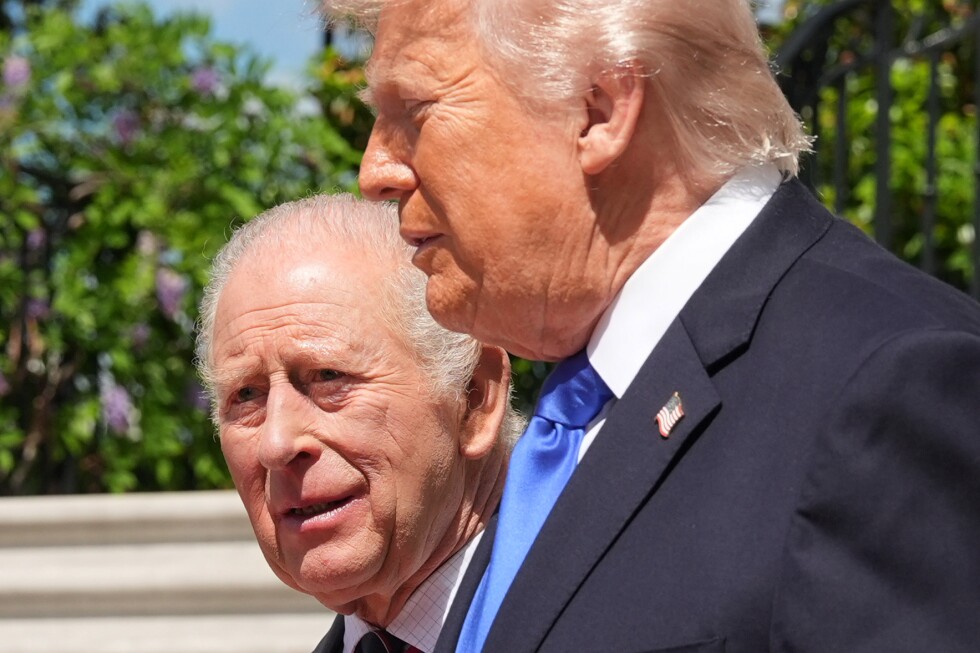
LONDON — Following King Charles III’s high-stakes four-day state visit to the United States this week, former U.S. President Donald Trump has heaped praise on the British monarch, announcing a rollback of select tariffs on Scotch whisky as a goodwill gesture tied to the royal tour. The trip, which brought the King and Queen Camilla to Washington D.C., New York and Virginia, was crafted as a carefully calibrated diplomatic mission to patch growing rifts between the Trump administration and the U.K. government, timed to coincide with the 250th anniversary of U.S. independence.
Against a backdrop of deep trans-Atlantic divisions over Washington’s push for military action against Iran — divisions that have left U.S. relations with Prime Minister Keir Starmer’s government severely strained — the King delivered a performance widely hailed as a masterclass in quiet diplomacy. He balanced warm overtures to his U.S. host with carefully measured, implicit criticism of Trump’s policy priorities, leaving experts debating whether the visit can deliver long-term improvement to an alliance already frayed by policy disagreements.
Kristofer Allerfeldt, an American history professor at the University of Exeter, assessed that while the trip was unlikely to resolve long-running trans-Atlantic tensions in the long run, it had successfully reaffirmed the British monarchy’s standing at home. “He’s done us proud,” Allerfeldt noted, crediting the King’s confident performance for restoring much of the institution’s prestige.
The mission unfolded against significant political friction even before the King arrived in the U.S. Trump has repeatedly lambasted Starmer, whom he once praised, for refusing to join U.S. military strikes on Iran, dismissing the British prime minister as unfit to bear the legacy of Winston Churchill — the World War II leader who coined the phrase “special relationship” to describe the U.K.-U.S. bond. This criticism is part of a broader rift between Trump and NATO allies, whom he has publicly labeled “cowards” and “useless” for declining to join the Iran campaign. That tension, however, has not eroded Trump’s long-standing admiration for the British monarchy, a sentiment he says was deepened during his unprecedented second state visit to the U.K. last September.
Some British opposition lawmakers had even called for the reciprocal U.S. visit to be canceled entirely, warning that unpredictable statements or actions from Trump could leave the monarch in an awkward, embarrassing position. In the end, though, the four-day tour was marked by widespread warmth and very few awkward moments — with one notable exception: Trump broke with long-standing convention that private conversations with the monarch remain confidential, sharing unprompted remarks attributed to Charles during a white-tie state dinner at the White House.
In those public remarks Tuesday, Trump claimed Charles “agrees with me, even more than I do” that Iran must never be permitted to acquire nuclear weapons, and added that “if that were up to him,” the King “would have followed the suggestions we made with respect to Ukraine.” Buckingham Palace responded calmly to the disclosure, noting only that “the king is naturally mindful of his government’s longstanding and well-known position on the prevention of nuclear proliferation.”
Publicly, the King left no ambiguity about his policy priorities — and the differences between his position and that of the Trump administration. In the centerpiece address of his visit, a speech to a joint session of the U.S. Congress, Charles stressed the need for “unyielding resolve” in supporting Ukraine’s defense against Russian invasion, a sharp implicit rebuke of Trump’s “America First” agenda that has cast doubt on long-term U.S. support for Kyiv. The speech was packed with subtle, regal pushback on Trump administration priorities: the King reaffirmed the indispensable role of NATO, emphasized the critical value of checks on executive power, highlighted the urgent threat of climate change, and celebrated the strength of “vibrant, diverse and free societies.” He also referenced his own service in the Royal Navy, a branch of the British military that Trump has previously disparaged.
Historian Anthony Seldon told *The Guardian* that the King could not have struck a better balance in his remarks. “It’s difficult to imagine he could have gone much further in what he said and what he didn’t say,” Seldon said. “He judged it incredibly well: very brave, very smart, very clever.”
Allerfeldt pointed to the unusual cross-partisan reception the speech received, with multiple standing ovations from both Democratic and Republican lawmakers. “Apart from the section on the natural world and the environment, both Republicans and Democrats stood up and applauded,” he noted. In a lighter moment at the White House state dinner, the King even won laughs from the crowd with a self-deprecating joke about British troops burning down the White House during the 1812 war.
Organizers judged the trip a notable success even with the lingering shadow of Prince Andrew, the King’s younger brother who has been stripped of his royal titles, exiled from public royal life, and is currently under investigation over his long-standing ties to disgraced convicted sex offender Jeffrey Epstein. Andrew has repeatedly denied any wrongdoing connected to Epstein’s crimes. Victims of Epstein had publicly called on the King to meet with them during the visit; while the King did not hold a formal meeting, he referenced their experience indirectly in his congressional speech, noting the need to “support victims of some of the ills that, so tragically, exist in both our societies today.” Andrew Lownie, author of the Andrew biography *Entitled*, called the address “the best defense of the monarchy in years.”
Shortly after the royal couple departed the U.S. to return to the U.K., Trump made the surprise announcement that he would lift select tariffs on imported Scotch whisky, framing the move as a tribute “in honor of the King and Queen of the United Kingdom.” Buckingham Palace welcomed the decision, saying in a statement that the King “sends his sincere gratitude for a decision that will make an important difference to the British whisky industry and the livelihoods it supports.”
Trump doubled down on his praise for the monarch in an interview with Sky News after the visit, calling Charles “a phenomenal representative” for the United Kingdom, before returning to his familiar criticism of Starmer. “Your prime minister has to learn to deal the way he deals, and he’ll do a lot better,” Trump told the outlet.