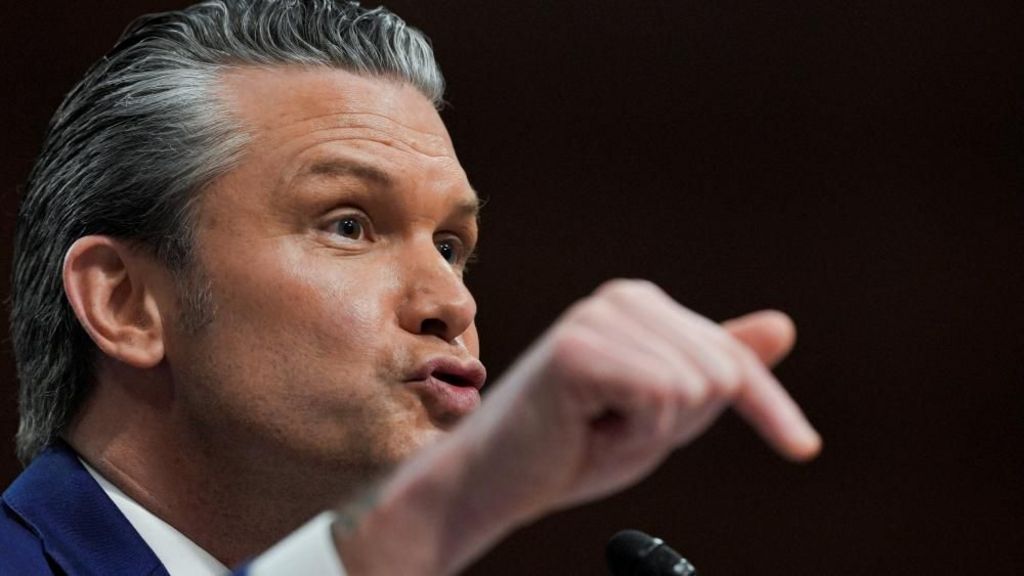
A high-stakes legal and political battle has erupted in Washington over the Trump administration’s interpretation of long-standing war powers law, after US Defence Secretary Pete Hegseth claimed the 60-day congressional approval deadline for US military involvement in the US-Israeli conflict with Iran has been paused amid an ongoing ceasefire.
Hegseth made the argument Thursday during a Senate questioning session, just one day ahead of the 60-day mark, which falls Friday. The clock began ticking March 2, when President Donald Trump formally notified Congress of the strikes against Iran that launched the open conflict. Under the 1973 War Powers Resolution — a law passed to rein in executive war authority after the Vietnam War — any president must end US military involvement within 60 days of formal notification unless Congress explicitly approves an extension or formally declares war.
Top Trump administration officials have pushed back against suggestions the deadline will be breached, asserting that active hostilities against Iran have already ended. A senior anonymous administration official confirmed that no exchanges of fire between US and Iranian forces have occurred since April 7, after a ceasefire took effect in early April that has since been extended. Per the administration’s position, the existing ceasefire means the 60-day clock mandated by the War Powers Resolution is either paused or stopped entirely. Hegseth doubled down on this reading during Thursday’s hearing, telling senators “We are in a ceasefire right now, which our understanding means the 60-day clock pauses or stops in a ceasefire.”
That interpretation has been rejected out of hand by Democratic Senator Tim Kaine, who led the questioning on the issue. Kaine pushed back immediately, arguing “I do not believe the statute would support that. I think the 60 days runs maybe tomorrow, and it’s going to pose a really important legal question for the administration there.”
The conflict itself began in late February, when US and Israeli forces launched wide-ranging strikes on Iran that killed the country’s supreme leader. Iran responded with coordinated attacks on Israel and US-aligned Gulf states, raising tensions across the entire Middle East. The US and Israel have justified their military action by claiming Iran is actively pursuing a nuclear weapons capability — a charge Tehran has repeatedly and forcefully denied. Even after more than a month of ceasefire, no permanent peace deal has been reached through ongoing talks, and the strategic Strait of Hormuz, one of the world’s most critical energy shipping chokepoints, remains effectively closed, sending ripples of economic disruption through global energy markets that have pushed up fuel prices for consumers around the world, including in the United States.
CBS News, the US partner of the BBC, has reported that White House and Pentagon officials are already holding active discussions with congressional members from both parties to secure formal authorization for continued military involvement. To date, every Democratic-led attempt in both the House and Senate to constrain Trump’s military action against Iran has failed, thanks to unified Republican opposition in most cases. Democratic lawmakers have vowed to continue pushing for votes and procedural actions, saying their efforts force lawmakers to put their positions on the record for constituents. While most Republican lawmakers have stood with the administration so far, some have signaled they may reconsider their stances once the 60-day deadline passes.
The debate over the War Powers Resolution deadline comes one day after Hegseth faced sharp questioning during a House hearing on the conflict, where a top Pentagon official disclosed that US military operations in Iran have already cost taxpayers $25 billion, equivalent to roughly £18.5 billion. During that House hearing, many Republican committee members reiterated their support for the administration’s campaign. Florida Congressman Carlos Gimenez argued that Iran poses an existential threat to the US, saying “When someone tells me for 47 years that they want to kill us, I think I am going to take them at their word. I support our efforts to make sure that Iran never has a nuclear weapon.”
US media have so far published conflicting reports about what options the Trump administration is currently weighing if Congress refuses to grant an extension, leaving the ultimate path forward for US military involvement in the region uncertain.