Nestled across 30,000 acres of sun-drenched central Florida, spanning three counties and four zip codes, the Villages is widely known as the world’s largest retirement community. Often nicknamed “Disney without the rollercoasters,” this meticulously landscaped, age-restricted haven for adults over 55 draws transplants from across the country with its endless recreational opportunities, vibrant social scene, and leisurely resort-style lifestyle.
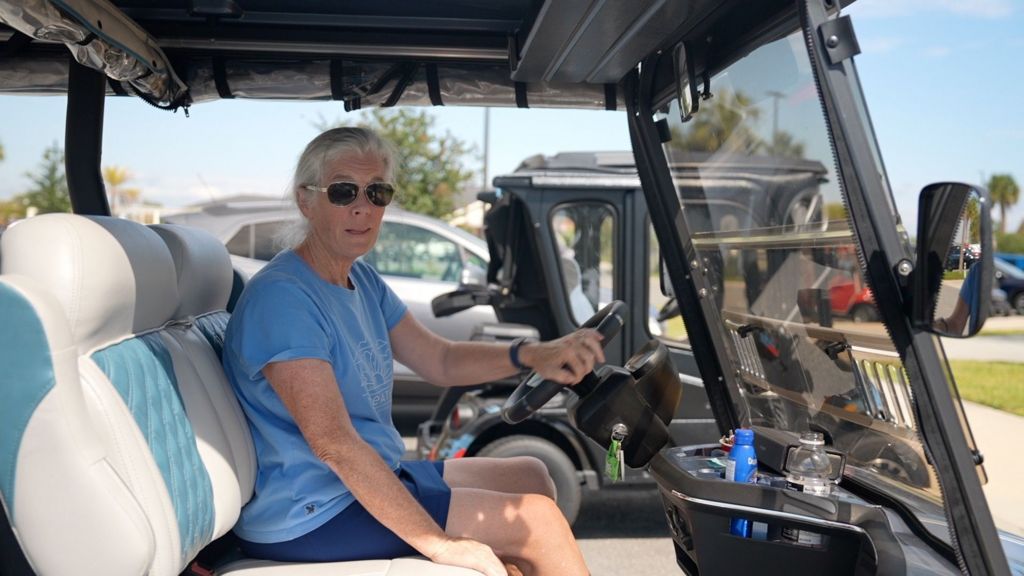
Residents themselves gush about the community’s one-of-a-kind appeal. “It’s like being at a resort on a full-time basis,” says 79-year-old Betty Brock, who relocated from North Carolina. “If you get bored here, it’s not the Villages’ fault—it’s yours.” Sixty-two-year-old Terri Emery puts it even more simply: “The bottom line is, it’s kind of like utopia.” On any given day, residents can be found dancing to live cover music at one of the community’s five public squares, cruising the sprawling network of paths in colorful, customized golf carts—the neighborhood’s preferred mode of transport—or gathering for meals at local restaurants. “You move here to be young; you don’t move here to die and become old,” Emery explains.
But even this seemingly perfect retirement paradise is not immune to the deep political divides roiling the United States. Following Donald Trump’s return to the presidency last year, political tensions have simmered across the community, and the former president-turned-commander-in-chief’s upcoming rally speech this Friday, part of his midterm election push to promote his economic policies to voters, has thrown those rifts into sharp relief.
While Trump’s supporters in the Villages have scrambled to secure tickets and celebrate the presidential visit, local Democrats and Trump critics have organized counter-protests. What unites both sides, however, is a widespread unwritten agreement: discussing politics across party lines is best avoided.
“Everybody does still try to get along,” says 63-year-old Maddy Bacher, a Democrat who moved to the Villages from Connecticut. “You want to at least be able to say good morning and how are you and how’s the dog. But… I find you don’t socialize as much, and it’s kind of difficult, because everything you do move to talk about might have a political consequence.” Brock echoes that sentiment, noting that while politics occasionally comes up in casual conversation, “not as much as you think, because you don’t ever know where that line is.”
Political friction during the COVID-19 pandemic pushed divisions to a breaking point for many residents, prompting Bacher to launch a Democratic-only pickleball team. Her husband followed suit, starting a separate golf group for liberal residents after many reported feeling uncomfortable with the right-leaning views common on the community’s public greens. The Villages is home to more than 3,000 niche hobby clubs catering to every interest from female fly fishing to parrot ownership, and Bacher recalls one member quitting a local clay arts club entirely over clashing views on COVID-19 booster shots.
Long a reliable Republican stronghold that backed Trump in all three of his presidential campaigns, the Villages has seen a surge in Democratic organizing in recent years. Last month, nearly 7,000 local residents turned out for two simultaneous “No Kings” protests against Trump—a turnout that stunned even long-time liberal activists. “Nothing turns out Democrats like Trump,” says Bill Knudson, president of the Villages Democratic Club, who moved to the community with his wife four years ago. Knudson says he was “kinda stunned” at how many new members showed up to a club meeting held just weeks after Trump’s inauguration, with many going out of their way to seek out the group to get involved.
As of this week, Knudson and other Democratic organizers have been busy crafting protest signs and finalizing plans for Friday’s demonstration. Traffic gridlock and safety concerns have kept some partisans on both sides at home: the community is so large that Knudson says it would take him an hour of driving 20 miles per hour in his golf cart just to reach the rally site.
Even with the rising tensions, many cross-party friendships persist. Retired lawyer Dorothy Duncan, a Democrat who participated in the “No Kings” protest and is preparing to join this week’s demonstration, still meets regularly for coffee with staunch Trump supporter Tom Samson. The 81-year-old Pittsburgh native and retired pest control business owner says what draws him to Trump is his unfiltered style: “He doesn’t have a filter and says whatever’s on his mind, and he’s not a politician.”
Duncan and Samson’s friendly, civil cross-aisle chat is far from the norm, residents agree. Bob Carberry, who moved to the Villages 14 years ago, recalls the community was once almost entirely apolitical—until Trump entered national politics. “The emotional level of politics is something that’s emerged probably more so in the last five years with Trump,” he says.
For Trump’s backers, Friday’s rally is the most anticipated community event of the year. “He’s a man that does do what he says he’s going to do, and he may not be diplomatic, and he may not be charming, may not be politically correct, but he’s doing what every president before him has promised to do when they’re out there campaigning but have never done,” says Sharlene, a supporter who declined to share her last name. Though she will miss the speech due to work, local Republicans have organized watch parties and are discussing golf cart parades for shut-out supporters.
Seventy-nine-year-old Phil Montalvo, a retired lawyer who launched a second Republican club in the Villages three years ago to cut down on commute times for conservatives on opposite ends of the sprawling community, says nearly all local GOP members are “jazzed” for Trump’s visit. Montalvo notes that Trump’s “America First” message has resonated deeply with the Villages’ conservative majority, with Trump serving as a unifying figure for local Republicans. Citing voter registration numbers from Sumter County—one of the three counties that host the Villages—Montalvo points out that out of all registered voters, there are just 23,000 Democrats compared to 77,000 Republicans. While he acknowledges that Democratic visibility has grown, he says conservatives are not intimidated: “It’s great that they express themselves. We think they have the wrong message, but that’s their prerogative.”
Some Trump supporters are less welcoming of opposing views. Emery, who has secured a ticket to Friday’s rally, calls the anti-Trump protests “absolutely disgusting,” going so far as to label protesters communists. “The only king is the Lord. Trump is not a king. He’s our president, and if you like him or not, he’s still your president at the end of the day.” She recounts a recent story of a local Trump supporter who called police after a neighbor took down his pro-Trump flag—one of dozens of small, bitter conflicts that have become more common since 2016, when Trump was first elected.
Democratic golfer Thomas Bacher says that even casual neighborhood traditions have fallen victim to polarization. “We’d have a block party and things like that, and then… some of the people started putting up Trump flags. And that just caused a big rift. We didn’t have block parties anymore. People wouldn’t talk to each other anymore.”
Longtime resident Roy Irwin, who moved to the Villages in 2012, says the community has become a perfect microcosm of the entire country’s political divide. “I try to talk gently with everybody, no matter what their belief—respect their opinion,” he says. “It’s just like anywhere else—there’s people feeling very strongly on both sides.”
Not all residents fit neatly into one political camp, though these ideologically flexible voters are rare. Seventy-seven-year-old lawyer Edward Hannan, who describes himself as “not fixated ideologically,” says he will skip Friday’s rally mostly to avoid hours of waiting and strict security screenings. Hannan says he disagrees with Trump on many issues but admires his organizational skill, a trait he says has been lacking in many previous U.S. presidents—though he criticizes Trump’s aggressive style. “You should not denigrate people who disagree with you; you should reason with them,” he says. Hannan laments that open political dialogue has all but disappeared in the Villages, with most residents either avoiding politics entirely or only discussing it with like-minded friends. “So that’s a negative, because getting diverse ideas in a small group is difficult.” When asked if his moderate views make him an anomaly in the community, he answers immediately: “Yes.”
Home to more than 150,000 residents over the age of 55, the Villages’ growing political rifts offer a clear window into how national partisan divides are reshaping even the most insulated, leisure-focused American communities.