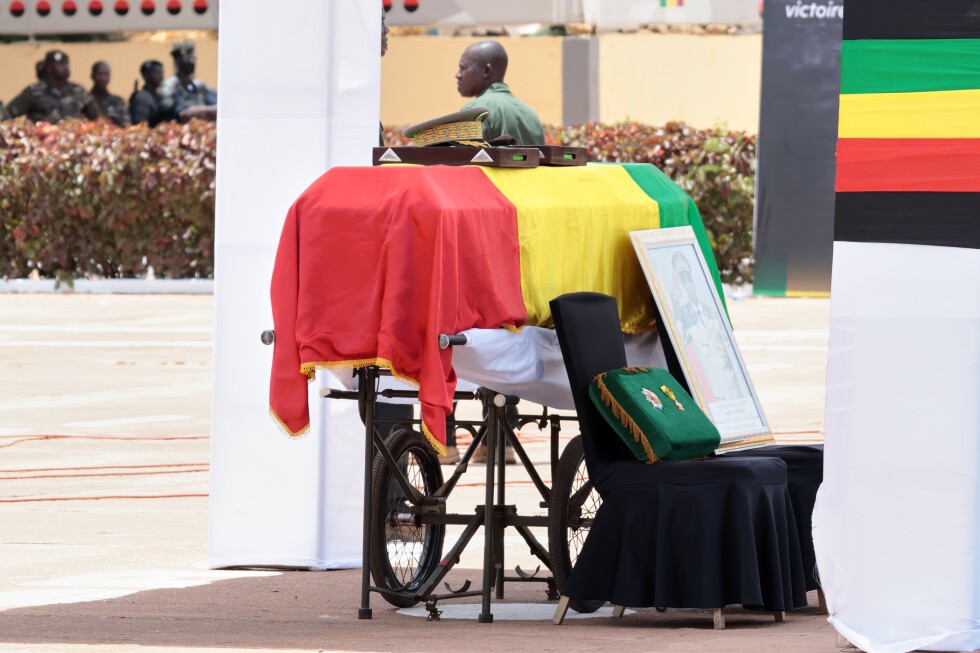
DAKAR, Senegal — On Thursday, thousands gathered to honor the life of former Malian Defense Minister General Sadio Camara, the central architect of Mali’s ruling military junta’s controversial security partnership with Russia, just one week after he was killed in the largest coordinated militant assault the West African nation has seen in more than 10 years. Camara’s unexpected death, which comes on the heels of a string of major military setbacks for Malian government forces and their Russian mercenary allies, has sparked new analysis of potential internal rifts within the junta and raised widespread questions about the future of the country’s close alignment with Moscow.
Following two days of official national mourning declared by the junta, the funeral ceremony was led by junta leader General Assimi Goita and aired live across Malian national television to allow citizens across the country to pay their respects. Camara’s casket was wrapped in the national flag of Mali — its iconic green, yellow, and red stripes on full display — while large, formal portraits of the late general lined the walls of the ceremony venue for attendees to view.
Born in 1979 in Kati, a garrison town located just outside Mali’s capital Bamako, Camara died in the same community Saturday when a militant car bomb detonated outside his personal residence. His military career began decades earlier: in the late 2000s, he served as a field officer deployed to northern Mali, where rising insurgent activity led by armed factions with ties to Al-Qaeda had plunged the region into instability. After graduating from Mali’s national military academy, Camara traveled abroad for advanced military training, including a posting at a prestigious Russian military academy — a formative experience that would shape the trajectory of his later political career.
Mali’s general public first gained widespread recognition of Camara in August 2020, when he appeared as a colonel on national television alongside four other senior military officers who had just successfully overthrown democratically elected President Ibrahim Boubacar Keita. The group of coup leaders accused Keita of being overly reliant on French political backing and failing to address the growing wave of militant attacks that had devastated large swathes of the country. They campaigned on a promise to restore national security and stability, a pledge that resonated with many Malians frustrated by years of unaddressed insurgency.
In the wake of the 2020 coup, the new military government quickly pivoted away from Mali’s long-standing Western security partnerships, turning toward Russia as its primary alternative security ally, and moving to expel French counterterrorism troops and United Nations peacekeeping forces from the country. Camara emerged almost immediately as the most central figure in forging this new relationship, serving as defense minister in both of Mali’s successive military governments — first after the 2020 coup, and then being reappointed to the role following a second coup in May 2021 that brought Goita to full executive power.
Ulf Laessing, head of the Sahel program at the Germany-based Konrad Adenauer Foundation, described Camara as the undisputed “architect of cooperation with Russia.” According to Laessing, it was Camara who first proposed the 2021 deployment of Russian mercenary forces to Mali and pushed for the expulsion of the U.N. peacekeeping mission MINUSMA, a long-standing international presence in the country. Frequent trips to Moscow to meet with Russian defense officials solidified his role as the main bridge between the Malian junta and the Kremlin, and even as the country’s security situation deteriorated steadily under his tenure, Camara remained an irreplaceable leader for the ruling military faction, Laessing noted.
Recent weeks have brought major new setbacks for the Russian-Malian alliance. Just days before Camara’s assassination, the newly formed Russian Africa Corps — a regular Russian military unit that answers directly to Moscow’s defense ministry, estimated to have roughly 2,000 troops deployed across Mali — announced it had withdrawn its forces from the key northern city of Kidal. The withdrawal came just two days after separatist insurgent groups declared they had seized full control of the strategic city.
Rida Lyammouri, a senior fellow at the Morocco-based Policy Center for the New South, argues that Camara’s death, combined with growing frustration among both ordinary Malians and senior military leaders over the failure of Russian forces to curb the ongoing insurgency, could push the junta to open a formal review of its partnership with Moscow. Even before Camara’s killing, discontent over Russian strategy had been quietly building within military circles, Lyammouri said.
Adding to speculation about a potential policy shift, Laessing noted that Goita met with Russia’s ambassador to Mali on Tuesday this week, but has also signaled he is “open to collaboration with some Western countries, such as the United States” going forward. For now, the future of Mali’s security alliances remains uncertain, as the junta navigates the loss of its most prominent pro-Russia leader and growing pressure to reverse years of deteriorating security.