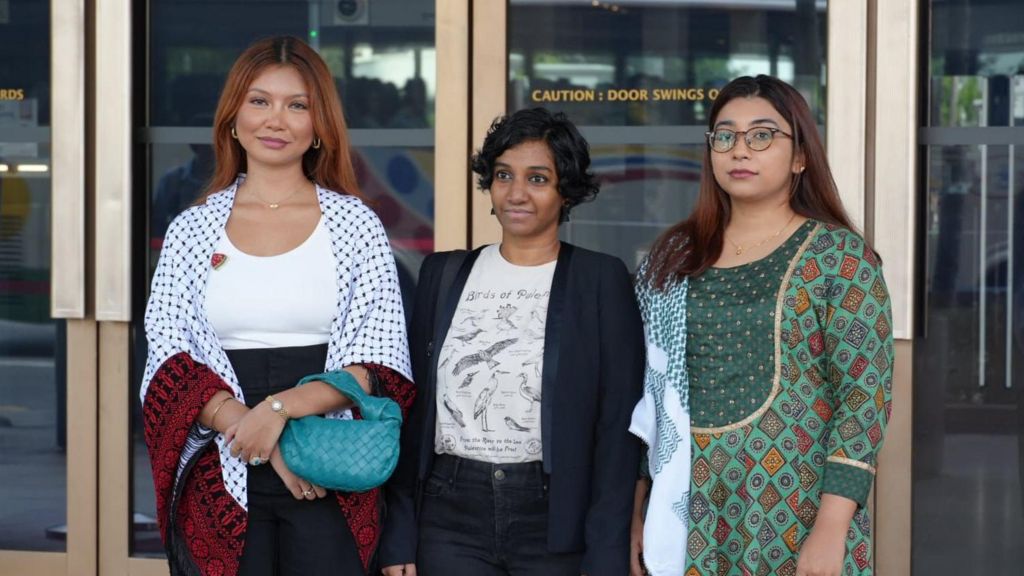
In a high-profile legal reversal that spotlights longstanding tensions between protest regulation and freedom of expression in Singapore, the city-state’s High Court has overturned a previous acquittal and imposed fines of S$3,000 (equivalent to roughly US$2,300 or £1,700) on three women activists who organized a public march in support of Palestinian people. The case traces back to February 2024, when activists Mossammad Sobikun Nahar, Siti Amirah Mohamed Asrori, and Kokila Annamalai led a group of approximately 70 participants on a walk from a nearby shopping mall to Singapore’s Istana presidential compound, located adjacent to the mall. The march was organized to deliver a petition letter to the prime minister calling for the Singaporean government to sever diplomatic and economic ties with Israel, amid the ongoing military conflict in Gaza.
Photographs from the event show demonstrators holding umbrellas emblazoned with watermelons, a symbol that has become a globally recognized motif for pro-Palestinian advocacy. Singapore maintains extremely strict regulations on public assemblies, and all public demonstrations require government approval. In the wake of the outbreak of the Israel-Gaza war, authorities have enacted a blanket ban on all public gatherings related to the conflict, making any unapproved pro-Palestinian protest a criminal offense.
The three organizers were formally charged in June 2024 for violating regulations by organizing an unpermitted procession in a restricted zone near the Istana. During their initial trial held in late 2024, the defense team argued that the women had merely walked along public roadways, and had no prior knowledge that the stretch of route passing the presidential compound fell within a prohibited area for unapproved gatherings. The trial judge ultimately ruled to acquit all three defendants in October 2024, concluding that evidence presented in court proved the women had made good-faith efforts to comply with Singapore’s laws, and were “trying their level best not to run afoul of the law.” Following the acquittal, Annamalai told the BBC that the ruling had given “a new sense of energy and hope” to Singaporean civil rights activists.
Prosecutors challenged the acquittal in an appeal to Singapore’s High Court, which issued its final ruling Thursday. The High Court judge rejected the original acquittal, stating that the three activists bore responsibility for failing to conduct more thorough inquiries to confirm whether their planned procession would be legally permitted under local regulations. After the ruling was issued, Annamalai reaffirmed the activists’ commitment to their cause in comments to the BBC, noting “There is a long fight ahead towards democratisation in Singapore, and acts of civil disobedience have an important part to play. We should have every right to walk to the Prime Minister’s Office at the Istana to deliver letters from ordinary Singaporeans.”
The Singaporean government has long defended its strict demonstration regulations as a necessary policy to preserve public peace, social stability, and intercommunal harmony across the country’s multi-ethnic population. However, civil society and human rights critics argue that these sweeping regulations effectively stifle freedom of expression and discourage grassroots civil activism, particularly on contentious geopolitical issues such as the Israel-Gaza conflict.