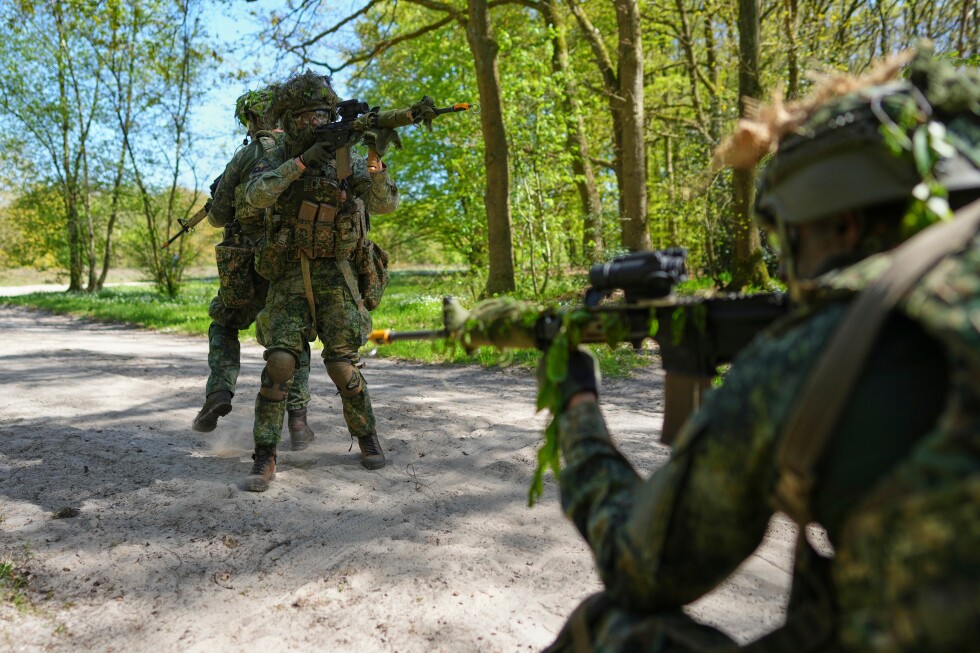
Deep in a forested training ground in eastern Netherlands, a company of Dutch reserve infantrymen slip silently between tree trunks, their faces streaked with camouflage paint and Colt C7 rifles held ready. Sweeping their surroundings for simulated hostile threats, the weekend exercise is far more than routine training: it is part of a sweeping national push to expand the Netherlands’ armed forces, one that mirrors a continent-wide military build-up reshaping European defense policy amid growing geopolitical tension.
The Dutch government and military leadership have set an ambitious target to grow active and reserve personnel from 80,000 today to 120,000 by 2035, a plan that has earned cross-party political backing across the political spectrum. The expansion of reserve forces is a core pillar of this strategy, and the initiative has gotten an unexpected boost from the country’s royal household: Queen Máxima and her eldest daughter, Princess Amalia, the heir to the Dutch throne, have enlisted as volunteer reservists. Images of Máxima training at a shooting range have circulated globally, creating what Dutch defense officials have dubbed the “Amalia effect,” a surge in public interest that has left recruiters grappling with a welcome but unprecedented challenge.
Dutch Defense State Secretary Derk Boswijk confirmed the phenomenon in an interview with the Associated Press. “It’s really a thing, yes. It’s very inspiring to see how members of our royal family inspired people to join our armed forces,” he said. Currently, the Netherlands counts roughly 9,000 active reservists, with a target of at least 20,000 by 2030. Today, “We have more applications than we can handle,” Boswijk noted, adding that the military is now working overtime to address bottlenecks: limited training capacity, insufficient housing for new recruits, and backlogs in issuing essential gear from uniforms to firearms. Even so, Boswijk calls it a “luxury problem” for a force that long struggled with low public engagement.
The Dutch recruitment push is not an isolated effort. Across Europe, nations are expanding and modernizing their militaries in response to two defining shifts in global security: the ongoing grinding war in Ukraine launched by Russia, and growing uncertainty over the long-term commitment of the United States to the NATO alliance, the foundation of European collective defense since the end of World War II. European Union and NATO officials have warned that Russian President Vladimir Putin could be prepared to launch an attack on another European nation within three to five years if he secures victory in Ukraine, prompting NATO to update its defense plans to require allies to prepare for large-scale conventional conflict, with a focus on agile, rapidly deployable forces.
Many European nations are adjusting their recruitment models to meet new force requirements. Germany is considering a proposal to improve pay, training, and service flexibility for short-term recruits, avoiding a full revival of conscription suspended in 2011 but leaving the door open to limited compulsory service if voluntary enlistment falls short. France, like the Netherlands, is leaning into voluntary expansion: a new program launching in September will recruit 3,000 18 to 25-year-olds for 10-month uniformed service across metropolitan and overseas France, with a target of 50,000 new volunteers annually by 2035.
In northern and eastern Europe, where the threat of Russian aggression is felt most acutely, many nations have retained or reintroduced conscription. Finland requires all male citizens to complete military service while allowing voluntary service for women. Sweden reinstated gender-neutral partial military service in 2017, holding a lottery to fill remaining slots if voluntary enlistment is insufficient. Denmark uses a similar system, and Latvia revived its draft in 2023 in direct response to Russia’s full-scale invasion of Ukraine.
The Netherlands has never formally abolished conscription, but call-ups have been suspended since 1997, and the government has no plans to revive the policy. Instead, defense officials are working to make military service attractive to a far broader cross-section of Dutch society, recognizing that modern threats extend far beyond traditional battlefields into cyberspace and digital infrastructure. “We need all kind of skills, to keep our society, our country, our allies safe,” Boswijk said. “So, yes, we need also people wearing hoodies, having blue hair, who can game perfectly.”
For many new Dutch recruits, shifting global insecurity and lessons from national history are key motivations. Lisette den Heijer, a prospective reservist, recalled the lessons she learned in primary school about the 1940 Nazi invasion of the Netherlands, which saw the country conquered in just five days. “I don’t want history to repeat itself,” she said at a recent information session for new volunteers. A private first class in the 10th Infantry Battalion, who spoke anonymously due to his civilian work in the defense sector, noted a clear shift in training priorities over the last half-decade. “So where we were just focused on peaceful operations in 2018, we’re now more focusing on protecting vital infrastructure,” he said, pointing to his recent deployment as part of the massive security operation for the 2024 NATO summit in The Hague.
A female corporal in the reserve battalion, who also spoke on condition of anonymity, echoed that observation. “When I first joined, there was almost no risk or almost no threat … and now it’s changing so we are more aware of it,” she said. That shift has pushed a change in mindset toward “more what we call ‘green things,’ infantry things,” she added, “We are here to defend our country and to make sure to keep the threat down.”
Under current Dutch rules, reserve personnel commit just 300 hours of service annually, mostly through regular weekend training exercises. Traditionally, reservists are tasked with securing domestic critical infrastructure, supporting national emergency responses such as flood control sandbag operations, and are not deployed to overseas combat missions. On the recent weekend exercise in the eastern Netherlands, the reserve unit’s mission wrapped up successfully after the team rooted out a hidden simulated enemy combatant from a camouflaged foxhole. Exchanging high-fives after the exercise, the reservists broke down their camp and prepared to return to their civilian lives, ready to answer the call if their country needs them.