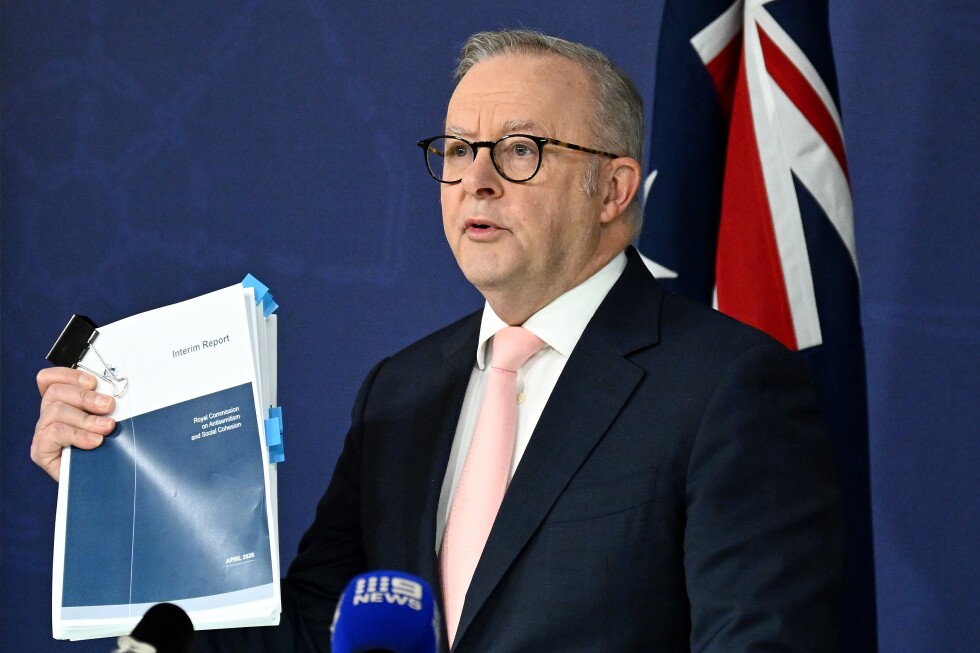
Canberra, Australia – Six months after a terror attack at a Hanukkah celebration on Sydney’s Bondi Beach left 15 people dead, a landmark government inquiry into surging antisemitism across Australia has tabled its first interim report, calling for immediate national action on tighter firearms regulation to prevent similar atrocities.
The deadly December 14, 2025, attack was carried out by father and son pair Sajid and Naveed Akram, who used firearms legally registered to Sajid, an Indian-born Australian permanent resident. Authorities have confirmed the assault was inspired by the Islamic State group. Sajid was killed by responding police at the scene, while his son survived his injuries and faces charges including 15 counts of murder, 40 counts of attempted murder, and terrorism-related offenses. Naveed has not entered any pleas to the accusations.
In response to the attack, the federal government convened the Royal Commission on Antisemitism and Social Cohesion to investigate the rising trend of anti-Jewish hate crimes and develop policy responses. On Thursday, Royal Commissioner Virginia Bell released 14 formal recommendations in the commission’s first interim update, with five of those proposals remaining classified and undisclosed to the public for national security reasons.
The report explicitly highlights a dramatic spike in antisemitic incidents across Australia dating back to the outbreak of the Israel-Hamas war on October 7, 2023. It further warns that the U.S.-Israeli military strikes on Iran in February 2025 amplified existing security risks for Australian Jewish communities, raising the likelihood of targeted attacks against Jewish people and sites.
Central to the commission’s unclassified recommendations is a push for sweeping nationwide gun reform. Key proposals include implementing nationally uniform firearms regulations, launching a federally coordinated gun buyback program, restricting non-citizen permanent residents from holding gun licenses, capping individual gun ownership at a maximum of four weapons, and introducing periodic mandatory reviews of all active gun licenses. The federal government has proposed splitting the cost of the gun buyback initiative with Australia’s six states and two territories, though some state governments have already rejected contributing to the program’s funding.
The current proposed restrictions on gun ownership for non-citizens would have blocked Sajid Akram from legally purchasing or holding firearms prior to the attack, a fact that has underscored the urgency of the commission’s recommendations for national policymakers.
Addressing reporters following the report’s release, Prime Minister Anthony Albanese announced that his federal government had committed to adopting all recommendations that fall under federal jurisdiction, and would work collaboratively with state and territorial leaders to advance the full package of reforms. Albanese tied the proposed changes to the 30th anniversary of the 1996 Port Arthur massacre, a mass shooting that killed 35 people and led to one of the world’s strictest national firearms agreements, which effectively banned rapid-fire rifles across the country.
“Thirty years after that landmark reform, our nation is measurably safer because of the hard choices we made then,” Albanese said. “This new reform is equally necessary, and I will continue to engage constructively with state and territory leaders to deliver it.”
Albanese emphasized that while the inquiry confirms risks to Australian Jewish communities have grown, it found no urgent overhauls to existing security frameworks are required to maintain public safety. He noted that rising antisemitism is not unique to Australia, but a global trend that demands coordinated government action. To that end, the federal government has already allocated AU$102 million (equivalent to roughly US$73 million) to upgrade security infrastructure at Jewish community sites, including synagogues, schools and community centers. These funds are administered by the Executive Council of Australian Jewry, the peak representative body for Australian Jewish communities.
Alex Ryvchin, co-chief executive of the council, described the inquiry’s interim report as a critical milestone in addressing the widespread trauma the Bondi Beach attack left in the Australian Jewish community. “Our community carries deep trauma, and there are still many unanswered questions about what happened,” Ryvchin told the Australian Broadcasting Corporation. “This is an important first step toward the day when Jewish Australians can gather for Hanukkah, for any community event, and feel safe, knowing they will not be targeted. That is the goal we are working toward, and it will take time to get there.”
Full public hearings for the royal commission are scheduled to open next Monday, as the inquiry continues its work examining the root causes of rising antisemitism and developing long-term policy recommendations for social cohesion and community safety.