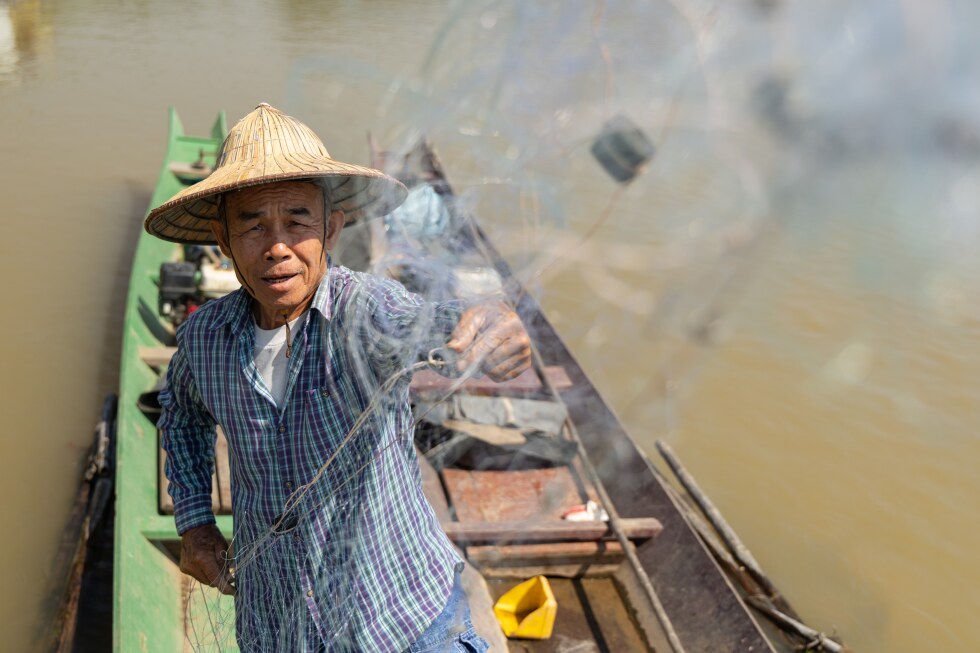
For 75-year-old Thai fisherman Sukjai Yana, each morning on the Mekong River brings the same grim routine. Perched on the bow of his weathered long-tail fishing boat in Chiang Saen, a generations-old fishing hub in northern Thailand, he pulls in his net to sort a meager catch of small fish, his disappointment growing as he wonders whether buyers will even take his contaminated-looking haul. Some days, he earns nothing at all.
Yana is far from alone in this crisis. He is one of an estimated 70 million people across mainland Southeast Asia who depend on the nearly 5,000-kilometer Mekong River, a waterway that has sustained communities and ecosystems for millennia. Today, a surging global demand for rare earth minerals has sparked an unregulated mining boom that is poisoning the Mekong and its tributaries, putting millions of lives, livelihoods, and even global food supplies at risk.
The epicenter of this boom is war-torn Myanmar, but operations have rapidly spread east into Laos, sending toxic runoff from mining sites downstream through Thailand, toward Cambodia and Vietnam. While the Mekong has long struggled with cumulative pressures—from plastic pollution and upstream hydropower dams to destructive riverbank sand mining—environmental experts warn that mining-related toxic contamination could prove an existential threat to the entire river basin.
## A Growing Danger to Public Health and Food Systems
Rare earth mining works by stripping away riverbank rock and flushing soil with harsh chemicals to extract the sought-after minerals, leaving behind a trail of waste laced with dangerous heavy metals: arsenic, mercury, lead, and cadmium. These toxins seep into tributaries and flow into the main Mekong, accumulating in fish and irrigating farmland across the region. Exposure to these elements raises the risk of cancer, organ failure, cognitive impairment, and developmental harm, with children and pregnant women facing the most severe consequences.
Thailand is currently bearing the brunt of the contamination, with toxins already threatening its $10 billion-plus annual export market for rice, fruits, and vegetables that feed consumers from U.S. grocery stores to Japanese kitchens and Malaysian dinner tables. In the hilly Thai village of Tha Ton, 63-year-old farmer Lah Boonruang points to the full range of toxin-exposed crops he grows—rice, garlic, corn, onions, mangoes, and bananas—all irrigated with water from the Kok River, a Mekong tributary that flows out of Myanmar carrying heavy metal pollution. “If we can’t export, a farmer is the first to die,” he said, echoing widespread fear across agricultural communities.
For Thailand’s 63-year-old Lahu ethnic elder Sela Lipo, the contamination has severed a centuries-old cultural tie to the river. Famed as skilled fisherpeople, the Lahu have been officially warned to avoid using river water for drinking, fishing, or irrigation. “The Lahu’s way of life is always with a river,” Lipo explained. “The contaminated river has cut off our lifeline.”
Thai environmental leaders warn that the contamination could unravel the country’s most iconic agricultural industry. “Our worry is that toxins accumulate in the rice we export. This would make our rice farming industry, which is our culture, collapse,” said Niwat Roykaew, founder of The Mekong School, an environmental institute based in Chiang Khong, northern Thailand. Thai scientists have already recorded elevated heavy metal levels in other key Mekong tributaries, including the Sai and Ruak rivers.
## Limited, Local Action Amid Cross-Border Barriers
Addressing the crisis has proven extraordinarily difficult. Thailand’s government has acknowledged it has little political or diplomatic leverage to shut down unregulated mining operations across its borders in conflict-riven Myanmar and Laos. Domestic action is also constrained by limited scientific expertise, incomplete data, and insufficient funding, according to Aweera Pakkamart of Thailand’s Pollution Control Department.
Currently, most of the work to track and address contamination falls to local governments, public universities, and regional bodies such as the Mekong River Commission, which focus primarily on monitoring heavy metal levels and educating at-risk communities about the dangers they face.
Warakorn Maneechuket, a researcher at Thailand’s Naresuan University, has confirmed that recent samples of water, fish, and sediment from Mekong tributaries contain dangerously high concentrations of mining-related heavy metals. Dissecting a catfish caught from the Kok River in her lab, she points to clear signs of toxic exposure: tumor-like growths, discolored scales, and abnormal eye pigmentation.
To expand monitoring and raise public awareness, Naresuan University researcher Tanapon Phenrat has helped develop a custom smartphone app that trains local fishers to identify and upload photos of suspicious, contaminated fish. The app builds a crowdsourced citizen science database that researchers hope will help quantify the full scale and spread of contamination across northern Thailand. “Each and every sample is very important,” Phenrat noted.
## The Global Demand Driving a Local Disaster
The unregulated mining boom flooding the Mekong with toxins is fueled by exponentially growing global demand for rare earth elements, materials that are foundational to nearly all modern technology. From smartphones and electric vehicle batteries to military hardware including F-35 fighter jets, submarines, missiles, and radar systems, rare earths are a critical input for both civilian and defense industries. While the elements themselves are geologically common, costly mining and complex refining processes have left global supply chains heavily concentrated, making new sources highly sought after.
Researchers at the U.S.-based Stimson Center used satellite imagery analysis to identify nearly 800 unregulated and suspected rare earth mining sites along Mekong tributaries in Myanmar, Laos, and Cambodia. Regan Kwan, a Stimson Center researcher tracking the expansion, explained that Myanmar’s ongoing civil war has driven a geographic diversification of mining operations, with new sites popping up along 26 different river stretches across Laos. Most of Myanmar’s rare earth output is exported to China, with more than $4.2 billion in heavy rare earths shipped between 2017 and 2024, a majority of that trade occurring after the 2021 military takeover of Myanmar.
At the same time, the U.S. has prioritized securing new independent supplies of critical rare earth minerals for its own defense stockpiles, which have been drawn down by military commitments in the Middle East and support for Ukraine. This global competition for new sources has created a race to extract that has bypassed all environmental regulations and cross-border cooperation, leaving the Mekong to pay the price.
Brian Eyler, another Stimson Center expert on the Mekong, called the toxic runoff crisis one of the most devastating events to hit the river basin in modern history. Only 20th century conflicts including the Vietnam War and the Khmer Rouge genocide caused more widespread harm, Eyler noted, adding that mining contamination ranks a close second. He described the crisis as an “atomic bomb” for the Mekong basin, far more damaging than other well-documented threats such as large upstream dams—and it is still growing, with no signs of slowing down.