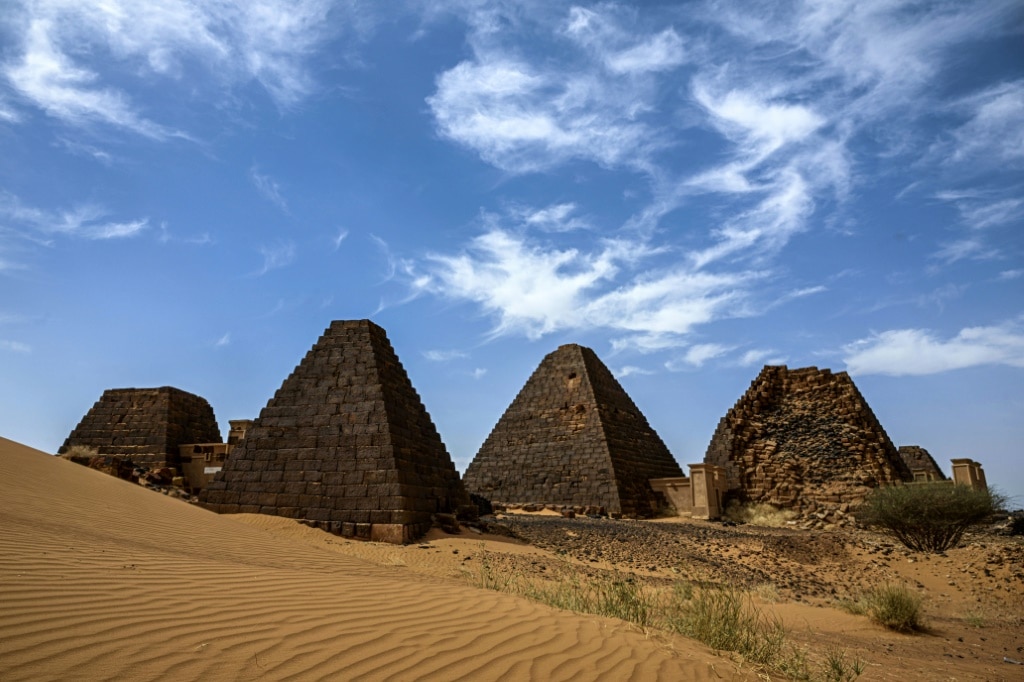
Three full years into Sudan’s devastating civil conflict between the national army and the Rapid Support Forces (RSF), one of the country’s most precious cultural treasures, the ancient Meroe Pyramids, stands protected only by a tiny band of caretakers bound by generations of legacy and devotion.
Mostafa Ahmed Mostafa, 65, is the latest descendant in a family line of groundskeepers that has tended to these desert monuments for decades. Clad entirely in white, he walks as a near-solitary sentinel across the 2,400-year-old Bajrawiya necropolis, part of the Island of Meroe UNESCO World Heritage Site that holds 140 pyramids constructed during the peak of the ancient Kingdom of Kush. “These pyramids are ours, it’s our history, it’s who we are,” he says, standing in the shadow of the weathered dark sandstone structures.
None of the Meroe pyramids remain fully intact. The first wave of destruction came in the 1800s, when European treasure hunters used dynamite to blast apart tombs in search of ancient artifacts. Two more centuries of wind-blown sand and erosive rain have reduced many structures to rubble, leaving broken remnants of the once-majoric Kushite burial monuments.
A three-hour drive from Sudan’s capital Khartoum, Meroe was once the country’s most-visited heritage attraction. Today, the only sound cutting across the silent desert is the occasional grunt of a lone camel. Mostafa shares site duties with just two other people: Mahmoud Soliman, lead archaeologist and site director, and young archaeologist Mohamed Mubarak, who has worked at Meroe since 2018. The small team cobbles together what limited resources they can find to slow the damage caused by shifting sand and seasonal rainfall.
Apart from a brief early-war influx of displaced people seeking distraction from the crisis, the site has remained largely abandoned. That reality is a stark contrast to Meroe’s pre-war revival, when Sudanese heritage enjoyed growing national attention following the 2018-2019 popular uprising that ousted longtime autocrat Omar al-Bashir. Soliman recalls peak weekends bringing busloads of 200 tourists at a time from Khartoum, as young Sudanese embraced their ancient history and organized group trips to explore the site. A popular protest chant of the era even wove Kushite heritage into the revolution: “My grandfather Taharqa, my grandmother Kandaka,” referencing a legendary Kushite pharaoh and the title of ancient Kushite queens, who became symbols of the revolution’s women leaders.
Local communities also relied on Meroe’s tourist trade. Nearby Tarabil village, named for the local word for “pyramids,” was home to dozens of artisans who sold handcrafted souvenirs and rented camels to visitors, with livelihoods entirely tied to the site. On a recent April visit, Khaled Abdelrazek, a 45-year-old local artisan, hurried to the entrance as soon as he heard visitors had arrived, displaying his hand-carved miniature sandstone pyramids and reminiscing about the days when dozens of vendors plied their trade at the site.
Months before war erupted in the final days of Ramadan 2023, Meroe was gearing up for a busy season: documentary film crews had visited, a music festival had been hosted, and big plans were in place for post-Eid tourism. All of those plans were dashed the moment fighting broke out.
Today, the team’s primary concern is constant vigilance against decay. Soliman walks the site scanning for new cracks, shifting sand dunes, and unstable scaffolding that needs repair ahead of each rainy season. Unlike the larger, more gradual-sloped pyramids of neighboring Egypt, Meroe’s smaller, steeper structures were originally engineered to shed rainwater and withstand sand movement, but every new crack opens the door to accelerated erosion.
Queen Amanishakheto’s pyramid, the largest on site, built for the 1st century CE Kushite ruler, offers one of the most stark examples of the site’s history of destruction. In 1834, Italian adventurer Giuseppe Ferlini — who destroyed dozens of Meroe’s pyramids in search of treasure — completely levelled Amanishakheto’s tomb and stole her royal jewelry, which now remains on display in Egyptian museums in Berlin and Munich. Today, the queen’s tomb is little more than an empty sandbox, though the outer wall of her mortuary temple still stands, bearing a larger-than-life carving of the queen holding a spear and smiting enemy captives, a reminder of the power she held 2,000 years ago.
Wandering past ancient reliefs of the Kushite lion god Apademak, Egyptian-derived deities Amun and Anubis, lotus carvings, and Meroitic hieroglyphs, Soliman shared his quiet hope for the future. For now, large-scale restoration and a return of tourism remains a distant dream, he says, but he cannot help but hold onto hope: “This place has so much potential.”
For the small team guarding Meroe, even amid a national crisis that has left most Sudanese focused solely on securing food, water, and shelter, protecting this heritage for future generations remains a non-negotiable mission. “Now, everyone’s top priority is of course food and water and shelter. But this is also important,” Mubarak says. “We need to protect this for future generations, we can’t let it be destroyed or wither away.”