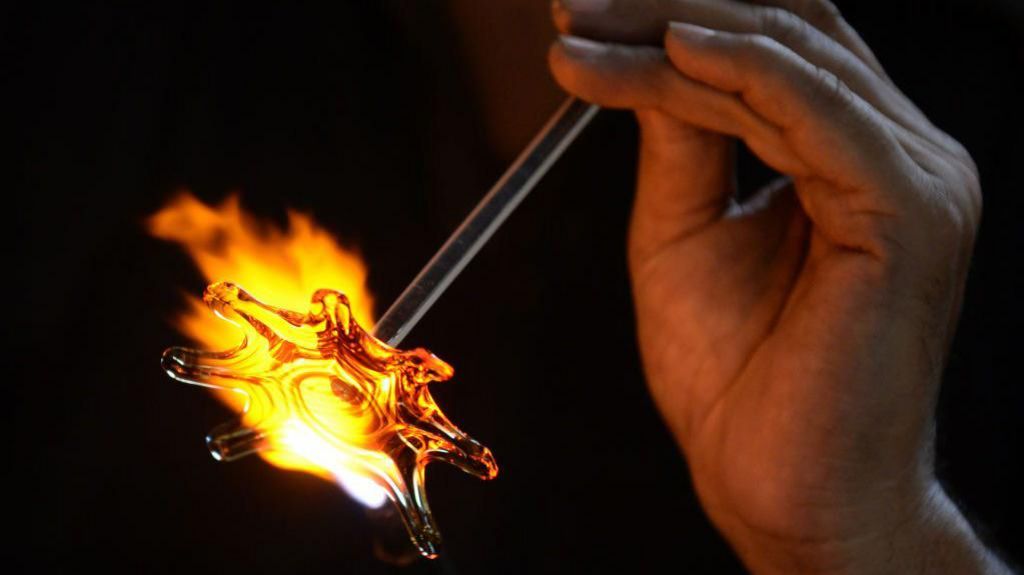
Half an hour’s drive from the world-famous Taj Mahal in India’s northern Uttar Pradesh Pradesh, Firozabad has built its identity around glass. Known nationally as India’s “glass city”, this industrial hub accounts for 70% of the country’s total glass output, with most production spread across hundreds of small and medium-sized family-run factories. The sector sustains nearly 150,000 daily-wage workers, whose incomes hover between 500 and 1,000 rupees ($5.29 to £3.91) a day – earnings that leave almost no buffer against sudden cost increases or production disruptions. Today, that vulnerability has been laid bare by escalating tensions in the Middle East, whose ripple effects have reached deep into Firozabad’s workshops and left thousands of livelihoods hanging in the balance.
Glass manufacturing is an energy-intensive process: furnaces must maintain extremely high, consistent temperatures around the clock to keep production running safely. If a furnace cools completely, it can suffer irreversible damage, and restarting it requires massive time and capital investments most small factory owners cannot afford. This means the entire industry relies entirely on a stable, affordable supply of natural gas – and that supply has been thrown into chaos by Middle East conflict.
Nearly half of India’s total natural gas imports pass through the Strait of Hormuz, the narrow strategic Gulf shipping route that has been heavily disrupted by ongoing regional tensions. While some shipments have resumed in recent weeks, factory owners across Firozabad report they have yet to see any relief from the shortage. To cope with the national supply squeeze, the Indian government implemented a 20% cut to commercial gas allocations, forcing producers to adapt their operations to ration fuel.
Sanjay Jain, who has operated a glass bangle manufacturing unit in Firozabad for four decades, told BBC reporters his production has plummeted sharply since the cuts went into effect. To keep his furnaces from cooling beyond repair, Jain has lowered operating temperatures and paused production for three to four days at a time – a stopgap measure that has cut his output drastically but kept his business from total collapse.
The crisis in Firozabad exposes India’s broader systemic vulnerability to global energy shocks. The country relies heavily on imported natural gas across all sectors, from transportation to residential use, leaving industrial hubs built around gas-dependent manufacturing uniquely exposed. Firozabad’s 400-plus small manufacturing clusters produce a vast range of glass goods, from bangles and home decor to car headlamp covers and luxury chandeliers, feeding a domestic glass market valued at more than $200 million. Many small factory owners report losses ranging from 25% to 40% since the Middle East conflict escalated, with no clear path forward if supply instability continues.
Natural gas shortages are not the only pressure weighing on the industry. Mukesh Bansal, a representative of the All India Glass Manufacturers’ Federation, explained that the conflict has driven up costs across the entire supply chain. Many key chemical components used to melt glass are imported from the Middle East, so trade disruptions have pushed raw material prices sharply higher. On top of that, global shipping cost increases have priced many Indian exporters out of international markets, particularly the large U.S. market for decorative glass goods. Bansal noted his own business has suffered losses exceeding 45% since the conflict began, saying “the combination of gas shortages and rising input costs has made this situation almost unmanageable.”
The strain is hitting low-wage workers the hardest. Umesh Babu, a 35-year-old bangle maker who works 10-hour days in an uninsulated open-air workshop just meters from a 1,000C furnace, has already seen his work week drop from six days to four. To cut household expenses, he has pulled his children out of school. “This is the only skill I have,” he said. “If the factories stop hiring, I don’t know where I’ll turn to feed my family.”
The Indian federal government has acknowledged the urgency of the crisis, stating it “recognises the need for uninterrupted furnace operations” and is implementing emergency measures to stabilize energy supplies. Federal ministries have held regular coordination briefings, and the petroleum ministry has prioritized energy allocations for critical sectors including pharmaceuticals, steel, automobiles and agriculture. Uttar Pradesh’s state government also announced a temporary wage increase after thousands of northern Indian factory workers held protests earlier this month that turned violent in parts of the state, where demonstrators demanded living wages and better working conditions. Workers say the temporary increase still falls far short of what they need to keep up with soaring inflation.
Economists warn that without long-term intervention, many of Firozabad’s small and micro manufacturing units will not survive. Economist Arun Kumar noted that most of these labor-intensive small operations operate on extremely limited working capital, leaving them no financial buffer to withstand extended shortages. “If this situation continues, many units will either shut down permanently or operate at severely curtailed capacity for the foreseeable future,” he said.
Damage to energy infrastructure across the Middle East from recent fighting between March and early April could take months to repair, meaning supply disruptions will persist even after the Strait of Hormuz returns to full operation. “The situation won’t go back to normal for months even after the route reopens,” Kumar explained.
A recent UN Development Programme report warns that the ongoing conflict could push as many as 2.5 million additional people in India into extreme poverty. For Firozabad’s glass sector, which sits at the heart of India’s small and medium enterprise ecosystem – a segment that contributes 30% of India’s national GDP and employs hundreds of millions of people – this crisis is more than a local problem: it is a warning of how global geopolitical instability can quickly unravel livelihoods for low-income workers across the world.