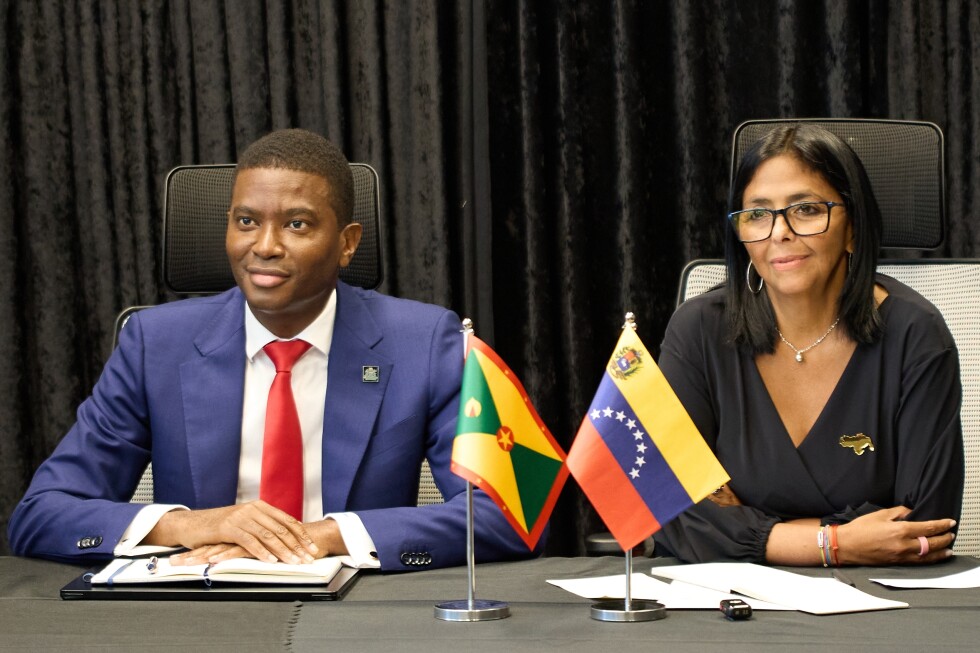
GEORGETOWN, Guyana – A long-simmering centuries-old territorial dispute between Caribbean neighbor Guyana and Venezuela has reignited into a new diplomatic clash, after Guyana’s president issued a formal complaint to regional leaders over a provocative symbolic gesture by Venezuela’s acting president. The controversy centers on a lapel pin worn by Delcy Rodríguez, Venezuela’s interim head of state, during her recent official visits to Caribbean nations: the pin is shaped explicitly to match the borders of Guyana’s resource-rich Essequibo region, a territory that makes up two-thirds of Guyana’s total land area and has been claimed by Venezuela for more than a century. The gesture comes amid already heightened tensions following the U.S. capture of former Venezuelan president Nicolás Maduro in a surprise overnight raid on his Caracas residence in early January, after which Rodríguez stepped into the acting presidency. In the weeks since that political shift, the pin has become an increasingly common public symbol among senior Venezuelan government figures, ruling party lawmakers, state media anchors and other ruling bloc representatives. Guyana President Irfaan Ali delivered his formal complaint in an official note addressed to Terrance Drew, Prime Minister of St. Kitts and Nevis and current chairman of the Caribbean Community (Caricom), the regional trade and coordination bloc that hosts Rodríguez’s recent travels. Ali confirmed that Rodríguez wore the disputed pin during her official stop in Barbados on Monday, marking the second confirmed instance of her displaying the symbol on an overseas trip – the first came during an official visit to Grenada earlier in April, on her first international tour since assuming the acting presidency. In the note, Ali emphasized that the pin serves as an open, public assertion of Venezuela’s invalid territorial claim to sovereign Guyanese land. Beyond the symbolic provocation, Ali outlined a key concern: that when Rodríguez wears the pin during official visits hosted by other Caribbean nations, the gesture could be misread by third parties as quiet acceptance or even endorsement of Venezuela’s claim by the host government. Ali stressed that Caricom has long stood on clear principles in backing Guyana’s sovereignty over the Essequibo region, and that this commitment needs to be reflected not just in official statements, but also in how member states conduct official diplomatic engagements with Venezuelan representatives. The roots of the dispute stretch back to an 1899 international boundary commission, which set the current border between the two territories when Guyana was still a British colony. Venezuela has long argued that the commission’s ruling was obtained through improper means and stripped the country of the Essequibo territory. The competing claims are currently being adjudicated at the International Court of Justice (ICJ) based in The Hague, Netherlands. Ali reminded Caricom member states that the bloc has previously issued unequivocal public support for Guyana’s sovereign claim to the region at major summit meetings. He pushed for clear action, arguing that Venezuelan representatives should not be permitted to display territorial claim symbols such as the Essequibo-shaped pin or altered maps that include the region as Venezuelan territory, as such gestures threaten to undermine the ongoing legal process at the ICJ. Ali has previously publicly pushed back against other Venezuelan moves to assert the claim, including the inclusion of Essequibo on official Venezuelan government maps, which he has called a calculated, intentional provocation that Guyana rejects entirely. Tensions have escalated dramatically in recent years as major offshore oil reserves were discovered in the Essequibo region, which is licensed for exploration and production by Guyana to international energy firms including U.S. operators. On multiple occasions, Venezuela has deployed military gunboats to the offshore oil blocks, issuing demands that all production activity cease – demands that operating rigs have declined to obey to date. As of Tuesday, no response to Guyana’s complaint had been issued by Venezuelan government officials, who could not be immediately reached for comment by reporters.
More than fashion: A pin worn by Venezuela’s Rodríguez on state visits riles Guyana