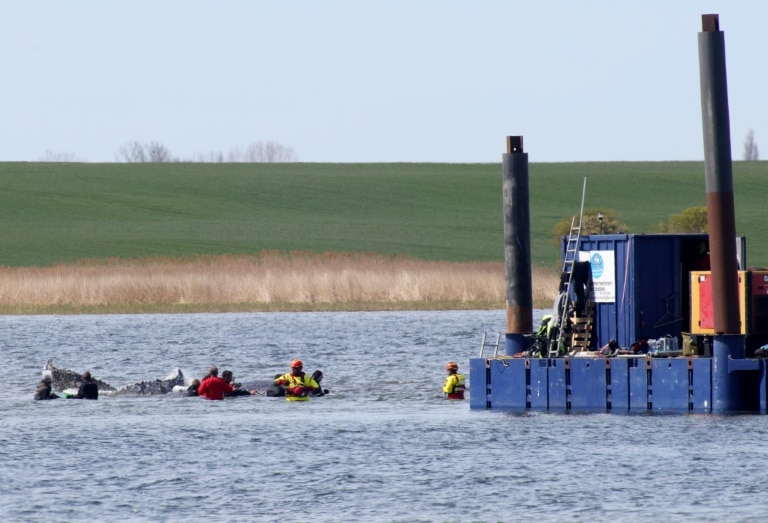
For weeks, a lost humpback whale’s fight for survival has held the entire nation of Germany in suspense. On Tuesday evening, that saga took a pivotal turn: the 20-ton marine mammal, dubbed Timmy by local media, was successfully guided into a converted cargo barge fitted with a water-filled hold, and the vessel departed for the North Sea to carry out what many call a last-ditch effort to return the animal to its natural habitat.
Timmy’s ordeal began in late March, when the young humpback – which normally makes its home in the cold, nutrient-rich waters of the Atlantic Ocean – strayed hundreds of kilometers off course and became stuck on a sandbank off the Baltic coast near the northern German city of Luebeck. After the whale freed itself only to become re-trapped multiple times, rescue teams attempted a series of interventions, from digging artificial escape channels to using inflatable flotation devices, but every attempt ended in failure. By early April, state officials formally abandoned rescue efforts, concluding that Timmy could not be saved.
That decision sparked immediate public outcry, pushing authorities to reverse course and approve a new privately funded rescue plan put forward by two German entrepreneurs. The proposal, which involves transporting Timmy via barge to the North Sea for release if the animal remains strong enough, was dismissed by many marine experts as a long shot, with critics arguing that the stress of capture and transport would only worsen the whale’s condition and reduce any chance of survival.
Despite the skepticism, rescuers pulled off a breakthrough earlier on Tuesday. Teams fitted stabilizing straps around the 13-meter whale, then guided it down a specially dug sand channel toward the waiting barge. With rescue divers swimming alongside, Timmy picked up speed and voluntarily swam into the water-filled hold, drawing cheers from on-site teams and spectators watching live streams and shore-side broadcasts.
“I can’t even put my happiness into words,” Karin Walter-Mommert, one of the entrepreneurs backing the mission, told German tabloid Bild. “You could see that the whale was fighting, that he wanted to live. Knowing he’s now safely in the barge is simply wonderful – it proves the fight for Timmy was worth every effort.”
The operation received official approval after government vets confirmed the whale was healthy enough to withstand the journey north to the North Sea, his intended release site. A temporary green net barrier has been fitted across the barge’s entrance to keep Timmy contained during the voyage. Till Backhaus, environment minister for the state of Mecklenburg-Western Pomerania where the stranding occurred, praised the round-the-clock work of rescue teams, saying “In the end, we have saved this animal.”
Backhaus has defended the controversial mission against criticism from the scientific community. “I’ve always said: those who do nothing make no mistakes,” he told reporters Tuesday. “If the scientists who claimed this was all pointless had seen the young whale just now, how he swam into the barge all on his own, they would understand.” In a written statement responding to critics who accused officials of sidelining scientific input, Backhaus countered that authorities had always based their decisions on available evidence: “No one could tell us with certainty that the whale would die, or when. On the basis of these uncertain conclusions, we decided to allow the rescue attempt to go forward.”
The weeks-long saga of Timmy the stranded whale has dominated German media, with rolling coverage on national television, constant updates from online news outlets, and widespread discussion across social media platforms. But the high-profile rescue has also sparked fierce public debate, angry exchanges between supporters and critics of the operation, and even the spread of unfounded conspiracy theories about the whale’s stranding and the rescue’s motives. As the barge carrying Timmy makes its way toward the North Sea, the entire country continues to hold its breath, waiting to see if the high-risk effort will end with the young whale swimming free.