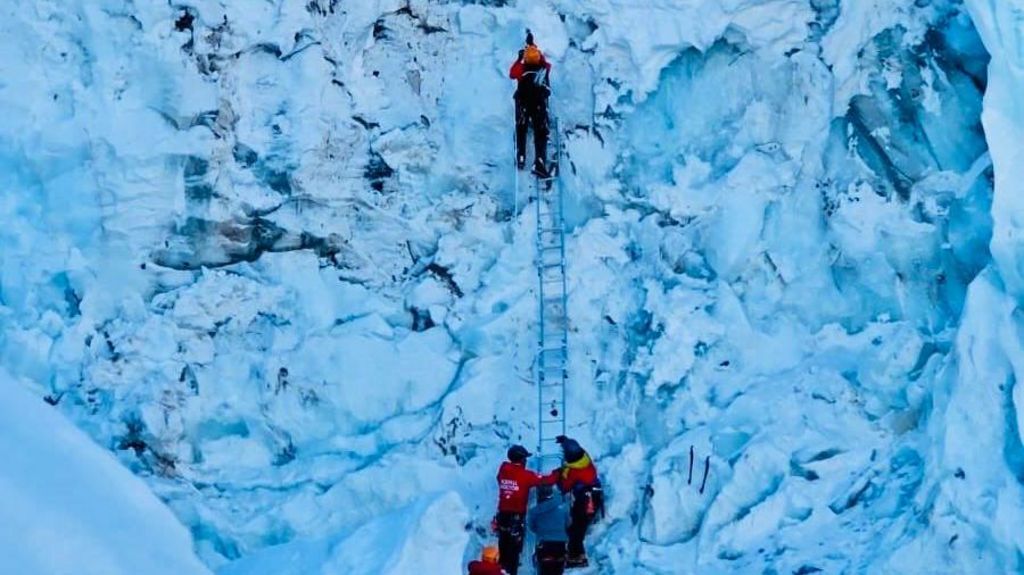
For two weeks, a massive fallen glacial serac had put all spring climbing plans on hold at Mount Everest, trapping teams below Base Camp and threatening to upend the annual prime climbing season. But following urgent days of work by elite high-altitude crews, a usable alternative path has been carved through the dangerous Khumbu Icefall, opening the way for climbing teams to resume their acclimatization rotations toward the summit.
Ram Krishna Lamichhane, director general of Nepal’s Department of Tourism, confirmed to the BBC that specialized icefall doctors have successfully installed fixed ropes all the way to Camp 2, which sits at an altitude of roughly 6,400 to 6,500 meters (21,000 to 21,325 feet) above sea level. “Still there are some risks, but icefall doctors have picked up the most convenient available route and identified the path forward,” Lamichhane said. He added that climbers are expected to begin moving toward Camp 1 and Camp 2 for acclimatization exercises starting tomorrow.
The disruption began in early April, when rope-fixing teams launching preparations for the 2026 spring season encountered the 100-foot (30-meter) tall serac that had calved off the glacier and blocked the standard route. Crews were forced to pause work for two weeks as they waited for the unstable ice block to begin melting naturally, putting all season preparations roughly two weeks behind the original schedule. This delay has sparked growing concerns that the backlog will lead to the dangerous summit queues that have plagued crowded Everest seasons in past years.
The route-clearing work was a collaborative effort carried out by experienced icefall doctors from Nepal’s Sagarmatha Pollution Control Committee (SPCC) alongside veteran sherpas from expedition operator associations, who specialize in navigating the constantly shifting icefall terrain. Lakpa Sherpa, a veteran climber and expedition manager who oversaw part of the work, explained that modern technology played a key role in speeding up the operation. Airlift support was used to deliver critical supplies including fixed ropes, aluminum ladders, snow stabilizer bars and food to high-altitude crews during the most challenging phases of the work. Teams also leveraged cutting-edge survey tools: “3D photogrammetry and real-time drone surveys to map the Khumbu Icefall and assess hazards like seracs and crevasses,” he said.
While the route to lower camps is now open for traffic, officials and expedition leaders have stressed that major hazards remain in the area. Lakpa Sherpa warned that the original massive unstable serac is still at high risk of collapse within the next four to five days, and urged climbing teams to avoid carrying heavy payloads through the affected section of the icefall. “Safety is our highest priority; further rotations should proceed with extreme caution and at your own risk,” he said. Acknowledging the delays to the season timeline, he urged permit holders to remain calm: “The season is slightly delayed but the summit will come,” he added.
Nepal’s Department of Tourism echoed that safety message in a post to X, noting, “As climbers navigate the route, utmost caution is urged, particularly in the serac-affected section. Wishing all a safe ascent.”
This year, 425 climbers have received official permits to attempt a summit of Mount Everest from the Nepali side of the border. According to the Department of Tourism, these permits will generate roughly 924.2 million Nepalese Rupees, equivalent to approximately $6.1 million or £4.5 million, in government revenue, making the spring climbing season a key contributor to Nepal’s tourism-driven economy.