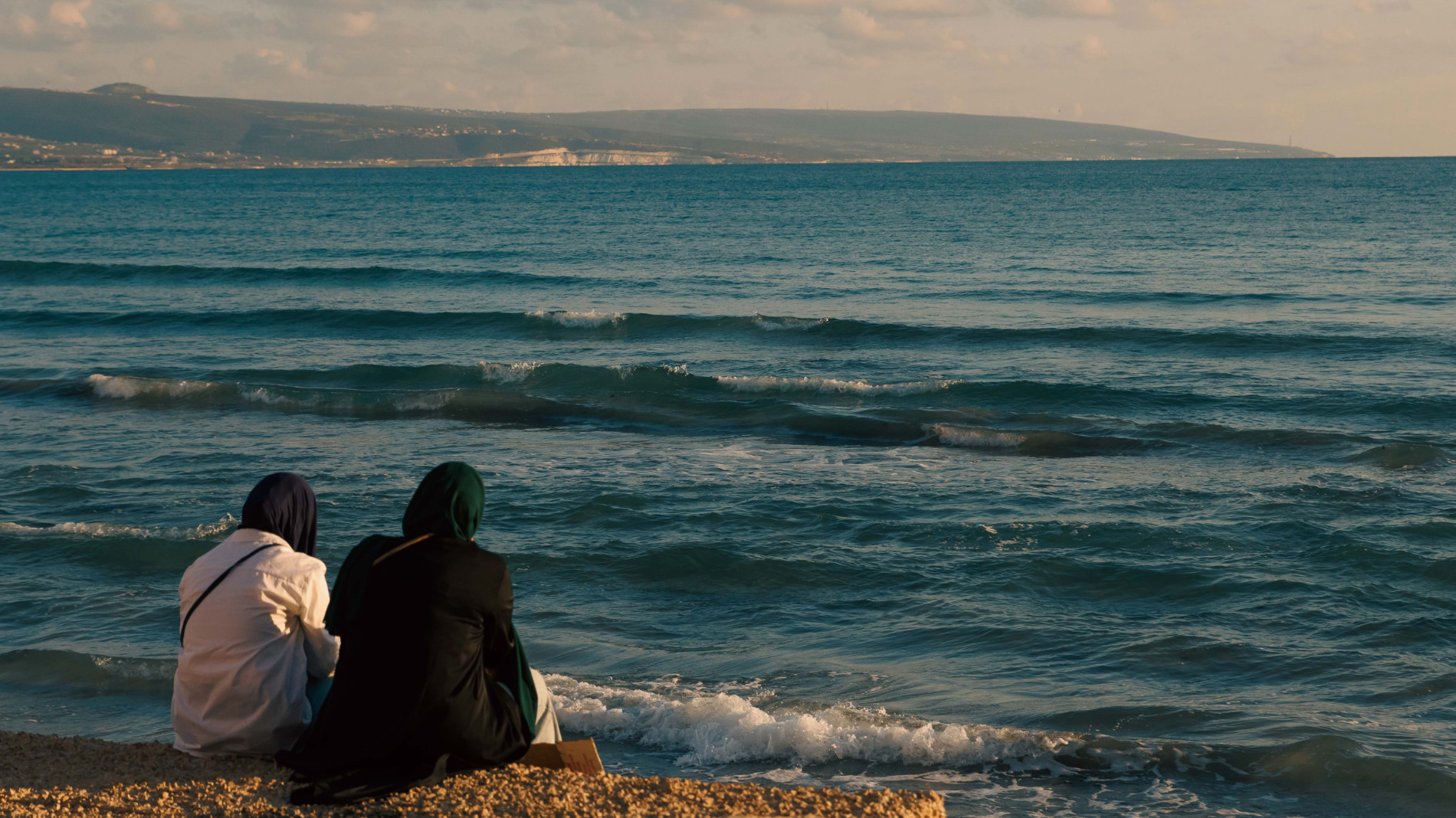
Every dawn and dusk along the Mediterranean seafront of Sour, Lebanon’s largest southern coastal city, a quiet, anxious ritual plays out. Dozens of residents gather along Nabih Berri Street, their gazes fixed southward across the glittering water, all the way to the border town of Naqoura, where the line between their homeland and occupied territory now blurs.
On the horizon, eight kilometers from Sour, the white limestone cliffs of al-Bayada rise from the sea. Today, those cliffs are an advanced forward operating base for Israeli troops, part of the expanding ground invasion that has pushed deep into southern Lebanon. Even when the soldiers are hidden from view, their presence hangs heavy over the city, leaving locals with a constant, unsettling feeling of being watched.
Lina, a local resident whose apartment overlooks the newly seized territory, spoke with quiet despair. “Israel has long targeted Naqoura. The headland gives them unobstructed view of our entire coastline,” she explained. “We already lived under constant drone surveillance for years. Now they watch us directly from that cliff.”
Sour has become a hub for thousands of displaced Lebanese who fled their homes near the Blue Line – the UN-drawn boundary established in 2000 to mark Israel’s withdrawal from southern Lebanon. Even Sour has suffered severe damage from repeated Israeli strikes, but for these displaced families, it remains the only available refuge. For most of them, their original homes are either uninhabitable after weeks of bombardment or now lie under Israeli occupation.
After Hezbollah granted limited press access to the frontline, journalists were able to travel a short distance south of Sour for a few hours to document the situation on the ground. The winding coastal highway that once bustled with local traffic and tourist traffic is now almost entirely empty. Only a handful of vehicles pick their way through a landscape of ruin, where posters of Hezbollah fighters killed after the Lebanese front opened on 8 October 2023 line every damaged guardrail.
A checkpoint manned by a small contingent of Lebanese army personnel blocks the road further south; no civilian or journalist can pass. Israeli troops hold positions less than a kilometer away, in al-Bayada, the first coastal town to fall within Israel’s self-imposed “Yellow Line” – a new demarcation drawn roughly 10 kilometers inside Lebanese territory, established after a 10-day ceasefire took effect. This new occupation buffer zone follows the same model Israel employed in Gaza, barring tens of thousands of residents of border communities from returning to their land and homes.
A short drive inland from the coast lies al-Mansouri, a small village that mirrors the devastation seen across every community in southern Lebanon. Empty streets stretch between piles of collapsed concrete, and every structure bears the scars of Israeli bombardment. Even the village mosque was not spared: its minaret was sheared off by an airstrike, leaving a jagged stump against the sky.
After the ceasefire came into force on 17 April, a new tragedy unfolded when a small group of villagers tried to return to their homes to assess damage and retrieve belongings. Almost immediately, they came under direct fire from Israeli forces. One resident, speaking on condition of anonymity to Middle East Eye, described the chaotic aftermath. “We scattered across the village to hide when the firing started,” they said. “Neither our security forces nor the Red Cross were allowed to come in. This is land we’ve spilled blood to defend, and we were left completely alone.”
Survivors recounted that any attempt to escape by car was met with immediate gunfire from both ground troops and attack aircraft. What followed was a four-day siege, where trapped residents survived only by picking wild lemons from orchards to eat. Mohammad, a 30-something villager who was not present during the siege, described how he pieced together his own father’s final moments from surviving witnesses. “He was trapped in a ring of fire,” Mohammad said, his gaze vacant. “Then the building he was hiding in was hit by a strike.”
Official data from Lebanon’s health ministry confirms the escalating human cost: more than 2,500 people have been killed in Israeli strikes across southern Lebanon since 2 March alone, including 177 children, 277 women, and 100 medical personnel.
While al-Mansouri does not technically fall inside the Yellow Line, it sits directly on its edge, and Israeli positions on the overlooking hilltop give troops full visibility across the entire village. Moussa Zein, a 65-year-old resident who recently returned to al-Mansouri to try to rebuild, said locals are still struggling to process the new reality of occupation on their doorstep. “The ceasefire is violated dozens of times every single day, while our government drifts aimlessly into talks with the enemy,” Mohammad added, referencing the recent direct negotiations between Tel Aviv and Beirut hosted in Washington – the first such talks in 30 years.
Like many residents, Moussa is determined to stay in his home, despite the daily risk of Israeli strikes that have continued even after the ceasefire. What deters him more than the threat of violence is the scale of destruction: the village has no running water, no electricity, and basic services remain completely destroyed. “Our lives, our parents’ lives, have all been shaped by repeated wars and invasions,” Mohammad said. “For years, no one paid attention to what was happening here. But now the whole world can see: Hezbollah is just a pretext for Israel to seize our land.” As evidence, he points to comments Israeli Prime Minister Benjamin Netanyahu made last summer on the I24 news network, where he described his goal as fulfilling a “historic and spiritual mission” deeply tied to the vision of Greater Israel and the Promised Land. “The occupation cannot last. We believe in the resistance – it is the only thing that can protect us,” Mohammad said.
A few kilometers southeast of al-Mansouri, Majdal Zoun, another small town on the Yellow Line’s edge, shares the same fears and uncertainty. Once home to roughly 5,000 residents, the hilltop town is now almost entirely deserted. Almost every house bears the scars of Israeli strikes, and it is nearly impossible to find a single intact structure. A group of young women displaced to Sour return to the town every day, refusing to abandon their ancestral home. “This is our village. We will not leave it to the enemy, so we come back and forth every day. We believe in the resistance,” they said in unison, standing at the village cemetery looking out toward Sour on the horizon. When a surveillance drone hums low overhead, they glance up anxiously, their faces tightening with fear. “Majdal Zoun’s geographic position makes it a prime target for Israel. We are scared they will try to seize it any day now,” one added.
From the southern edge of Majdal Zoun, the occupied village of Shama is visible just two kilometers away. Its historic fort, which houses the shrine of the prophet Shamoun al-Safa, has been heavily damaged in Israeli strikes. In mid-April, Lebanon’s Ministry of Culture announced it had filed an urgent complaint with UNESCO, calling for immediate international intervention to protect the archaeological and religious site. During the Middle East Eye visit, no troop movements were visible, but several Israeli flags flying over the fort can be seen clearly from Majdal Zoun.
Further inland to the east, the village of Tayr Harfa is also under Israeli occupation. Regular explosions echo across the hills, and plumes of smoke rise above the tree line. “They are blowing up every house that’s still standing. After bombing us, they want to raze everything to the ground, just like they did in Gaza,” said Ali, a 39-year-old resident from the area. Ali’s own village is now surrounded on its southern flank by the Israeli army, and he fears for its future. “Unfortunately, we expect nothing from the Lebanese army. We only have the resistance to rely on. Otherwise, Majdal Zoun will fall too,” he said. Ali praised what he called the heroic resistance of Hezbollah fighters, who inflicted significant losses on Israeli troops before the ceasefire and stopped them from advancing further into Lebanese territory. Confrontations continue even after the truce: on 23 April, Hezbollah announced it had shot down an Israeli surveillance drone operating over the area.
A few kilometers further north in the village of Qlaileh, the community is mourning the loss of several Hezbollah fighters killed in recent combat. One mother sits gently stroking a portrait of her dead son, her eyes filled with constant tears. Beside her, 30-year-old Rana said the fighters’ sacrifices will not be forgotten. “We cannot rely on anyone but ourselves. We will fight to keep our land, because this is all we have,” she said.