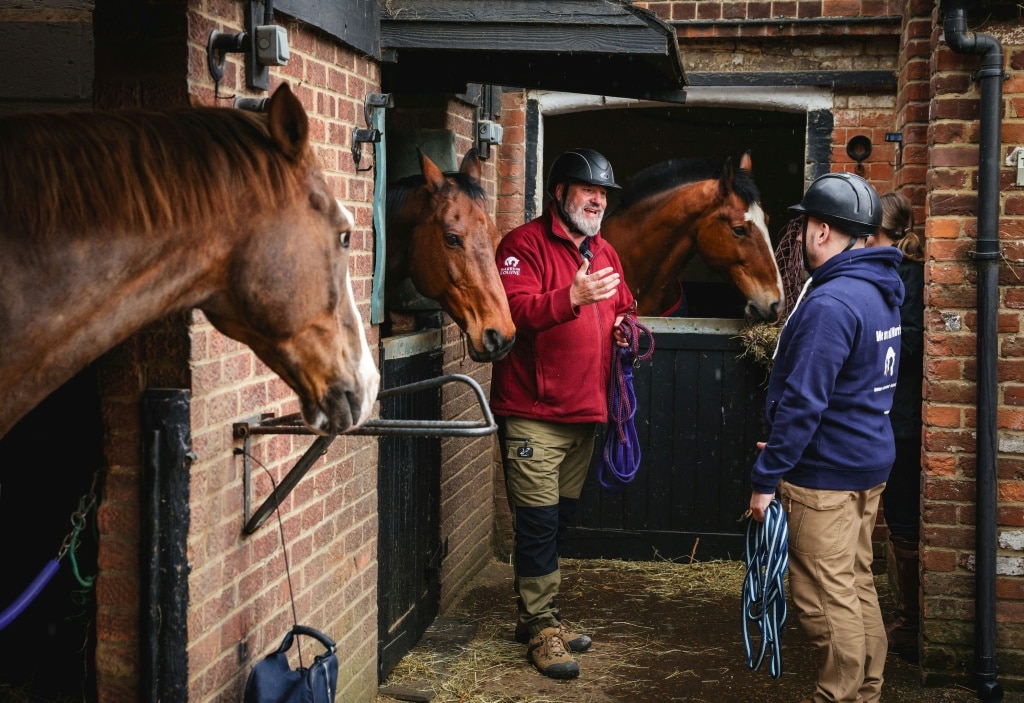
For uniformed service members and police officers who routinely risk their lives in service to the public, breaking points are rarely discussed openly. But behind the stoic public image, many struggle with crippling physical injuries and unmanaged mental health trauma that traditional therapies often fail to address. For three British servicemen and law enforcement officers, the path to recovery did not come from a human clinician — it came from an unlikely source: horses.
Former Royal Air Force reservist John Lewis, serving police officer Nick Morton, and ex-military intelligence operative Al Strudwick all reached catastrophic lows in their post-service or on-duty lives. Lewis, whose 12-year military career ended abruptly after a traffic accident left him with multiple broken bones that forced him into medical retirement, grappled with constant suicidal thoughts. Morton, a 20-year veteran police officer, suffered a total mental breakdown after years of responding to unspeakably traumatic incidents, including child murders. Strudwick, who underwent a double leg amputation after a life-threatening sepsis infection, lost all sense of self-worth and confidence after the procedure. Oddly enough, all three shared one additional common trait: a deep-seated fear of horses.
Today, all three men credit their dramatic recovery to Warrior Equine, a small British charity that uses equine interaction to support vulnerable current and former service members. Founded in 2019 by Ele Milwright, whose husband is a serving RAF officer, the organization grew out of Milwright’s years of informal observation of the unaddressed trauma many veterans bring home after overseas deployments.
“I did notice a lot of our friends and colleagues were coming back a little bit quirky,” Milwright told AFP. “You couldn’t quite put your finger on it, but they came back and it was different. Nobody told you what to do about it. It was the elephant in the room. So three things: understanding the value of horses, understanding how horses think, their psychology, and my commitment to help people with a military background or those who serve, all came together.”
To keep operating costs low, the charity does not own permanent facilities or a herd of its own horses. Instead, it partners with civilian equestrian centers and borrows military horses to run three-day intensive therapy courses, hosting between six and eight cohorts of participants each year. Milwright works alongside chief equine instructor Jim Goddard, who has years of experience working with veterans.
The core of the charity’s approach centers on the natural connection between equine psychology and emotional regulation for traumatized humans. During the courses, participants are tasked with leading a horse into an enclosed pen and using only their body language, breath control, and energy to encourage the animal to move and interact with them. Horses are innately attuned to tension and emotional instability; only when a participant can achieve a calm, focused state that feels safe to the animal will it choose to engage voluntarily. This exercise becomes a tangible, immediate reward for participants learning to manage their own overwhelming stress and trauma responses.
For Lewis, who tried multiple traditional talk therapies and was so skeptical of the equine program that he turned around three times on his drive to his first course, the experience proved transformative. He ultimately pushed through his doubt, recognizing that he had nothing left to lose and wanted to build a stable life for his two children.
“That vulnerability became exacerbated every time I was away from my family and my kids,” Lewis explained. “It became so overwhelmingly controlling. Even if I went into a supermarket to buy a loaf of bread and there wasn’t any bread on the shelf, that was me failing to be able to protect them. Then I would get into conflict in the supermarket just because there wasn’t bread on the shelf.”
After working with the horses, Lewis says his life is unrecognizable. “The point where the horse can detect that you’re in control of those stress emotions going on inside you, they will, of their own free will, walk over to you and follow you around with no lead,” he said. “They’ll stay close to you in this amazing way. And the way it’s been described to us, and you can really see it, is that they just want to sit there and trust you.” Today, Lewis says his crippling controlling behaviors are gone, and while he acknowledges the trauma he experienced will always be part of his story, he is no longer trapped by it: “That dark tunnel doesn’t even stare me in the face. I know it’s there. But I’m able to turn my back on it every single time.”
For Strudwick, the program restored the self-confidence he lost after his amputation, so much so that he was able to climb Wales’ Pen y Fan mountain — a core training test for British SAS candidates — from his wheelchair. “It made me realise how far I had come, from lying in a hospital bed for 50 nights, and being released with damaged kidneys and a slowly recovering liver, to climbing a mountain,” he said. Known for his sharp, self-deprecating humor even after his trauma — his upcoming memoir about his recovery is titled *Finding My Feet Again* — Strudwick says the program gave him his joy of life back.
In recognition of the organization’s extraordinary track record of success, Warrior Equine has been selected as the official charity partner of the 2025 Royal Windsor Horse Show, one of the most prestigious equestrian events in the United Kingdom, running from May 14 to 17. The partnership is expected to raise critical funds to expand the charity’s reach and help hundreds more uniformed service members find healing through the unexpected connection with horses.