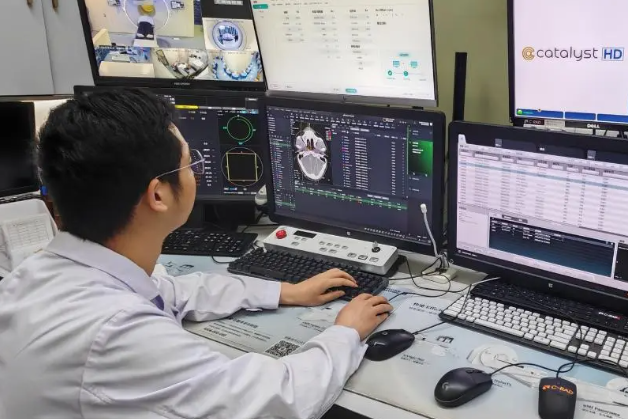
A decade-long research project led by scientists at Sun Yat-sen University Cancer Center in Guangzhou has yielded an artificial intelligence-powered innovation that is set to reshape radiation therapy for cancer, particularly nasopharyngeal carcinoma, by drastically improving precision and cutting down on clinician workload.
Nasopharyngeal carcinoma, which forms in the upper throat behind the nose, is primarily treated with radiation therapy. The stakes of this treatment are extraordinarily high: an undersized radiation field leaves sections of the tumor untreated, raising the likelihood of cancer recurrence, while an overly broad field can inflict irreversible damage to critical nearby structures including the brainstem, temporal lobe, middle ear, and optic nerve. Such collateral damage often triggers life-altering complications ranging from chronic headaches and memory loss to permanent hearing and vision impairment, severely diminishing a patient’s post-treatment quality of life.
To avoid these outcomes, clinicians must complete a meticulous pre-treatment step called target volume delineation, where they manually identify and trace the boundaries of both the tumor and surrounding healthy organs on medical scans to define the exact radiation field. Before this new technology was introduced, this demanding task required clinicians to maintain intense focus for three to six hours per patient, according to Sun Ying, a professor at the cancer center.
The complexity of the process is further compounded by changes in patient anatomy over the course of treatment. A full course of radiotherapy typically spans six to seven weeks and requires more than 30 separate treatment sessions. During this period, tumors often shrink and patients may experience weight loss that shifts the exact position of the remaining cancer. This means initial scans taken at the start of treatment quickly become outdated, leaving clinicians to update delineations repeatedly to avoid misaligned radiation delivery.
To solve these longstanding challenges, the research team led by the center’s vice-president Ma Jun, an academician of the Chinese Academy of Sciences, and Sun spent more than 10 years developing their proprietary AI-powered “digital dissection” technique. The system is trained on large datasets that map how nasopharyngeal tumors grow and shift over the course of treatment, allowing it to automatically generate highly precise outline of target radiation areas in real time as a patient’s condition changes. Clinicians then only need to review and make minor adjustments to the AI-generated outline before finalizing an adaptive radiotherapy plan, which adjusts to current patient anatomy during each session.
In a recent demonstration at the center, the entire process — from integrated CT imaging to completed adaptive radiation delivery — was finished in under 30 minutes for a nasopharyngeal carcinoma patient.
Zhou Guanqun, a chief physician at the center, noted that the new system already outperforms 50% of specialist physicians in terms of delineation accuracy. Beyond accuracy gains, the technology has cut the variation in outline work between different clinicians by 50% and boosted workflow efficiency by more than five times, bringing total treatment time for each case down to roughly 30 minutes from the multiple hours previously required for manual delineation alone.
The innovation marks a significant step forward in making precision radiotherapy more accessible and consistent, addressing a critical gap in cancer care that has long depended on individual clinician skill and experience.