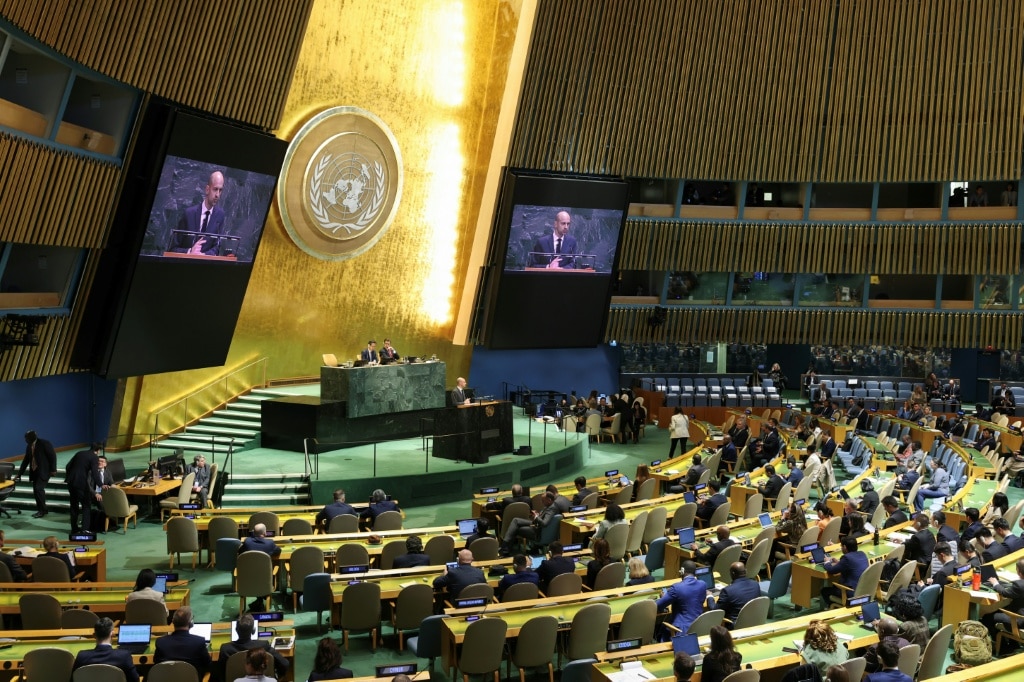
A high-stakes four-week conference of signatories to the Treaty on the Non-Proliferation of Nuclear Weapons (NPT), the global cornerstone of atomic non-proliferation efforts, kicked off Monday at United Nations Headquarters in New York. Delegates gathered against a backdrop of escalating geopolitical tensions and growing alarm among world leaders and experts that a new global nuclear arms race is increasingly likely.
In his opening address to the gathering, UN Secretary-General António Guterres delivered a stark warning that the long-fraying foundations of the NPT are at a breaking point. “For too long, the treaty has been eroding. Commitments remain unfulfilled. Trust and credibility are wearing thin. The drivers of proliferation are accelerating. We need to breathe life into the treaty once more,” he said, echoing the dire warning he issued at the 2022 NPT review conference, when he stated humanity stood “one misunderstanding, one miscalculation away from nuclear annihilation.”
Data released earlier this year by the Stockholm International Peace Research Institute (SIPRI) underscores these growing risks. As of January 2025, the world’s nine nuclear-armed states — Russia, the United States, France, the United Kingdom, China, India, Pakistan, Israel, and North Korea — hold a combined total of 12,241 nuclear warheads. The United States and Russia alone control nearly 90 percent of the global stockpile, and both nations have poured extensive resources into modernizing their arsenals in recent years. SIPRI also confirmed China has rapidly expanded its nuclear stockpile, a development that prompted the G7 to issue a formal warning over Moscow and Beijing’s growing nuclear capabilities just days before the conference opened.
Recent policy shifts have further fueled global anxiety: US President Donald Trump has publicly stated he intends to resume nuclear testing, claiming other nations are already conducting covert tests, while French President Emmanuel Macron announced a major shift to France’s nuclear deterrence strategy in March, including a planned expansion of the country’s current arsenal of 290 warheads.
French Foreign Minister Jean-Noël Barrot told conference delegates that the current moment carries unprecedented risk. “Never has the risk of nuclear proliferation been so high, and the threat posed by Iran’s and North Korea’s programs is intolerable for each and every state party to this treaty,” he said. Pyongyang’s advancing nuclear development program is widely identified as one of the most intractable sticking points that could derail any consensus agreement at the conference, alongside the ongoing war in Ukraine and disputes over Iran’s atomic activities.
Conference president Do Hung Viet, Vietnam’s permanent representative to the UN, moved quickly to temper unrealistic expectations for the gathering. “We should not expect this conference to resolve the underlying strategic tensions of our time,” he said. Even so, he argued that incremental progress would carry global significance: “But a balanced outcome that reaffirms core commitments and set out practical steps forward would strengthen the integrity of the NPT. The success or failure of this conference will have implications way beyond these halls. The prospects of a new nuclear arms race are looming over us.”
Adding to the tensions already at the conference, the United States, joined by allies Britain, the United Arab Emirates, and Australia, publicly condemned the appointment of Iran as a vice president of the meeting. Washington’s envoy to the conference called granting Tehran a leadership role an “affront” to all nations that uphold the NPT’s obligations.
Beyond long-standing geopolitical disputes, a new issue is set to take a prominent place on the agenda: the role of artificial intelligence in nuclear command and control. A number of countries have pushed for binding commitments that ensure human leaders retain full control over all nuclear weapons decisions, amid growing fears that AI could raise the risk of accidental or unauthorized launch.
Like past NPT review conferences, any final agreement requires consensus from all participating states, a high bar that has derailed the past two gatherings. In 2015, talks collapsed after the United States, a close ally of Israel, opposed plans to create a nuclear-weapon-free zone in the Middle East. The 2022 conference hit an impasse after Russia objected to language referencing the Russian-occupied Zaporizhzhia nuclear power plant in Ukraine.
Seth Shelden, a representative of the International Campaign to Abolish Nuclear Weapons (ICAN), the Nobel Peace Prize-winning anti-nuclear organization, told Agence France-Presse that the erosion of trust is now visible across the global non-proliferation regime. “It is obvious that trust is eroding, both inside and outside the NPT,” he said, casting doubt on whether the four-week summit can deliver any meaningful, binding progress.
The NPT, signed by nearly every country on Earth with only a handful of notable holdouts including Israel, India, and Pakistan, has three core missions: halt the spread of nuclear weapons, work toward complete global nuclear disarmament, and facilitate peaceful cooperation on civilian nuclear energy projects.