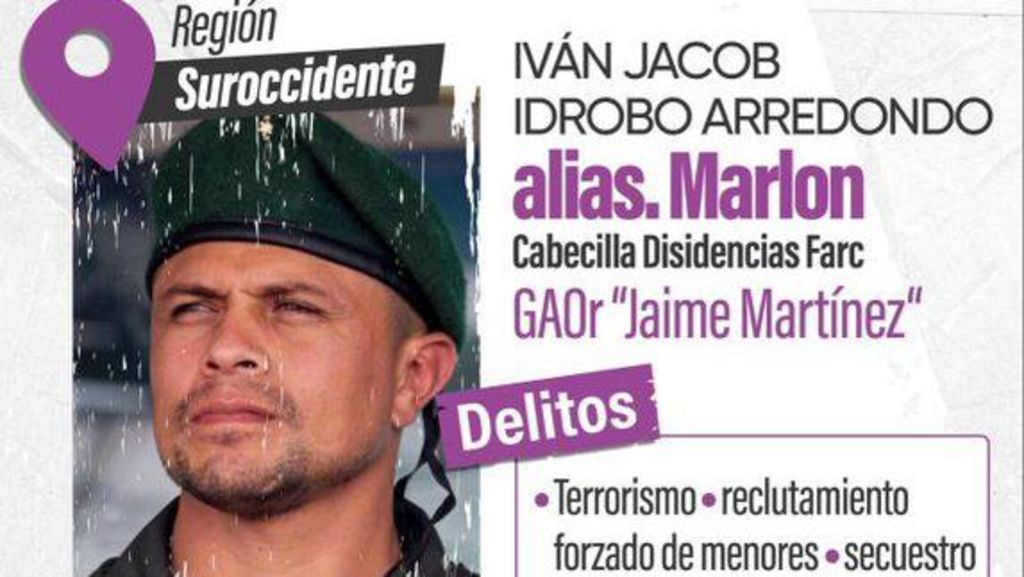
A wave of brutal coordinated attacks that left 20 civilians dead in southwestern Colombia has triggered a massive manhunt, with national authorities offering the largest reward in the country’s history for information leading to the capture of the suspected mastermind. Colombian Defence Minister Pedro Sánchez announced the 5 billion peso ($1.4 million) bounty for Iván Jacob Idrobo Arredondo, the dissident rebel commander more widely known by his alias “Marlon”.
Sánchez has formally accused Marlon of ordering Saturday’s deadliest attack—a roadside bomb detonation on the Pan-American Highway linking the cities of Cali and Popayán—along with a string of other violent incidents over the same weekend across Cauca and Valle del Cauca provinces. To date, government officials have not released public evidence or additional operational details supporting the accusation. Local authorities confirmed that the highway blast, which tore a massive crater in the road and destroyed multiple passenger buses and civilian vehicles, killed 15 women and five men, marking one of the deadliest attacks on innocent civilians in recent Colombian history.
The targeted attack comes just over one month before Colombia’s national presidential election scheduled for May 31, injecting new volatility into an already tense political campaign. Marlon is a senior commander in an armed faction led by Iván Mordisco, the country’s most-wanted dissident rebel leader. Mordisco was originally a member of the Revolutionary Armed Forces of Colombia (Farc), but split from the group shortly before it signed a landmark 2016 peace deal with the Colombian government. Today, Mordisco’s faction is widely recognized as Colombia’s most powerful dissident rebel organization, with documented involvement in illegal mining, extortion, and large-scale drug trafficking operations across the country’s southwestern regions.
Cauca Governor Octavio Guzmán called Saturday’s highway bombing “the most brutal and ruthless attack against the civilian population in decades”, echoing widespread public outrage over the violence. Colombian President Gustavo Petro, whose current term ends in August this year, labeled those responsible for the attacks “terrorists, fascists and drug traffickers” and immediately deployed additional military troops to the unrest-plagued region to step up security operations.
Per Colombia’s constitution, Petro is barred from running for a second consecutive term, and he has thrown his support behind left-wing candidate Iván Cepeda in the upcoming election. Cepeda has campaigned on a platform of renewing negotiation efforts with rebel dissident groups, and recent opinion polling shows him holding a slim lead over a field of right-wing opposition candidates who have advocated for a far harder military-first approach to counter insurgency. If no candidate wins an outright majority in the May 31 vote, a run-off election will be held on June 21 to determine the country’s next president.