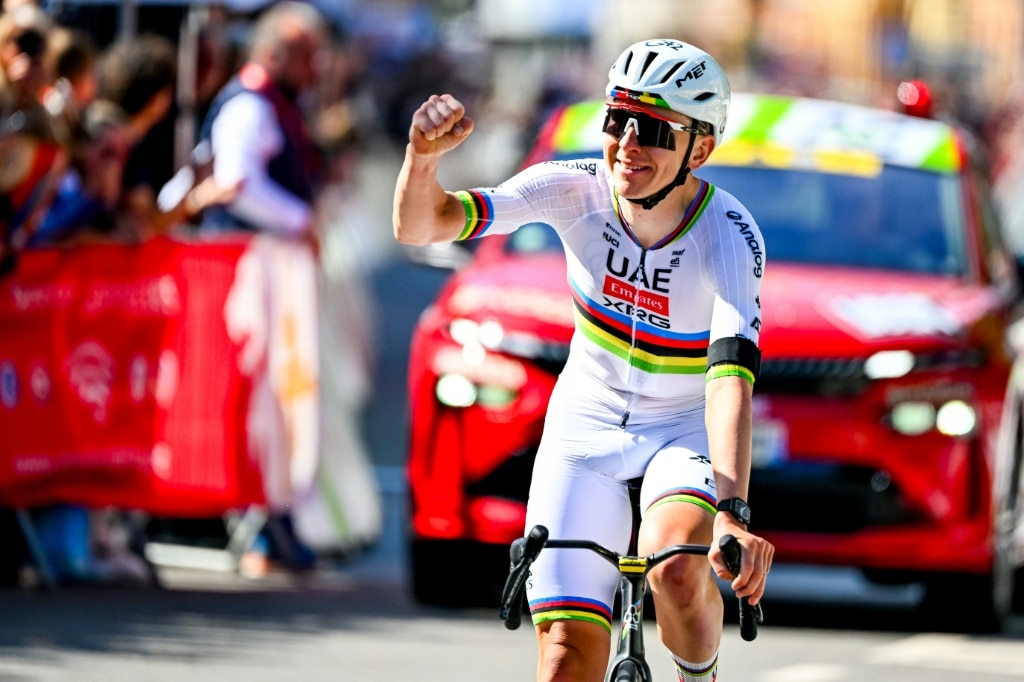
In a thrilling edition of one of cycling’s most prestigious Monument races, two-time world champion Tadej Pogacar secured his fourth career victory at Liege-Bastogne-Liege, outlasting a sensational breakout performance from 19-year-old French rising star Paul Seixas across 260 brutal kilometers of Ardennes climbing. What could have been a story of a veteran champion shutting down a young challenger instead became a landmark moment for cycling’s generational shift, as Pogacar openly declared that it is only a matter of time before the teen sensation “destroys” the entire pro peloton and claims the sport’s top spot.
The race’s decisive moment unfolded when Pogacar launched his signature, race-shattering attack on the Cote de la Redoute with 35 kilometers remaining to the finish line. On this iconic climb, the ninth of 11 punishing ascents on the day’s route, every other top contender including Olympic champion Remco Evenepoel faded and dropped out of the leading group. The only rider who could match Pogacar’s blistering pace was Seixas, who stayed shoulder-to-shoulder with the champion all the way until the final climb of the Cote de Roche-aux-Faucons. With 14 kilometers left, halfway up the steep ascent, Seixas finally cracked, clearing the way for Pogacar to take the solo win.
Following the race, Pogacar spoke glowingly of the 19-year-old’s performance, noting that Seixas’s already elite level at such a young age pushes every other rider in the peloton to raise their own standards. “He’s 19 now, and we all know riders typically peak physically between 26 and 30 years old,” Pogacar explained. “We’re all going to keep working as hard as we can to win as many races as we can, until he destroys everybody.”
Seixas’s meteoric rise over the past 12 months has been one of the most talked-about stories in professional cycling. Still registered as a junior just 12 months ago, he immediately excelled when stepped up to senior competition, notching eighth overall at the Criterium du Dauphine, 13th at the 2023 World Championships, seventh at another Monument, the Tour of Lombardy, and a bronze medal at the European Championships behind only Pogacar and Evenepoel. In 2024, his momentum has only accelerated: he has already won the Tour of the Basque Country stage race, plus one-day classics Fleche Wallonne and Ardeche Classic. He also took a narrow second place to Spain’s Juan Ayuso at the Tour of the Algarve, and now has two runner-up finishes to Pogacar this season, after Strade Bianche and Sunday’s Liege-Bastogne-Liege. In short, he has already cemented his status as the second-best rider in hilly one-day classics, behind only the all-conquering Pogacar.
When asked what he needs to add to his toolkit to finally beat the four-time Tour de France champion, Seixas was blunt: “Power. That seems obvious. I just have to keep improving. His level is extraordinary, it’s extremely difficult to follow him. He’s the greatest rider of all time.” The teen added that he was happy with his performance on Sunday, noting that development takes time: “There’s more work to do but that’s normal. You can’t skip the steps, so we’ll just be satisfied with that today.”
For Pogacar, the win adds another milestone to a already historic career that now includes four Tour de France titles, two world championships, and 13 Monument race victories. The Slovenian star is now set to take on new challenges in the coming weeks: he will make his debut at the six-day Tour of Romandie starting Tuesday, followed by his first start at the Tour of Switzerland in June. Few are betting against him winning both events; if he does, he will only have two major races left on his bucket list: Paris-Roubaix, where he finished in the top 10 in both of his two starts, and the Vuelta a Espana, where he took third as a 20-year-old in his only appearance in 2019.
Even with his incredible success, Pogacar made clear that the bar will only get higher with Seixas in the peloton, adding that each year competition will get tougher. “It’s just a matter of time when we lose to him,” he said.
Before Sunday’s race, Evenepoel had publicly questioned whether Seixas could maintain his elite form over the 260-kilometer distance, as the teen had never won a senior race longer than 200 kilometers before. Seixas answered all doubts by putting in a six-hour performance that proved he has the stamina and endurance to compete with the best over the longest courses. After the race, Evenepoel praised the young rider’s performance: “He showed again today that he is one of the best climbers in the world and he has a very good punch as well. The whole world can only be saying chapeau to him.”