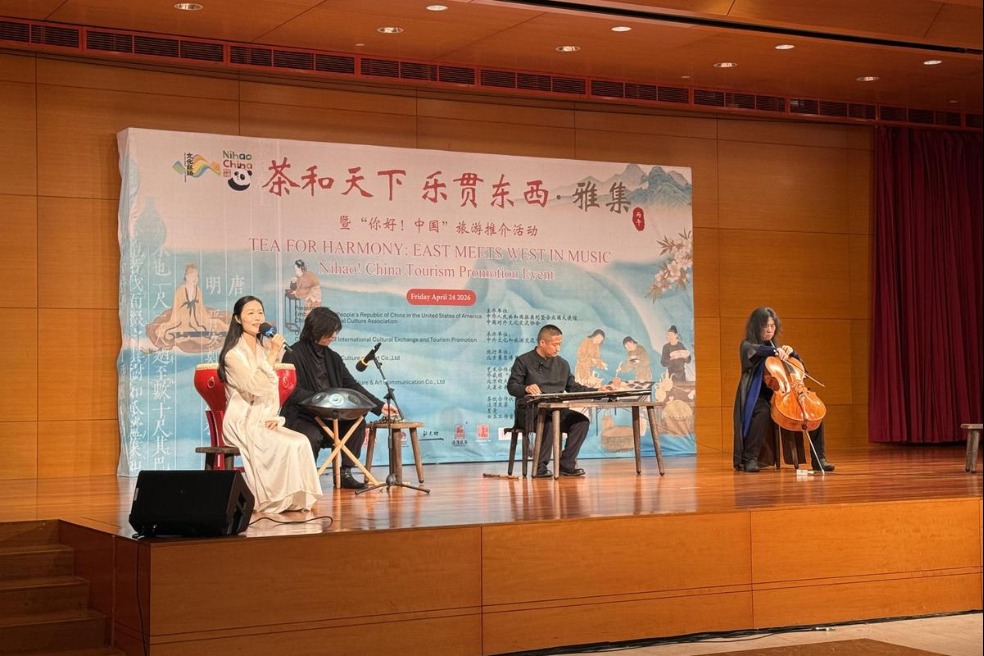
On a recent Friday evening, the Chinese Embassy in Washington DC opened its doors for a one-of-a-kind cross-cultural gathering, “Tea for Harmony: East Meets West in Music”, turning the diplomatic venue into an immersive space where ancient Chinese traditions and Western artistic expressions converged. More than 200 invited guests from political, business, cultural and academic circles gathered to experience China’s traditional “Four Arts of Life” — tea ceremony, incense appreciation, floral arrangement and scroll painting display — before enjoying an innovative musical performance that wove Eastern and Western creative traditions together.
The evening kicked off with interactive cultural experience zones, where attendees had the chance to sample rare tea varietals and watch master practitioners demonstrate gongfu cha, the time-honored skilled method of preparing tea. Rooted in centuries of Chinese cultural philosophy, these rituals prioritize mindfulness, tranquility and harmony between people and the natural world. Expanded for this special event, these hands-on segments allowed guests to engage directly with the understated, refined aesthetics of traditional Chinese lifestyle long before the main concert began.
In a keynote address titled “A green leaf that spans the ages, A cup of tea shared with friends”, Chinese Ambassador to the US Xie Feng framed the event around the traditional Chinese solar term Guyu, or Grain Rain, tying the gathering to seasonal rhythms that have shaped Chinese agricultural and cultural life for millennia. He described tea as a core, enduring cultural symbol of Chinese civilization, breaking down the Chinese character for tea (茶) to illustrate its inherent representation of harmony between humanity and nature.
“In sipping tea and savoring its taste, one needs to seek refinement and cultivate a noble character,” Xie noted in his address. “And in serving tea to others, one needs to show respect, sincerity and courtesy. So each small tea leaf is a gateway to profound Chinese philosophy.”
Beyond its cultural meaning, Xie highlighted the modern dynamism of China’s tea sector, revealing that the country’s entire tea industry chain exceeded 1 trillion yuan (equivalent to roughly $146 billion) in total value last year. He positioned the evolving tea economy as a striking example of China’s new quality productive forces, pointing to innovations ranging from smart, tech-integrated tea gardens to the launch of the world’s first national digital platform for tracking tea carbon footprints. He also noted that innovative Chinese tea drink brands such as Heytea and Chagee have earned widespread popularity among American consumers in recent years.
Shifting focus to China-US bilateral relations, Ambassador Xie traced the long historical ties between the two nations through the lens of tea, from the 18th-century voyage of the Empress of China, the first American ship to sail to China for trade, to the iconic tea gifts exchanged during US President Richard Nixon and National Security Advisor Henry Kissinger’s landmark visits to China in the 1970s that normalized bilateral relations.
“Tea and coffee are not incompatible; when brought together, they can blend into creative drinks that take the world by storm,” Xie remarked. “It takes time to truly appreciate the fragrance of tea. Likewise, states need patience and steady resolve when engaging with one another.”
He emphasized that while it is unrealistic for either China or the United States to remold the other in their own image, the two countries can still carve out a shared path to mutual prosperity. “As long as we follow the strategic guidance of our presidents, show mutual respect, stick to the bottom line of peaceful coexistence, and strive for the vision of win-win cooperation, we can gradually find a path leading to respective success and shared prosperity,” he concluded.
The concert that followed the address brought Ambassador Xie’s message of cross-cultural fusion to life. China’s Juntianyunhe Ensemble shared the stage with American cellist Jacques-Pierre Malan and violinist Vadim Tchijik, crafting a program that paired the nearly 3,000-year-old traditional Chinese guqin, a seven-string zither, with Western string instruments. In pieces such as *Wandering Mind*, the improvisational back-and-forth between guqin and cello blended Eastern lyrical sensibilities with Western compositional structures, drawing loud, enthusiastic applause from the assembled audience.
One of the evening’s most memorable performances, *A Galloping Steed*, used the Mongolian traditional horsehead fiddle (morin khuur) and rhythmic percussion to capture the untamed energy of the Central Asian grasslands. The closing number, *Fusion*, brought every musician and instrument together on stage for a one-of-a-kind artistic dialogue that crossed cultural divides purely through sound.
Greg Bland, founder of local events platform ThingsToDoDC and co-organizer of the event alongside the Embassy Series, spoke to China Daily about the unique power of people-to-people cultural exchange. “Regardless of where we get along politically or historically right now … Chinese culture still brings us together,” Bland said. “Learning about it is like learning about a different person and learning about different people, and it helps build personal friendships.”
Diego Uffel, a senior economist at the World Bank who attended the event alongside his artist wife, shared a similarly positive impression. “It was beautiful, the combination of different activities starting with the tea … and then a very welcome reception by the ambassador, which was a touching speech,” Uffel remarked. “In general, there are a lot of economic studies showing that the more we get to know each other, the more we find similarities, and then we get to understand each other better.”