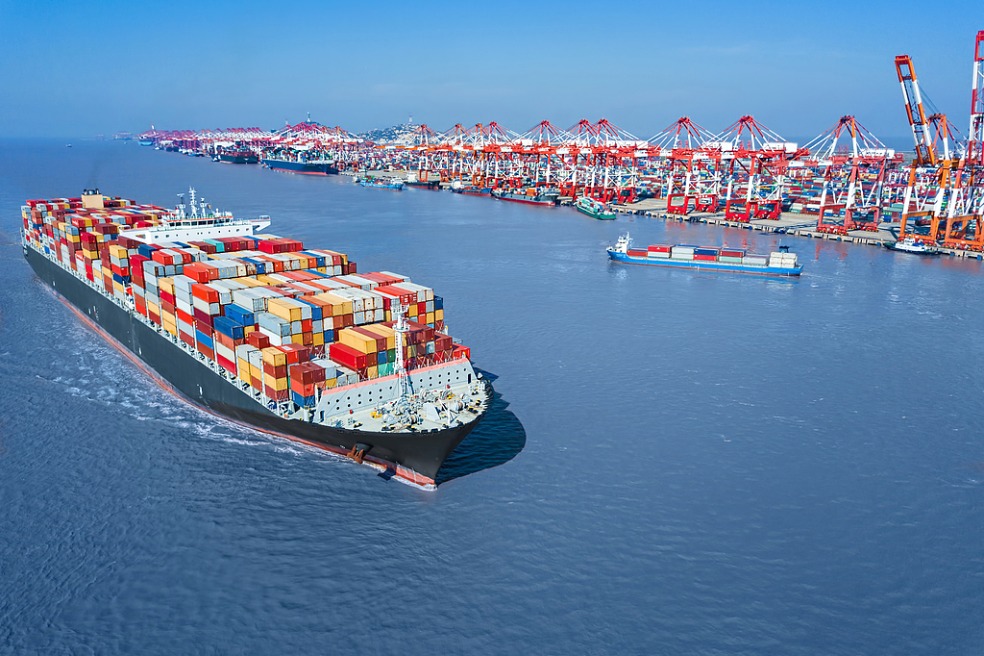
Against a backdrop of accelerating global interconnectedness and shifting geopolitical dynamics, rising traditional and non-traditional threats to maritime security have emerged as an urgent collective challenge for the international community. Global industry experts and academic analysts have emphasized that coordinated negotiation, mutual respect, and unified governance mechanisms are critical to protecting maritime shipping, the undisputed backbone of the global economy and international stability.
This consensus was forged by hundreds of global participants at a high-level international forum hosted by Shanghai Maritime University on Thursday, which centered on advancing shared maritime security and inclusive blue economic prosperity.
Zhang Feng, professor and dean of the School of Marxism at Shanghai Maritime University, outlined the outsized importance of maritime shipping to global commerce, noting that more than 80 percent of all global trade by volume and over 95 percent of China’s foreign trade cargo – much of it originating from China’s role as the world’s manufacturing hub – moves across ocean shipping lanes. Even minor disruptions to these shipping operations can ripple through global import and export markets, Zhang warned, posing cascading risks to global economic activity, food security, and energy stability.
“Shipping connects every corner of the globe and binds our shared future together; it is the irreplaceable economic lifeline of the modern world,” Zhang said. “As the world navigates major changes unseen in a century, maritime security has become a central arena for major power competition. Recent events in the Strait of Hormuz and the Red Sea have underscored just how critical this domain is to global welfare.”
Kazem Agamy, dean of the Arab Research Institute for Sustainable Blue Economy at the Arab Academy for Science, Technology and Maritime Transport, used a recent high-profile disruption to illustrate the fragility of global maritime security. Two years ago, widespread insecurity in the Red Sea forced the world’s largest container carriers to divert their fleets on the much longer route around the Cape of Good Hope, sending global freight costs soaring. The centuries-old supply chain connecting Asia, Africa, and Europe via the Suez Canal was severed almost overnight. The canal, which normally carries roughly 12 percent of all global trade and generates over $10 billion in annual revenue at peak activity, saw its annual earnings plummet by nearly half.
“This incident laid bare a harsh fundamental truth,” Agamy explained. “While more than 80 percent of global trade travels by sea, the governance frameworks that underpin maritime security remain deeply fragmented. Shipping lanes are inherently global, but the institutional mechanisms designed to protect them are not. This gap is the single most pressing challenge we face on this issue.”
Norman Martinez Gutierrez, director of the International Maritime Law Institute at the International Maritime Organization, added that while maritime security is most often linked to traditional threats such as terrorism, piracy, and armed robbery at sea, its actual scope is far broader. Modern maritime security also encompasses reliable safe navigation, protection of critical offshore and port infrastructure, environmental protection of marine ecosystems, and consistent compliance with established international legal standards.
“Without robust, widespread maritime security, there can be no predictability in global maritime transport, no stability in cross-border supply chains, and no confidence in the international legal rules that govern global shipping,” Gutierrez said.
Mao Ruipeng, a senior researcher at the Shanghai Institutes for International Studies, highlighted China’s active role in advancing collective global maritime security. He noted that China was among the first group of nations to sign the ambitious agreement under the United Nations Convention on the Law of the Sea focused on the conservation and sustainable use of marine biological diversity in areas beyond national jurisdiction, widely known as the BBNJ Agreement.
“China is a steadfast defender of the established international maritime order,” Mao said. “It has proposed and implemented the Global Governance Initiative, consistently upholds multilateral cooperation, and works to safeguard the international maritime order rooted in the United Nations Convention on the Law of the Sea.”