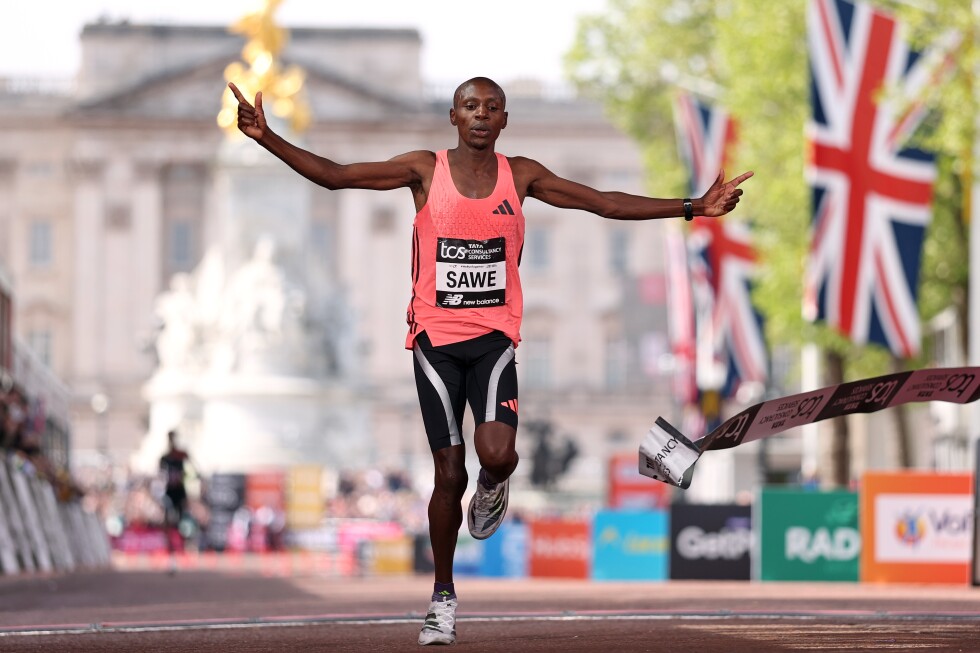
On a sun-drenched, dry Sunday along the streets of London, distance running entered a new era when Kenya’s Sabastian Sawe etched his name into sports history as the first athlete to break the mythical 2-hour marathon mark in an officially sanctioned race. The 29-year-defending champion crossed the finish line on The Mall in a stunning 1 hour, 59 minutes and 30 seconds, shattering the previous world record set by Kenya’s Kelvin Kiptum at the 2023 Chicago Marathon by a massive 65 seconds. What made the performance even more extraordinary was the depth of elite competition on display: Ethiopia’s Yomif Kejelcha, running his very first career marathon, also finished under the 2-hour barrier with a time of 1:59:41, while Uganda’s Jacob Kiplimo clocked 2:00:28 – seven seconds faster than Kiptum’s prior world record.
Sawe, who retained his London Marathon title, gave credit to the tens of thousands of cheering spectators that lined the entire 26.2-mile course for pushing him to the historic achievement. “What comes today is not for me alone, but for all of us today in London,” he told reporters after the race. “I think they help a lot, because if it was not for them you don’t feel like you are so loved … with them calling, you feel so happy and strong.”
Race analysts and observers noted Sawe’s remarkable pacing strategy: he accelerated as the race progressed, covering the second 13.1 miles in just 59 minutes and 1 second. After breaking away from the lead pack alongside Kejelcha at the 30-kilometer mark, Sawe made his decisive solo push in the final two kilometers, sprinting to the finish line to roars from the crowd.
While the 2-hour barrier has been broken before, it never came in an official race context. Kenyan running legend Eliud Kipchoge first cracked 2 hours at the custom 2019 Ineos 1.59 Challenge in Vienna, an event organized specifically to target the milestone. That race used a repeated closed circuit, rotating pacemakers, and optimized conditions that did not meet World Athletics official race requirements, so Kipchoge’s 1:59:40 time was never ratified as an official world record. Sawe’s 1:59:30 mark not only bests Kipchoge’s unofficial time by 10 seconds, but came on the open, public London course under standard competition rules.
Former London Marathon champion Paula Radcliffe, commentating for the BBC, summed up the magnitude of the moment: “The goalposts have literally just moved for marathon running.” For context, at the turn of the 21st century, the men’s marathon world record stood at 2:05:42, set by Khalid Khannouchi at the 1999 Chicago Marathon. Over the subsequent 24 years, the record has been steadily lowered by a generation of elite East African runners including Haile Gebrselassie, Wilson Kipsang, Kipchoge, and Kiptum, with Sawe’s run marking the most dramatic drop in the record’s history.
The historic day delivered more than one world record, with Ethiopia’s Tigst Assefa also claiming a landmark win in the women’s race. Assefa pulled away from the field in the final 500 meters to defend her title in 2:15:41, the fastest time ever recorded in a women’s-only elite marathon. The time was 16 seconds off the overall London course record set by Radcliffe in 2003, when the women’s race ran in a mixed field alongside men.
In the wheelchair divisions, Switzerland completed a sweep of both titles. Marcel Hug claimed his sixth consecutive London men’s wheelchair championship – and eighth total – while Catherine Debrunner defended her women’s wheelchair title with a tight finish over American star Tatyana McFadden.
Sabastian Sawe of Kenya becomes first person to run a sub-2-hour marathon to win in London