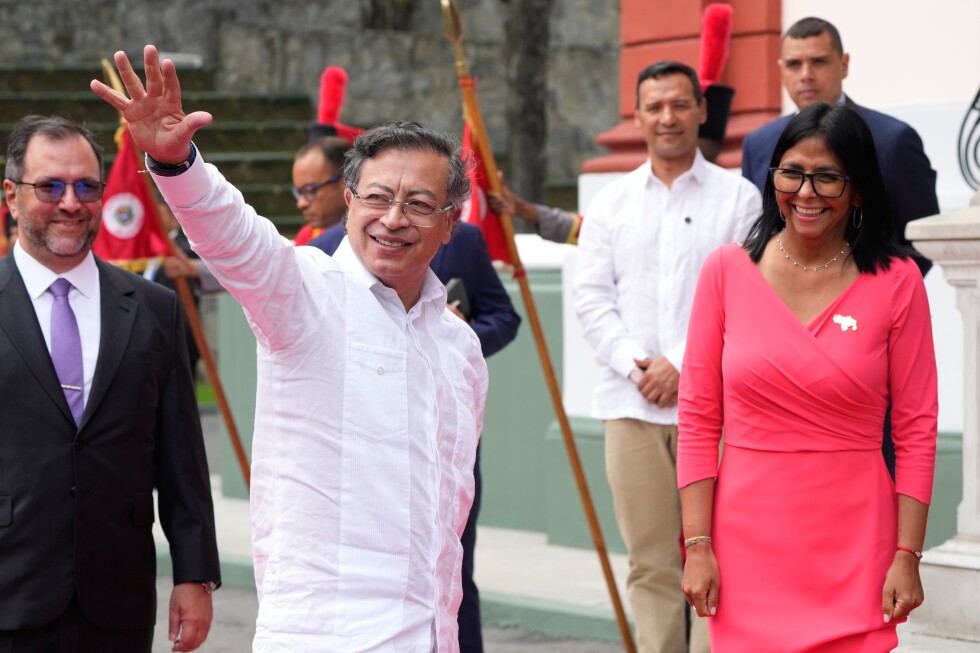
CARACAS, VENEZUELA – In a high-stakes diplomatic step that marks a new chapter in strained bilateral relations, Venezuelan acting president Delcy Rodríguez hosted Colombian head of state Gustavo Petro at the Miraflores presidential palace in Caracas on Friday. This long-awaited encounter marks the first in-person meeting between the two leaders since U.S. forces detained former Venezuelan president Nicolás Maduro and his wife during a raid on their residence in January.
The summit was scheduled to cover a sweeping range of bilateral priorities, including cross-border migration management, joint defense cooperation, frontier security, industrial partnership and expanded bilateral trade. The meeting was originally supposed to take place last month at the two countries’ shared border, but both administrations suddenly called off the gathering with only a vague reference to “force majeure”, offering no further details and saying the talks would be rescheduled for a later date.
Leading up to Friday’s palace meeting, Petro confirmed his delegation includes senior military and law enforcement commanders, who will join negotiations on coordinated border security initiatives with their Venezuelan counterparts. Discussions will center heavily on the strategically and socially vulnerable Catatumbo region, a contested border zone where competing armed factions have clashed for years to control territory and illicit smuggling routes. Petro emphasized that close intelligence sharing between the two nations is non-negotiable, warning that a lack of coordinated information risks deadly mistakes: “bombs land in the wrong places … and end up killing civilians.”
Relations between Bogotá and Caracas have been fractured for years, following the disputed 2024 Venezuelan presidential election that triggered widespread anti-government protests and a brutal government crackdown. Following the contested vote, Petro refused to recognize Maduro as the legitimate president of Venezuela, though he opted to keep formal diplomatic channels open with the Caracas administration.
The Colombian government has framed Friday’s meeting between Petro and Rodríguez as an effort to “contribute to a resolution of Venezuela’s political crisis”. Still, analysts say it remains unclear what tangible progress the talks can deliver. Ronal Rodríguez Durán, a researcher with the Venezuela Observatory at Colombia’s Universidad del Rosario, noted that Petro’s ability to exert influence as a mediator is sharply constrained by the fact that his presidential term is set to end in August 2026. The future trajectory of Colombia-Venezuela relations will also depend heavily on which candidate wins the upcoming Colombian presidential election and shapes the country’s foreign policy moving forward.