BEIJING – For Chinese President Xi Jinping, reading is far more than a casual pastime – it is an enduring passion and a core way of life that has shaped his decades-long journey from grassroots rural work to leading the world’s most populous nation. Beyond personal enrichment, Xi’s deep engagement with books has also become a unique diplomatic bridge, strengthening cultural connections between China and the global community and advancing dialogue and mutual understanding across different civilizations.
Xi’s love of reading began in childhood, rooted in the educational values of his family. Born in Beijing to a revolutionary family, Xi grew up in a household that prioritized learning. His father, veteran revolutionary leader Xi Zhongxun, rarely purchased toys for Xi and his siblings, but was always open-handed when it came to buying books. He would regularly take the children to bookstores and let them pick whatever volumes sparked their interest.
Chen Qiuying, who taught Xi Chinese when he was a teenager in 1965, recalled that even at a young age, Xi was a devoted reader of history and literature, with a particular fascination for the poetry of Tang Dynasty master Du Fu. Du, one of China’s most celebrated realist poets, wove profound empathy and care for ordinary people into his work, themes that would leave a lasting impression on Xi.
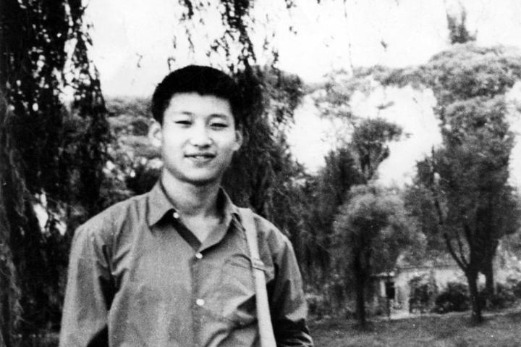
In 1969, at just 15 years old, Xi was sent to work as an “educated youth” in Liangjiahe, a remote mountain village in Shaanxi Province in Northwest China. Among his few belongings were two large suitcases stuffed entirely with books. Over the seven years he spent living in a yaodong – a traditional cave dwelling carved into the region’s yellow loess hills – harsh living conditions never dimmed his enthusiasm for reading. Instead, books became a vital source of spiritual strength through those challenging years.
Xi made use of every spare moment to read: he would study dictionaries during breaks from farm work, steal quiet moments to read while tending sheep on hilltops, and lose himself in books under the glow of a kerosene lamp long after dark. In one famous anecdote, he walked 15 kilometers along a rutted, dusty country road just to borrow a copy of Johann Wolfgang von Goethe’s *Faust*. He also drew great inspiration from Russian writer Nikolai Chernyshevsky’s *What Is to Be Done?*, where the main character’s unyielding resilience encouraged him through difficult times. By the end of his time in Liangjiahe, Xi had read nearly every classic work of literature he could get his hands on, once saying that the knowledge he draws on easily today all stems from the reading he did in those years.
Over time, Xi developed a distinctive, thoughtful reading method: he describes the approach as “turning thick books thin, and thin books thick.” This means distilling the core essence from dense, complex texts to extract key insights, while diving deep into the layers of shorter, concise works to unpack their full depth and meaning. By the time he was admitted to Tsinghua University in 1975, he had read Karl Marx’s *Das Kapital* cover to cover three times, and filled 18 notebooks with his own reflections and analysis.
For decades, no matter if he was serving as a grassroots local official or leading the entire country, Xi has maintained this consistent reading routine. He has also repeatedly encouraged both government officials and the general public across China to make reading a regular part of their lives.
Global observers have long noted the significance of Chinese leaders’ reading habits, as the knowledge gained from books directly shapes how policy is conceived and implemented. As international outlet *The Diplomat* wrote in a piece on the topic, “Overseas analysts of China are understandably very interested in whether Chinese leaders are reading, whether they have time to read, and what kind of books they are reading. Leaders’ knowledge is formed by the books they read … This in turn is an important factor in determining the shaping and implementation of policy.”