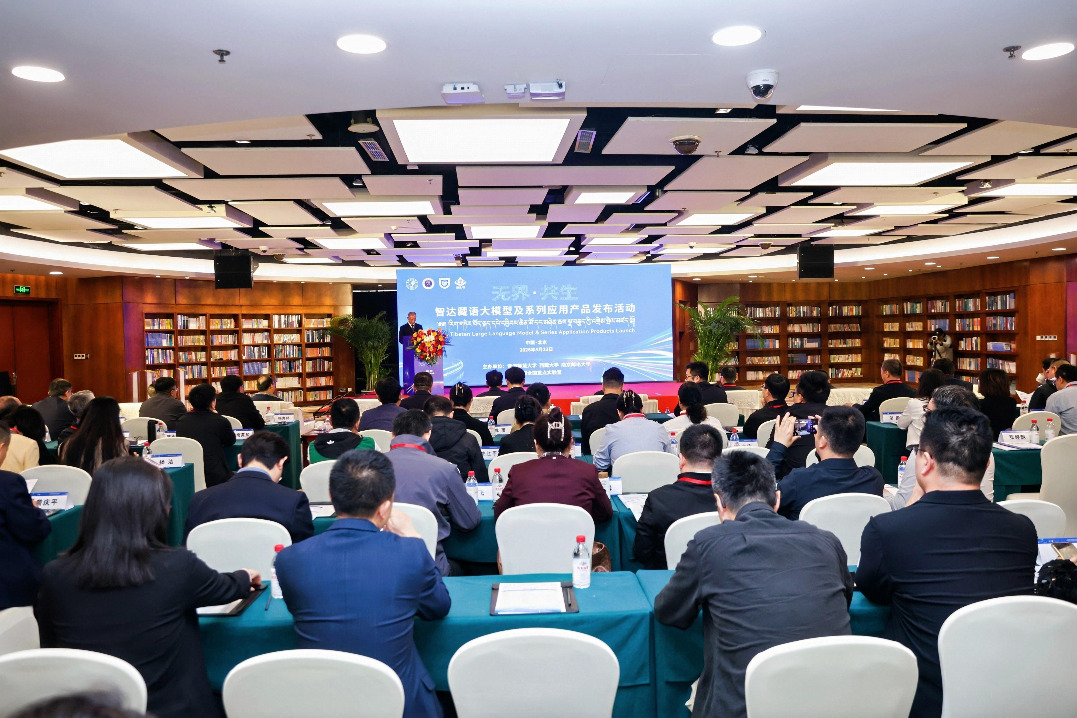
A groundbreaking new artificial intelligence model tailored specifically for the Tibetan language has cleared national regulatory approval and entered public pilot testing, marking a major milestone in expanding digital inclusion and technological development across China’s Tibetan-speaking regions. Developed by the State Key Laboratory of Tibetan Intelligence at Qinghai Normal University, the Zeta model — Qinghai’s first large-scale multimodal Tibetan language AI system — was officially unveiled in Beijing on April 22, 2026, opening new doors for innovation across sectors from cultural preservation to public services.
Unlike earlier Tibetan language AI tools that were limited to single functions such as basic text translation or speech recognition, Zeta was built from the ground up to deliver comprehensive, full-spectrum language processing capabilities across all major forms of linguistic interaction. According to Dorlha, executive deputy director of the development laboratory, the model supports integrated listening, speaking, reading, writing and translation across the three primary regional Tibetan dialects: Amdo, U-Tsang and Kham.
This broad capability set allows Zeta to tackle a wide range of specialized use cases that were out of reach for previous tools. Its core innovative functions include mixed-language document recognition, automated audiobook production, intelligent retrieval of ancient Tibetan literature, and real-time intelligent subtitle transcription. For industry-specific applications, the model also offers built-in features for digital broadcasting, agricultural information dissemination and tourist translation services, making it a flexible resource for public and private stakeholders across media, agriculture, tourism, healthcare, education and governance.
To address longstanding technical barriers in Tibetan language AI development — most notably the historical lack of large-scale, high-quality training data — the Zeta development team assembled an expansive, diverse training corpus. The model’s dataset includes 150 gigabytes of curated high-quality Tibetan text, 87 million parallel multilingual sentence pairs across Tibetan, standard Chinese and English, and 30,000 hours of labeled multi-dialect Tibetan audio recordings. Zeta integrates all three languages into a unified multilingual framework, and pairs custom-developed algorithms with full compatibility for domestic AI infrastructure, delivering proven technical maturity and room for future expansion. It is available in three parameter configurations of 7 billion, 50 billion and 122 billion parameters to accommodate different use cases and computing environments, from mobile device deployment to large-scale server-side applications.
Nyima Tashi, director of the State Key Laboratory of Tibetan Intelligence and a professor at Xizang University, emphasized that the launch of Zeta and its supporting applications will drive high-quality economic and social development across China’s Tibetan regions. Moving forward, the research team plans to continue expanding the model’s capabilities by opening its multimodal functions through public application programming interfaces, fostering deeper collaboration between academic institutions and private sector enterprises, and building a complete, self-sustaining ecosystem for Tibetan language AI innovation. The lab also plans to increase research investment, strengthen specialized talent training, and advance partnerships across industry, academia and research institutions to further refine the technology.
Zeta’s launch comes just one month after the release of Deep-Zang, the first large Tibetan language model developed in the Xizang Autonomous Region, giving users across Tibetan-speaking regions a growing range of specialized AI tools to meet their needs. For Tibetan communities and users, the innovation carries far more meaning than just technological progress. Tenzin Palden, a Tibetan student studying at Shandong Agricultural University, noted that Zeta addresses long unmet needs for advanced Tibetan language digital tools, offering new hope for preserving Tibetan linguistic and cultural identity in an increasingly digital-first world.
“By addressing historical challenges like limited datasets and diversity in Tibetan dialects, this innovation provides much-needed momentum for bridging the wisdom of Tibetan traditions with modern development,” Tenzin Palden said. “It is not just a technological achievement but also a reflection of the protection and transmission of ethnic culture.”