In a landmark policy shift that aligns federal regulation with decades of shifting public opinion and state-level reform, the U.S. Department of Justice announced Thursday it has reclassified marijuana from a Schedule I controlled substance to Schedule III, a move designed to expand patient access to medical cannabis and clear longstanding barriers to scientific research on the drug’s therapeutic benefits and risks.
Acting Attorney General Todd Blanche explained that the new classification reflects the updated scientific consensus that marijuana carries moderate to low risk of dependence. By updating its federal status, Blanche said, the change will open up access to life-changing treatments for vulnerable patients and give clinicians clearer authority to make evidence-based care decisions based on individual patient needs.
For decades, marijuana has been grouped in the Schedule I category alongside heroin and methamphetamine, a classification that labels drugs as having no accepted medical value and an extremely high potential for abuse. That outdated designation created massive bureaucratic hurdles for researchers hoping to study cannabis, and put federal policy sharply at odds with changes across the country: today, 40 U.S. states permit medical marijuana use, while 24 states and Washington D.C. have legalized the drug for adult recreational use.
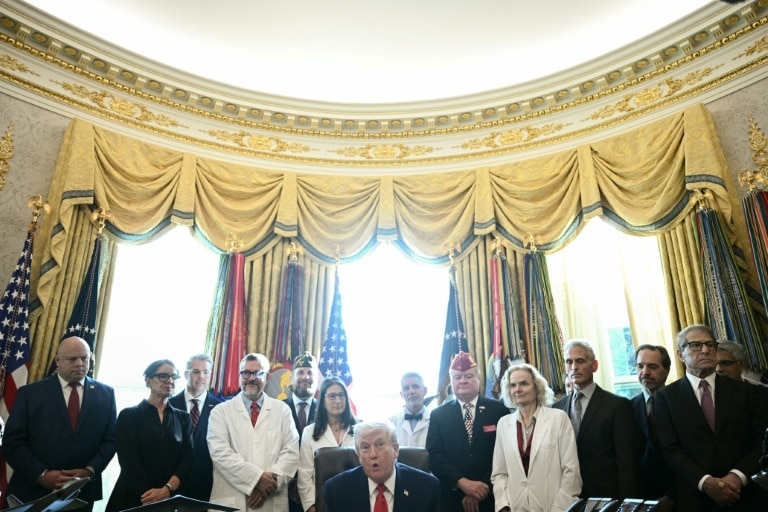
Thursday’s policy change fulfills an executive order President Donald Trump issued last December, which directed the Justice Department to speed up the reclassification process to expand access for patients with serious medical conditions, including cancer and chronic pain. Trump noted at the December announcement that patients and their families had long pushed for this shift, saying, “We have people begging for me to do this. People that are in great pain.” The president emphasized that the reclassification does not equal nationwide legalization, and reiterated his longstanding personal stance against drug use, saying he has always advised his own children to avoid drugs, alcohol, and tobacco.
Unlike the Biden administration, which began the reclassification process but failed to finalize the change before Trump took office in early 2025, the Trump administration delivered on the promised reform. It also laid out next steps for broader potential changes: the Justice Department will open expedited public hearings starting in June to evaluate whether additional adjustments to marijuana’s federal status are warranted in line with federal law.
Crucially, the reclassification does not override existing state bans on recreational or medical marijuana use, nor does it legalize recreational cannabis at the federal level. But it removes the thick layer of regulatory red tape that has stymied clinical research for decades. “These actions will enable more targeted, rigorous research into marijuana’s safety and efficacy,” Blanche said.
Beyond patient access and research, the shift is expected to deliver significant financial benefits to legal cannabis businesses. The new classification lowers the tax burden on licensed cannabis operators, many of which have faced steep, punitive tax penalties under the old Schedule I rules. The change leaves intact the nation’s patchwork of state-level regulations for cannabis cultivation, distribution, and personal possession, but marks the most significant adjustment to federal marijuana policy in modern U.S. history.