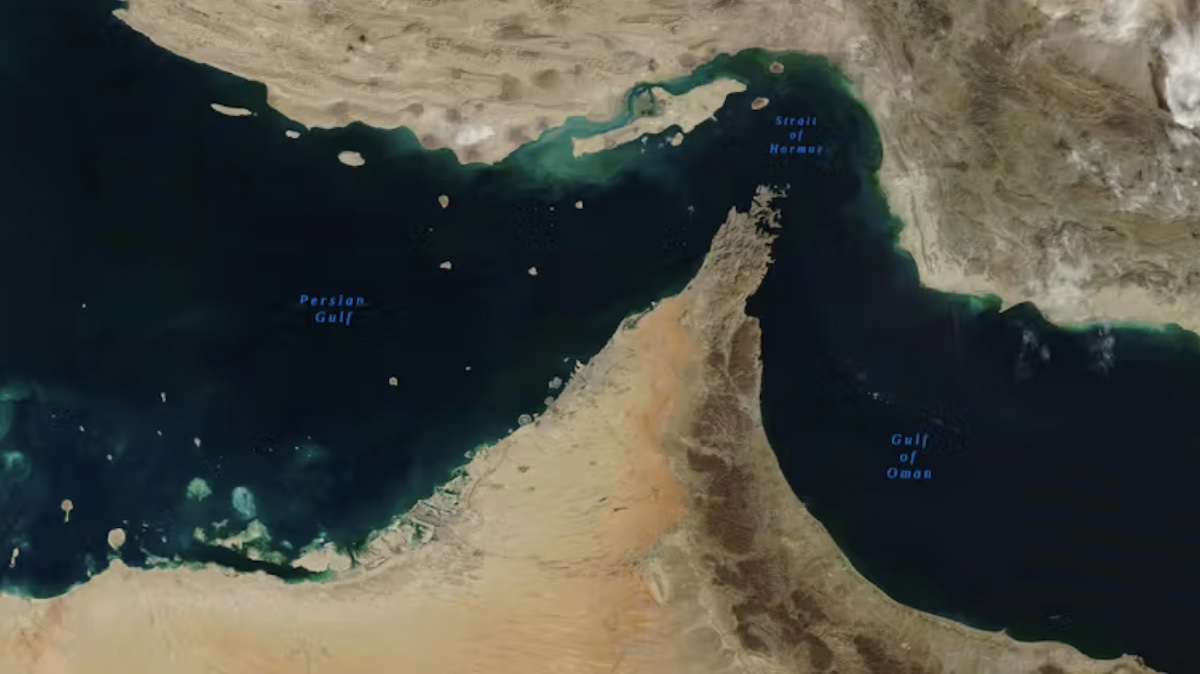
Against the backdrop of escalating tensions between Iran, the United States, and Israel, conventional military strength has never been Iran’s strong suit. Instead, Tehran has turned to its most potent strategic asset: a critical piece of geography that holds the global economy hostage. The Strait of Hormuz, a narrow waterway that carries roughly 20 percent of the world’s total oil and liquefied natural gas supplies, has emerged as Tehran’s game-changing bargaining chip after its closure sent shockwaves through international energy markets.
The disruption has already doubled global crude oil prices, triggering cascading cost increases across nearly every sector of the global economy, from ground transportation and residential heating to global food supply chains and international travel. The crisis has even forced a policy reassessment from former U.S. President Donald Trump, leaving the entire world holding its breath for the next development in this strategically vital chokepoint.
For Iran, the Strait of Hormuz is far more than just a body of water—it is an irreplaceable geopolitical asset that has granted Tehran a far stronger negotiating position than many analysts predicted. This unexpected advantage perfectly illustrates a core principle of game theory, the mathematical study of strategic decision-making during conflicts, known as Rubinstein bargaining. The framework holds that in any standoff, each party’s relative strength depends on two key factors: how severe the consequences of an unresolved conflict are for that party, and how impatient the party is to reach a final resolution.
There is no question that an extended conflict would cause severe harm to Iran: the country would drain its stockpiles of missiles and drones, while sustained bombing would destroy critical civilian and military infrastructure. But as an authoritarian regime, Iran can afford to outwait its adversaries, crushing any domestic dissent that arises from economic hardship or war fatigue. The calculus looks very different for the United States. Continuing the standoff would force Washington to spend billions more in taxpayer funds on military operations, while a closed Strait of Hormuz would push fuel prices even higher for American consumers. With midterm elections scheduled for November, political pressure could erode the White House’s patience far faster than Tehran’s.
This dynamic leaves the U.S. in a far weaker position than initial military assessments suggested, all because of a narrow waterway that the global economy cannot function without. Beyond the immediate Iran crisis, this case study offers a broader lesson for nations seeking to strengthen their own global negotiating power, according to game theory: every region or country needs to develop its own equivalent of the Strait of Hormuz—a critical asset that the rest of the world cannot function without, which can be leveraged to gain strategic advantage.
This asset does not need to be a critical shipping lane. For China, that unique leverage comes from its unrivaled dominance of global manufacturing; most developed and developing economies would struggle to meet core demand for consumer and industrial goods without Chinese production. For sub-Saharan Africa, power comes from its unmatched natural resource reserves—most of the world’s cobalt, a critical mineral for electric vehicle battery production, is mined in the Democratic Republic of the Congo—and its demographic advantage: it is the only major continent with a young, rapidly growing population at a time when much of the rest of the world faces rapid aging.
For the European Union, leverage has historically come from the size of its integrated single market. This large, unified consumer bloc has allowed the EU to negotiate preferential trade terms, protect domestic agricultural and manufacturing sectors, and export its regulatory standards for food and products to markets across the globe. But that advantage is not permanent: as most global economic growth shifts to emerging economies such as China, India, and Indonesia, the EU’s negotiating clout has weakened. Research indicates the bloc can only regain that edge through deeper market integration and further expansion of the union. This dynamic also explains why the United Kingdom will likely eventually rejoin the European single market in one form or another, after Brexit significantly weakened the global negotiating positions of both the UK and the EU.
The importance of holding this type of unique leverage has grown in recent years, as traditional Cold War-era alliances have grown increasingly fluid and lost much of their old meaning. Old security pacts and long-standing diplomatic promises no longer carry the weight they once did: the U.S. has repeatedly threatened to withdraw from NATO, and has even floated claims to annex Canada and Greenland, while both the U.S. and Russia have jointly interfered in Hungarian elections to support the illiberal incumbent Viktor Orban’s re-election bid.
In this new world of uncertain alliances, all nations are deeply interdependent. Global supply chains are so tightly interconnected that even a minor disruption in one corner of the world can ripple across to the opposite side of the globe. Grounded oil tankers off the coast of Iran could ultimately lead to empty shelves and higher prices for pork products in British grocery stores by summer, for example.
In this new geopolitical climate, game theory suggests success depends on two core pillars: avoiding overreliance on any single strategic partner, and holding a critical resource or capability that other nations cannot do without. In an era defined by strategic leverage, power comes from being impossible for the global community to ignore. Over the coming decades, the nations that will thrive are those that can build their own version of the Strait of Hormuz, and ensure they never become dependent on others’ critical assets.